


















Lesson 45 of 46 · Projects and Practice
Cheat sheet: key formulas and constants
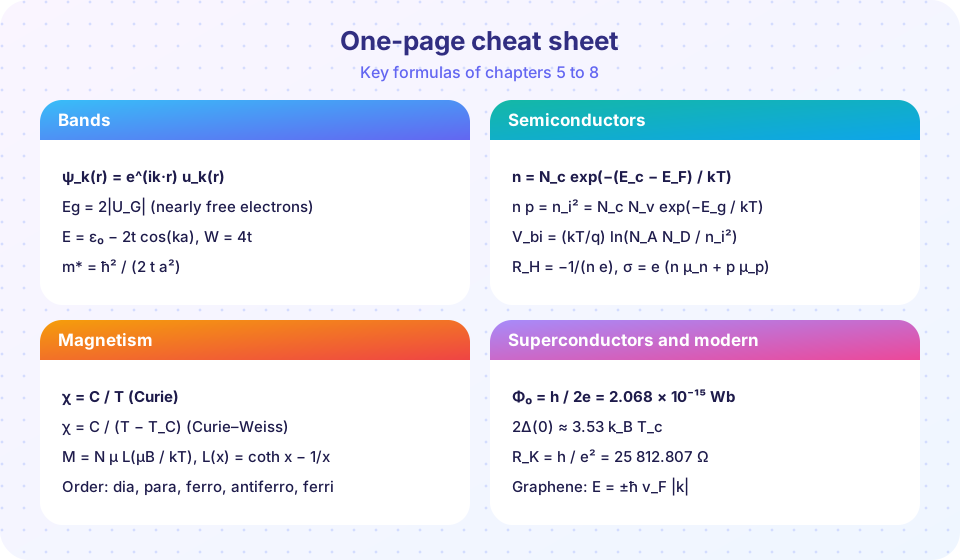
A one-page recap of the main formulas of bands, semiconductors, magnetism, superconductors and topological matter, with constants and an energy unit converter.
This page is a one-page summary of the formulas and constants from chapters 5 to 8. Print it, keep it next to your problem sets, and use the converter below to jump between electronvolts, kelvin, wavelength and frequency.
What you will learn
- Which formula answers which kind of question.
- The numerical values of the constants you need most.
- How to convert quickly between energy, temperature, wavelength and frequency.
Formulas by topic
| Topic | Formula | Notes |
|---|---|---|
| Bloch's theorem | ψ_k = e^(ik·r) u_k(r) | k in the first Brillouin zone |
| Free-electron gap | Eg = 2|U_G| | at k = nπ/a |
| Tight-binding chain | E = ε₀ − 2t cos(ka), W = 4t | m* = ħ²/(2ta²) |
| Intrinsic carriers | n_i = sqrt(N_c N_v) exp(−Eg/2kT) | n p = n_i² |
| Effective DOS | N_c = 2(2π m* kT/h²)^(3/2) | 2.51 × 10¹⁹ cm⁻³ for m* = m₀ at 300 K |
| Doped carriers | n ≈ N_D − N_A, p = n_i²/n | E_F − E_i = kT ln(n/n_i) |
| Junction | V_bi = (kT/q) ln(N_A N_D/n_i²) | W = sqrt(2ε(V_bi − V)(1/N_A + 1/N_D)/q) |
| Diode | I = I_s[exp(qV/kT) − 1] | 60 mV per decade |
| Hall effect | R_H = 1/(nq) = V_H t/(IB) | σ = e(nμ_n + pμ_p) |
| Curie law | χ = C/T, C = μ₀Nμ²/(3k) | Langevin L(x) = coth x − 1/x |
| Curie-Weiss | χ = C/(T − T_C) | m = tanh(m T_C/T) |
| London depth | λ_L = sqrt(m/(μ₀ n_s e²)) | field ∝ exp(−x/λ_L) |
| BCS gap | 2Δ(0) = 3.53 k_B T_c | Δ ∝ sqrt(1 − T/T_c) near T_c |
| Flux quantum | Φ₀ = h/2e | 2.068 × 10⁻¹⁵ Wb |
| Josephson | I = I_c sin φ, f = 2eV/h | 483.6 MHz per µV |
| Quantum Hall | ρ_xy = h/(νe²), ν = nh/(eB) | R_K = 25 812.807 Ω |
| Graphene | E = ±ħ v_F |q|, v_F = 3ta_cc/2ħ | E_n = v_F sqrt(2eħBn) |
Handy numbers
- kT = 25.85 meV at 300 K; 1 eV corresponds to 11 604.5 K.
- ħ²/2m₀ = 3.810 eV·Å²; Bohr magneton μ_B = 9.274 × 10⁻²⁴ J/T = 0.05788 meV/T.
- Silicon: Eg = 1.12 eV, n_i ≈ 10¹⁰ cm⁻³, ε_r = 11.7, μ_n ≈ 1350 and μ_p ≈ 450 cm²/(V·s).
- Curie temperatures: Fe 1043 K, Co 1388 K, Ni 627 K, Gd about 293 K.
- Critical temperatures: Al 1.18 K, Sn 3.72 K, Hg 4.15 K, Pb 7.20 K, Nb 9.25 K, MgB₂ 39 K, YBCO about 92 K.
Try it
Press Run (or Ctrl + Enter) to see the result here.
Program input · what you'd type while the program runs
Type the answers before you press Run, one per line. Each time the program reads a line (with input()), it gets the next line from this box.
Press Run (or Ctrl + Enter) to see the result here.
Program input · what you'd type while the program runs
Type the answers before you press Run, one per line. Each time the program reads a line (with input()), it gets the next line from this box.
Check your understanding
Quick check · 4 questions
of 4 answered You scored / 4 · perfect!
-
1. Which formula gives the gap in the nearly free electron model?
The gap is twice the Fourier component of the potential at the Bragg vector. -
2. Which constant combination is the flux quantum?
Φ₀ = h/2e = 2.068 × 10⁻¹⁵ Wb; h/e² is the von Klitzing constant. -
3. A photon of energy 1.12 eV has a wavelength of about
λ = 1239.84 nm·eV / 1.12 eV ≈ 1107 nm. -
4. At 300 K, kT equals about
k = 8.617 × 10⁻⁵ eV/K times 300 K.
Summary
- The formulas of chapters 5 to 8 fit on one page; the table above groups them by topic.
- The constants to memorize: kT = 25.85 meV, Φ₀ = 2.068 × 10⁻¹⁵ Wb, R_K = 25 813 Ω, μ_B = 9.274 × 10⁻²⁴ J/T.
- Energy conversions (eV, K, nm, THz) help you compare scales across experiments.
Next: Where to go next
Track your progress
Create a free account to tick off lessons and pick up where you left off on any device.
of Condensed Matter Physics lessons completed