


















Lesson 4 of 46 · Getting Started
Chapter 1 review: Getting started
Review what condensed matter physics studies, the five bond types, the Lennard-Jones and Madelung models, and the energy scales of solids, then test yourself with ten questions.
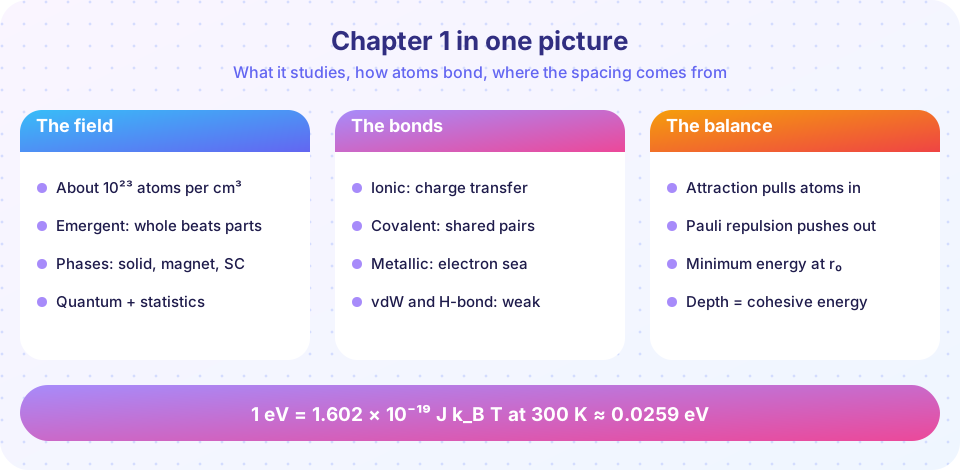
You now have the foundations: what condensed matter physics is, why collective behavior is more than the sum of its parts, and how atoms bind into solids. This review collects the key ideas on one page, gives you a converter for the energy units you will meet all course long, and ends with a ten-question quiz that mixes all three lessons.
What you will learn
- A compact recap of Chapter 1 you can return to.
- How to convert quickly between eV, joules, kelvin and wavelength.
- Where your understanding is solid and where to revisit a lesson.
The chapter in a table
| Idea | Key facts | Lesson |
|---|---|---|
| Condensed matter | About 10²⁸ to 10²⁹ m⁻³ particles; interactions dominate; "more is different" | What is it? |
| Phases | Classified by order parameter and broken symmetry; topological order is the exception | What is it? |
| Bond types | Ionic, covalent, metallic, hydrogen, van der Waals | Bonding |
| Binding curve | Attraction plus Pauli repulsion; minimum at r₀ | Bonding |
| Lennard-Jones | V = 4ε[(σ/r)¹² − (σ/r)⁶]; r₀ = 2^(1/6)σ; V(r₀) = −ε | Bonding |
| Ionic energy | U = −α e²/(4πε₀r₀)(1 − 1/n), α(NaCl) = 1.7476 | Bonding |
| Scales | 0.3 nm spacing; 1 eV bonds; k_BT = 0.0259 eV at 300 K | Course map |
Key terms
Emergence: properties of the whole that the parts lack.
Order parameter: zero in the disordered phase, nonzero in the ordered one.
Cohesive energy: energy to pull a solid into isolated atoms.
Madelung constant: the geometric factor in the Coulomb energy of an ionic crystal.
Energy units
Condensed matter physics mixes energy units freely, so fluency pays. The most useful identities:
- 1 eV = 1.602 × 10⁻¹⁹ J
- 1 eV corresponds to a temperature of 11,604.5 K (E = k_B T)
- 1 eV per particle = 96.485 kJ/mol
- A photon of energy E in eV has wavelength λ = 1239.84 / E nm
So visible light (500 nm) has a photon energy near 2.5 eV, comparable to a bond energy, while room temperature (0.0259 eV) is only a hundredth of that.
Common misconceptions
"Cohesive energy equals bond energy." For a solid with many neighbors the cohesive energy is the sum of half the bond energies over all neighbors of an atom (each bond counted once for two atoms), so it is not equal to a single bond.
"Lennard-Jones works for any solid." It is a model for closed-shell atoms (noble gases). Metals and covalent solids need other descriptions.
Try it
Press Run (or Ctrl + Enter) to see the result here.
Program input · what you'd type while the program runs
Type the answers before you press Run, one per line. Each time the program reads a line (with input()), it gets the next line from this box.
Check your understanding
Quick check · 10 questions
of 10 answered You scored / 10 · perfect!
-
1. Roughly how far apart are atoms in a typical solid?
Interatomic spacings in solids are 0.2 to 0.5 nm, a few ångströms. -
2. A ferromagnet becomes disordered above its Curie temperature. The order parameter is then
Magnetization vanishes above T_C because spins point randomly. -
3. Which statement about 'emergence' is correct?
The laws are unchanged. The collective behavior simply is not a property of any single particle. -
4. What is the cohesive energy of a solid?
It measures the overall binding of the crystal relative to free atoms. -
5. Which bond is strongly directional?
Covalent bonds are shared pairs located between specific atoms. -
6. For Lennard-Jones, if σ = 0.34 nm, the minimum is at about
r₀ = 2^(1/6)σ = 1.122 × 0.34 ≈ 0.38 nm. -
7. The Madelung energy of NaCl is mostly
The ionic bond is electrostatic; the repulsive term is a small correction (the 1 − 1/n factor). -
8. A 500 nm photon has an energy near
E = 1239.84 eV·nm / 500 nm = 2.48 eV. -
9. Why are noble-gas solids so soft and low-melting?
Closed-shell atoms bind only through fluctuating dipoles, about 0.01 to 0.1 eV per atom. -
10. Which describes the potential energy near r₀?
Any smooth minimum is quadratic to first order, so small vibrations are harmonic.
Summary
- Condensed matter physics is the physics of strongly interacting many-particle systems, organized by order and symmetry.
- Atoms bind through ionic, covalent, metallic, hydrogen and van der Waals interactions; every bond has an attractive tail and a repulsive core.
- Simple models (Lennard-Jones, Madelung) predict spacings and energies within tens of percent.
- Keep a handy set of unit conversions: 1 eV ↔ 11,605 K ↔ 96.5 kJ/mol ↔ 1240 nm.
Track your progress
Create a free account to tick off lessons and pick up where you left off on any device.
of Condensed Matter Physics lessons completed