


















Lesson 48 of 48 · Projects and Practice
Further Study: Where to Go After Astrophysics and Cosmology
Plan your next steps after this course: general relativity, quantum and particle physics, statistical mechanics, computing and observing, with a toy galaxy-collision simulation to try.
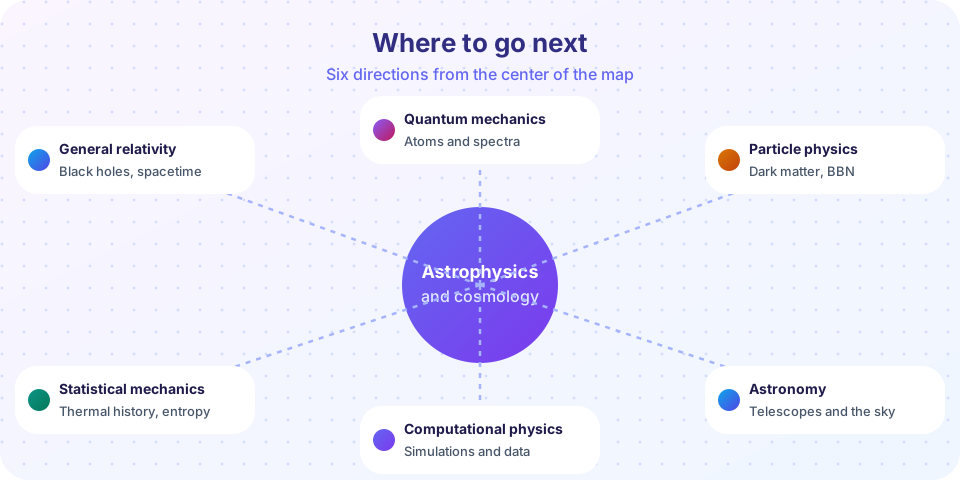
You have now followed the story from galaxies to the cosmic microwave background and the dark universe. The aim of this course was to give you a working picture: real equations you can compute with, and a feel for which parts of the picture are solid and which are still open. This last lesson shows how to keep going, which subjects will deepen each part of what you learned, and a small simulation to show what computational astrophysics feels like.
What you will learn
- Which subjects underlie each part of cosmology.
- How to choose a next step depending on your interest.
- What a first computational project looks like.
Key terms
Tensor: a mathematical object that generalizes vectors; general relativity is written with tensors.
Quantum field theory: the framework combining quantum mechanics and special relativity; the basis of particle physics.
N-body simulation: a computer model that follows many particles under gravity.
Statistical mechanics: the physics of many-particle systems and their temperature.
Observing proposal: a written plan that asks for telescope time.
Choosing a direction
| If you want to understand... | Study | Why it helps |
|---|---|---|
| Where the Friedmann equations come from; black holes; gravitational waves | Relativity and differential geometry | Cosmology is general relativity applied to the whole universe |
| Atoms, spectra, the physics of stars and the vacuum | Quantum mechanics | Spectral lines, nuclear fusion and quantum fluctuations in inflation |
| Dark matter candidates, nucleosynthesis, the early particle soup | Nuclear and particle physics | The early universe is a particle physics laboratory |
| Thermal history, blackbody radiation, freeze-out | Statistical mechanics | The CMB and relic abundances follow from statistical physics |
| Simulations and analysis of survey data | Computational physics | Numerical methods for N-body, fitting and error analysis |
| How observations are made; the night sky | Astronomy | Telescopes, coordinates, magnitudes and the observing practice |
| The electromagnetic side of light and radiation | Electrodynamics | Radiation, synchrotron emission from jets, polarization of the CMB |
| Orbits and the Lagrangian formulation | Lagrangian mechanics | The mathematical language for galaxy dynamics |
Habits of a working astrophysicist
- Order-of-magnitude first. Estimate the answer to within a factor of 10 before computing it.
- Know the error bars. A measurement without an uncertainty is not a measurement.
- Check the assumptions. Each formula holds in a regime;
v = H₀ dis only for smallz. - Simulate to understand. Simulated data with a known truth show whether a method works.
- Read the original papers. Landmark papers such as Rubin and Ford on rotation curves, Penzias and Wilson on the CMB, and the 1998 supernova papers are short and readable.
For textbooks at university level, look for standard titles such as An Introduction to Modern Astrophysics (Carroll and Ostlie), Cosmology (Weinberg), Modern Cosmology (Dodelson and Schmidt) and Galactic Dynamics (Binney and Tremaine). They assume calculus, linear algebra and some physics.
A first computational project
Galaxies collide. In 1972 Alar and Juri Toomre showed with a simple computer model that a close pass between two disk galaxies can pull out long tidal tails and bridges, like those seen in real interacting galaxies. Their model used only test particles in the field of two point masses, which is what the code below does. It is a toy: no gas, no stars with mass, no dark matter halo, no dynamical friction. Try changing the encounter distance and see how the tails change.
Press Run (or Ctrl + Enter) to see the result here.
Program input · what you'd type while the program runs
Type the answers before you press Run, one per line. Each time the program reads a line (with input()), it gets the next line from this box.
Press Run (or Ctrl + Enter) to see the console output here.
No output.
Common misconceptions
"Cosmology is settled." The standard model fits the data well, but dark matter, dark energy and inflation lack a known physical explanation, and tensions are unresolved.
"You need to master everything first." Pick one direction and learn it by doing problems; the subjects reinforce each other.
"A toy simulation proves how real galaxies behave." A toy shows a mechanism (here, tidal tails from a close pass). Real galaxies need gas, stars, dark matter and far more particles.
Check your understanding
Quick check · 4 questions
of 4 answered You scored / 4 · perfect!
-
1. Which subject provides the foundation for the Friedmann equations?
The Friedmann equations are solutions of Einstein's field equations for a homogeneous, isotropic universe. -
2. What did the Toomre model show?
Their 1972 simulation produced bridges and tails like those in interacting galaxies. -
3. Why is simulated data with a known truth useful?
The known truth is the benchmark for the method. -
4. Which habit is recommended before calculating?
An estimate catches mistakes early.
Summary
- Cosmology rests on general relativity, quantum and particle physics, statistical mechanics, computing and observation; each has a track on this site.
- Good habits: estimate first, know the uncertainties, check assumptions, simulate, read original papers.
- Toy simulations, such as a Toomre-style encounter, are a great way to start in computational astrophysics.
- Many big questions remain open: what dark matter and dark energy are, and whether inflation happened.
Back to the course overview: Astrophysics and Cosmology
Track your progress
Create a free account to tick off lessons and pick up where you left off on any device.
of Astrophysics and Cosmology lessons completed