


















Lesson 40 of 48 · Dark Matter, Dark Energy and Frontiers
Evidence for Dark Matter
Review the five independent lines of evidence for dark matter, work through a cluster mass estimate and a lensing calculation in Python, and meet the leading particle candidates and searches.
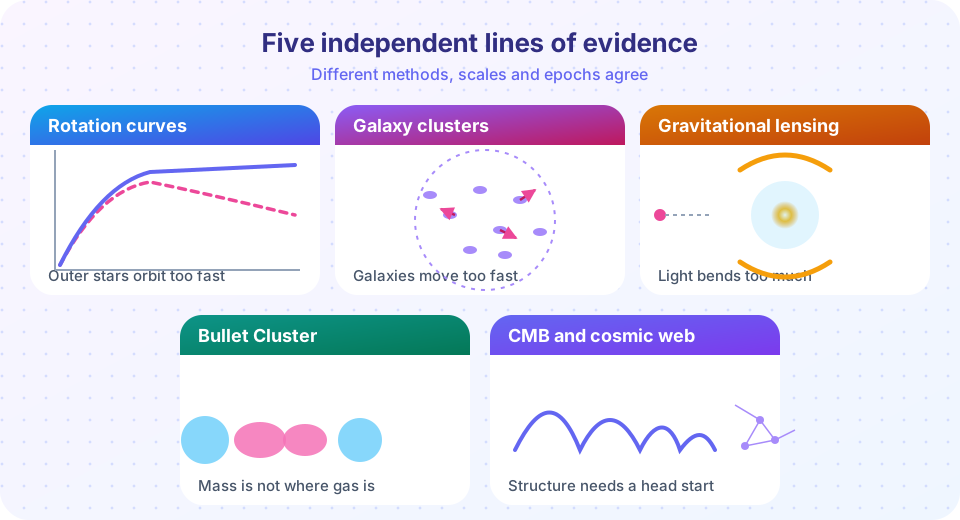
You already know one line of evidence for dark matter from chapter 5: flat galaxy rotation curves. A single anomaly could be a mistake or a failure of a model. What makes dark matter convincing is that many independent methods, using different physics at different scales and different times, all give the same answer: about five times as much unseen matter as ordinary matter.
In this lesson you will follow the evidence from clusters to the early universe, calculate a cluster mass and a lensing angle, and survey what the dark matter might be.
What you will learn
- The five main lines of evidence, and why they are independent.
- How to estimate a cluster mass from galaxy speeds, and an Einstein radius from lensing.
- Why the Bullet Cluster challenges modified gravity.
- The candidates and the status of the searches.
Key terms
Velocity dispersion (σ): the spread of the speeds of galaxies in a cluster.
Gravitational lensing: the bending of light by mass, which can distort or multiply images.
Einstein radius (θ_E): the angular radius of the ring image when source, lens and observer are aligned.
WIMP: a "weakly interacting massive particle", a hypothesized dark matter candidate.
Axion: a very light hypothesized particle, first proposed to solve a problem in particle physics.
Line 1 and 2: motions
Rotation curves (chapter 5) show that the matter inside a spiral galaxy's radius keeps growing out to large radius. Galaxy clusters gave the first hint: in 1933 Fritz Zwicky measured the speeds of galaxies in the Coma cluster and found them so large that the cluster would fly apart unless it contained far more mass than the stars. For a bound system in equilibrium the virial theorem gives M ≈ 3 σ² R / G, where σ is the line-of-sight velocity dispersion and R the radius. Rich clusters have σ ≈ 1,000 km/s and R ≈ 1.5 Mpc, giving about 10¹⁵ solar masses, far more than their stars and hot gas.
Line 3: gravitational lensing
General relativity says mass bends light. A cluster acts as a lens: background galaxies appear as arcs and multiple images. For a point mass M at distance D_L, with a source at D_S and D_LS between lens and source, the Einstein radius is
θ_E = √( (4GM/c²) × D_LS / (D_L D_S) ).
Measuring the arcs gives the mass projected along the line of sight, whether or not it shines. Weak lensing, the tiny coherent distortion of thousands of background galaxy shapes, maps mass in clusters and the cosmic web. Lensing masses agree with the dynamical ones, and both are several times larger than the visible mass.
Line 4: the Bullet Cluster
In the cluster 1E 0657-56, two clusters collided about 150 million years ago. The hot gas, which holds most of the ordinary matter, is shown by X-ray emission from Chandra: collisions made it slow down and form a bright shock, lagging behind in the middle. But lensing maps (Clowe, Markevitch, Gonzalez, Bradač and colleagues, 2006) show that most of the mass passed through, separated from the gas, in two clumps beyond it. The mass is not where the visible matter is. Simple modifications of gravity predict that the lensing mass should follow the visible matter, so this system is hard for them, though proponents have suggested explanations such as massive neutrinos. The data support collisionless dark matter.
Line 5: the early universe and structure
In the CMB, the heights of the acoustic peaks (see the CMB) need Ω_c h² ≈ 0.120 of matter that does not couple to light, in addition to Ω_b h² ≈ 0.022. Baryons alone could not have formed galaxies in 13.8 billion years: before recombination they were held up by radiation pressure, and the CMB's smoothness (one part in 100,000) is too small to grow into galaxies in that time. Dark matter, free of radiation, started clumping earlier and provided gravitational wells that baryons fell into. Computer simulations with cold dark matter reproduce the observed cosmic web of filaments, clusters and voids and the number and clustering of galaxies.
What could it be?
Brief list of candidates:
- MACHOs (compact objects such as black holes or brown dwarfs): microlensing surveys exclude them as the main component.
- Standard neutrinos: too light and fast ("hot"); they erase small structures. They contribute at most a percent or so.
- WIMPs: particles with masses of about 10 GeV to 10 TeV and weak-scale interactions would naturally leave the observed relic density (the "WIMP miracle"). Direct-detection experiments in deep underground laboratories (XENONnT, LZ, PandaX) have found no signal and have excluded much of the simplest parameter space.
- Axions and similar very light particles: searched for with strong magnetic fields (ADMX).
- Sterile neutrinos, primordial black holes and other possibilities remain.
Searches proceed in three ways: direct (detecting a dark matter particle scattering in a detector), indirect (seeing annihilation products such as gamma rays), and collider (producing it at the Large Hadron Collider). So far none has succeeded.
Common misconceptions
"Dark matter was invented to fix rotation curves." Its case rests on many independent measurements, including the CMB, clusters and lensing.
"MOND explains everything dark matter does." It does well on galaxy rotation curves, but struggles with clusters, the Bullet Cluster and the CMB peaks.
"Dark matter is a type of antimatter." Antimatter annihilates with matter and emits gamma rays, which would be visible.
"Experiments have ruled out dark matter." They have ruled out some candidates and parameter ranges, not the existence of dark matter itself.
Try it
Press Run (or Ctrl + Enter) to see the result here.
Program input · what you'd type while the program runs
Type the answers before you press Run, one per line. Each time the program reads a line (with input()), it gets the next line from this box.
Press Run (or Ctrl + Enter) to see the console output here.
No output.
Check your understanding
Quick check · 5 questions
of 5 answered You scored / 5 · perfect!
-
1. Who first noticed that galaxies in a cluster move too fast for the visible mass?
Zwicky studied the Coma cluster in 1933. -
2. What does the Bullet Cluster show?
The mass peaks lie beyond the gas, as collisionless dark matter predicts. -
3. What does gravitational lensing measure?
Light is bent by all mass, so lensing maps total mass. -
4. Why could baryons alone not form galaxies in time?
Dark matter began clumping earlier, forming wells for the baryons. -
5. Which dark matter candidate has been mostly excluded by microlensing surveys?
Microlensing finds too few compact dark objects to make up most of the dark matter.
Summary
- Evidence for dark matter comes from rotation curves, clusters, lensing, the Bullet Cluster and the CMB with structure formation.
- Cluster masses (virial and lensing) are about 10¹⁴ to 10¹⁵ solar masses, mostly dark.
- The Bullet Cluster shows mass separated from gas, favoring collisionless particles over modified gravity.
- Candidates include WIMPs and axions; direct, indirect and collider searches have found nothing so far.
Track your progress
Create a free account to tick off lessons and pick up where you left off on any device.
of Astrophysics and Cosmology lessons completed