


















Lesson 16 of 48 · Stellar Structure and Evolution
Stellar evolution: from protostar to remnant
Follow stars from protostar through the main sequence, red giant and supernova stages to white dwarfs, neutron stars and black holes, and see how stars make the elements.
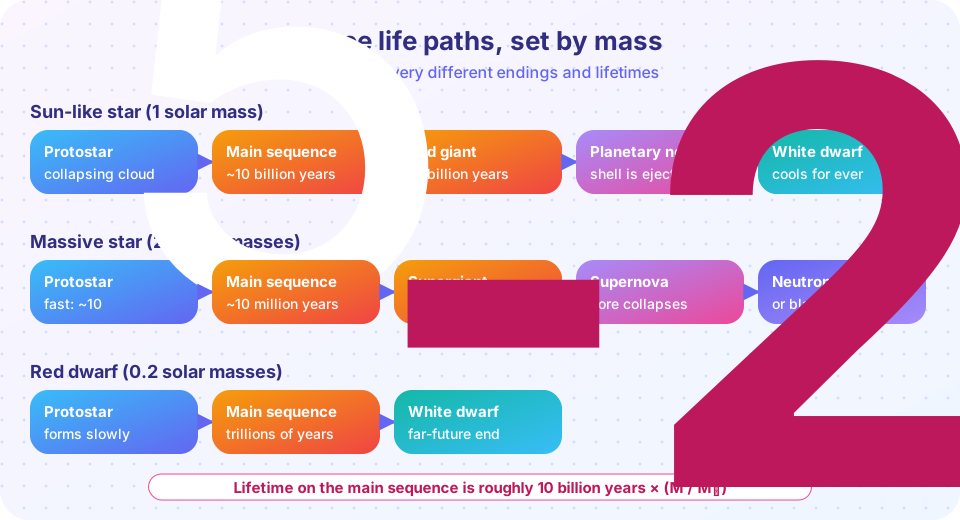
Stars change, but slowly: a human lifetime is a blink compared with a star's. We understand stellar evolution anyway because the Galaxy contains stars of every age and mass, like a forest with trees of all sizes. Combine that census with the physics of the last three lessons and the life stories fall out. This lesson follows three stars: a Sun-like star, a massive star and a small red dwarf.
What you will learn
- How stars form and what happens during the protostar stage.
- What happens when a Sun-like star leaves the main sequence, and its final fate.
- How a massive star ends in a core-collapse supernova.
- Where the chemical elements come from.
Key terms
Protostar: a contracting, heating clump of gas that has not yet started fusing hydrogen.
Planetary nebula: a shell of gas shed by a dying Sun-like star; it has nothing to do with planets.
Core-collapse supernova: the explosion that follows the collapse of the iron core of a massive star.
Degenerate matter: matter so dense that quantum rules, not heat, supply the pressure.
Nucleosynthesis: the making of new elements by nuclear reactions.
Birth
Stars form in cold molecular clouds, dense enough that gravity can win over gas pressure: a clump heavier than the Jeans mass collapses. As it contracts, half of the gravitational energy released warms the gas, and the clump becomes a protostar surrounded by a disc, which is the birth place of planets. For the Sun this took about 30 million years. When the core reaches about 10⁷ K, hydrogen fusion begins and the star settles onto the main sequence. Objects below about 0.08 solar masses never get hot enough: they are brown dwarfs.
A Sun-like star
Main sequence (about 10 billion years for the Sun). Hydrogen fuses to helium. Slowly the core becomes richer in helium, which makes it a little hotter and the fusion slightly faster, so the Sun's luminosity has grown by about 30% since it formed and will keep rising.
Red giant (after about 10 Gyr in total). When core hydrogen is exhausted, the helium core contracts and heats, while a shell of hydrogen around it fuses vigorously. The outer layers expand and cool: the Sun will swell to more than 100 times its present radius and become 2,000 or more times as luminous, at about 3,000–4,000 K. Mercury and Venus will be engulfed; Earth's fate depends on mass loss and tides.
Helium burning. When the core reaches about 10⁸ K, helium fuses into carbon and oxygen via the triple-alpha process. In low-mass stars this starts suddenly in a degenerate core (the helium flash). Afterwards the star settles on the horizontal branch or red clump.
Planetary nebula and white dwarf. Helium burning too runs out, and the star becomes a larger, cooler giant again. The envelope is blown away in strong winds and shed as a glowing shell, a planetary nebula, lit by the hot core inside. Only the carbon-oxygen core remains: a white dwarf, held up by electron degeneracy pressure (chapter 4) and slowly cooling for ever.
A massive star (above about 8 solar masses)
The first steps are the same, but faster, and the core gets hot enough to keep going: carbon, neon, oxygen and finally silicon burn in successive shells like an onion, each stage shorter than the last. The star ends with an iron core, the one that fusion cannot extract energy from. When that core reaches about 1.4 solar masses, electron degeneracy pressure fails. In less than a second the core collapses from a size of thousands of kilometres to about 20 km. It rebounds off the super-dense centre and, helped by an enormous burst of neutrinos, drives off the rest of the star in a core-collapse supernova. A typical explosion releases about 10⁴⁶ J, around 99% of it in neutrinos, and for weeks rivals the visible light of a whole galaxy.
The core becomes a neutron star (for initial masses up to roughly 20–25 solar masses, with exceptions) or a black hole (for the heaviest cores). On 23 February 1987, supernova 1987A in the Large Magellanic Cloud sent about two dozen neutrinos through detectors on Earth, a few hours before the light arrived, confirming the picture.
A red dwarf
Stars below about 0.35 solar masses are convective throughout, so they mix fresh hydrogen into the core and burn nearly all of it. With very low luminosity they stay on the main sequence for trillions of years, much longer than the present 13.8-billion-year age of the universe. No red dwarf has yet died, so what happens at the end is theory: they should slowly brighten, heat up and become helium white dwarfs.
Making the elements
The Big Bang produced hydrogen, helium and a little lithium (chapter 7). Almost everything else is made in stars: carbon and oxygen in giants, elements up to iron in massive stars and Type Ia supernovae, and heavier ones mainly by capturing neutrons. Slow neutron capture occurs in giant stars; rapid neutron capture occurs in some supernovae and, as the 2017 observation of two merging neutron stars strongly suggested, in those collisions, which seem to make gold and platinum. The carbon in your cells and the oxygen you breathe were made in stars that died before the Sun was born.
Common misconceptions
"Planetary nebulae are made of planets." The name comes from their round, disc-like look in early telescopes.
"All stars end in a supernova." Only stars above roughly 8 solar masses (or white dwarfs in certain binaries, as Type Ia) do. Most stars, including the Sun, fade as white dwarfs.
"The Sun will turn into a black hole." The Sun has far too little mass.
Try it
First, tabulate what happens to stars of different masses, using the approximate lifetime rule from the last lesson and the rough thresholds above.
Press Run (or Ctrl + Enter) to see the result here.
Program input · what you'd type while the program runs
Type the answers before you press Run, one per line. Each time the program reads a line (with input()), it gets the next line from this box.
Second, a schematic evolutionary track of a Sun-like star on the HR diagram. The waypoints are approximate numbers from stellar models; the lines between them are drawn by hand, so this is a sketch, not a calculation.
Press Run (or Ctrl + Enter) to see the result here.
Program input · what you'd type while the program runs
Type the answers before you press Run, one per line. Each time the program reads a line (with input()), it gets the next line from this box.
Check your understanding
Quick check · 5 questions
of 5 answered You scored / 5 · perfect!
-
1. What stops a massive star's fusion chain at iron?
Iron-group nuclei are the most tightly bound, so fusing them costs energy instead of releasing it. -
2. Which star will become a white dwarf?
Stars below about 8 solar masses lose their envelopes and leave a white dwarf. -
3. A planetary nebula is
It is an expanding shell lit by the hot core of an old star. -
4. Why have no red dwarfs died yet?
Lifetimes of hundreds of billions to trillions of years are far longer than 13.8 billion years. -
5. Most of the energy of a core-collapse supernova is carried by
About 99% of the roughly 10^46 J is emitted as neutrinos.
Summary
- Stars form from collapsing clouds; they begin fusing hydrogen when the core reaches about 10⁷ K.
- Sun-like stars become red giants, shed a planetary nebula, and end as white dwarfs.
- Stars above about 8 solar masses build an iron core and explode as core-collapse supernovae, leaving a neutron star or black hole.
- Red dwarfs live for trillions of years; elements heavier than helium were made in stars.
Next: Chapter 3 review
Track your progress
Create a free account to tick off lessons and pick up where you left off on any device.
of Astrophysics and Cosmology lessons completed