


















Lesson 33 of 48 · Cosmological Models
Chapter 6 review: Cosmological models
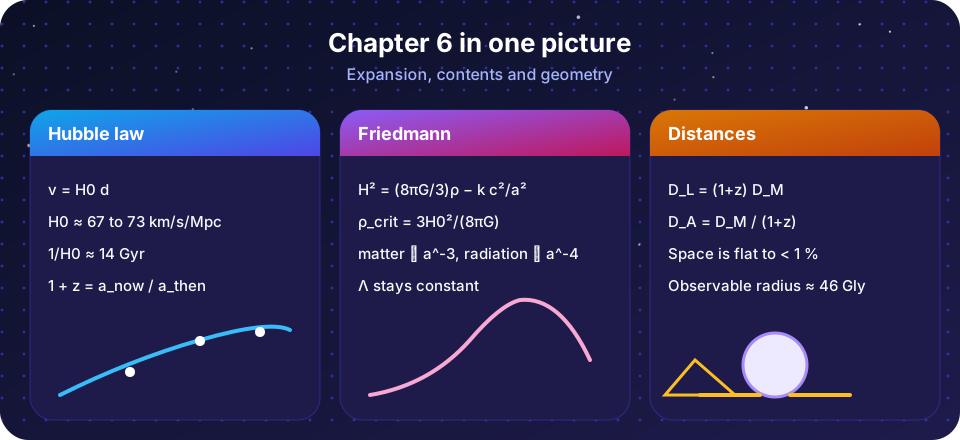
Review chapter 6 with a one-picture summary, a recap table, practice calculations on critical density and distances, and a ten-question quiz.
Chapter 6 gave you the machinery of modern cosmology: the observation that space expands, the equation that governs how it expands, and the language for the shape of space and for distances. These are the tools you need to read the early-universe and dark-energy chapters. Check yourself with the table, the practice code and the quiz.
Recap table
| Idea | Key statement | Lesson |
|---|---|---|
| Cosmological principle | Homogeneous and isotropic on large scales | Overview |
| Hubble law | v = H₀ d, H₀ about 67 to 73 km/s/Mpc |
Hubble law |
| Redshift | 1 + z = a_now / a_emit |
Hubble law |
| Friedmann equation | H² = H₀²[Ω_r a⁻⁴ + Ω_m a⁻³ + Ω_k a⁻² + Ω_Λ] |
Friedmann |
| Critical density | ρ_c = 3H²/(8πG), about 9×10⁻²⁷ kg/m³ today |
Friedmann |
| Acceleration | ä/a = −(4πG/3)(ρ + 3P/c²) |
Friedmann |
| Geometry | Closed, flat, open; observed flat to < 1 % | Geometry |
| Distances | D_L = (1+z) D_C, D_A = D_C / (1+z) |
Geometry |
Try it
Press Run (or Ctrl + Enter) to see the result here.
Program input · what you'd type while the program runs
Type the answers before you press Run, one per line. Each time the program reads a line (with input()), it gets the next line from this box.
Press Run (or Ctrl + Enter) to see the console output here.
No output.
Check your understanding
Quick check · 10 questions
of 10 answered You scored / 10 · perfect!
-
1. A galaxy at 300 Mpc has a recession speed of 21,000 km/s. What H0 does that give?
H0 = 21,000 / 300 = 70 km/s/Mpc. -
2. Light from a quasar has z = 4. The universe was then what fraction of its present size?
a = 1/(1 + z) = 1/5. -
3. Which component's energy density is unchanged by expansion?
A cosmological constant has w = -1 and constant density. -
4. Which pair of exponents describes matter and radiation densities?
Matter: a^-3. Radiation: a^-4 because of the additional redshift. -
5. Which situation makes the expansion accelerate?
From the second Friedmann equation, rho + 3P/c^2 < 0 gives positive acceleration. -
6. What does a flat universe mean?
k = 0 means Euclidean spatial geometry, which corresponds to the critical density in total. -
7. Angular-diameter distance relates to comoving distance by:
D_A = D_C / (1+z). -
8. Why is the observable universe 46 billion light-years in radius?
Comoving distances grow with expansion. -
9. What is the Hubble time for H0 = 70 km/s/Mpc?
1/H0 = 977.8/70 Gyr, about 14 Gyr. -
10. What did the 1998 supernova observations show?
Distant Type Ia supernovae are fainter than expected for a decelerating universe.
Summary
- The universe is homogeneous and isotropic on large scales and expands uniformly, giving
v = H₀ dand1 + z = a_now / a_emit. - The Friedmann equation links expansion to matter, radiation, curvature and dark energy.
- Dark energy accelerates the expansion; ΛCDM is the standard model, with age about 13.8 Gyr.
- The universe is flat to better than 1 percent, and distances (comoving, luminosity, angular) differ by factors of
1 + z.
Track your progress
Create a free account to tick off lessons and pick up where you left off on any device.
of Astrophysics and Cosmology lessons completed