


















Lesson 30 of 48 · Cosmological Models
The Hubble Law and the Expanding Universe
Understand the Hubble law v = H0 d, cosmological redshift versus Doppler shift, the scale factor, and how to fit a Hubble constant to galaxy data in Python.
In the 1910s Vesto Slipher at Lowell Observatory measured the spectra of spiral nebulae and found something odd: nearly all of them were redshifted, some by thousands of km/s. Hubble was not the first to notice that fainter, and therefore more distant, galaxies tend to have larger redshifts. Georges Lemaître derived the relation from general relativity in 1927, and Hubble's 1929 data, though poor by modern standards, made the case convincing. Today the Hubble law is the cornerstone of observational cosmology.
In this lesson you will see the law, understand why it implies expansion rather than motion through space, and learn the difference between Doppler and cosmological redshift.
What you will learn
- The statement and units of the Hubble law.
- Why a uniform expansion produces velocity proportional to distance.
- How redshift relates to the scale factor.
- How to estimate
H₀from data and what the current values are.
Key terms
Hubble constant (H₀): the proportionality between recession speed and distance today, about 67 to 73 km/s/Mpc.
Hubble flow: the smooth outward motion of galaxies caused by expansion.
Peculiar velocity: a galaxy's motion relative to the Hubble flow, caused by local gravity.
Cosmological redshift: the stretching of light's wavelength by the expansion of space.
Standard candle: an object of known luminosity, used to find distance.
The law
v = H₀ d
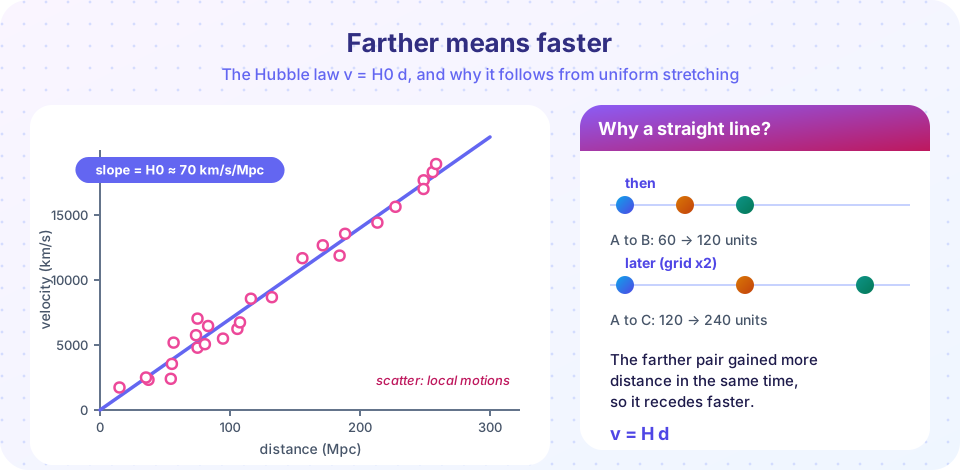
If you double the distance, you double the recession speed. The units of H₀ are km/s per Mpc: a galaxy 100 Mpc away recedes at 7,000 km/s if H₀ = 70. For small redshifts v ≈ c z, so z ≈ H₀ d / c. This holds for z below about 0.1; beyond that you need the full cosmological formulae of the lesson on geometry and distances.
The law is not a law of motion but a consequence of homogeneous expansion. Place three galaxies A, B and C on a line, with B at distance d from A and C at 2d. If every distance doubles in a time t, then B has moved d further away and C has moved 2d further in the same time, so C's speed is twice B's. The same result follows for any observer, so there is no center: from C, A and B also recede from C, each in proportion to its distance. Each galaxy sees all the others recede, and that is exactly what uniform stretching predicts. This is what Lemaître and Friedmann derived.
Scale factor and redshift
Describe the expansion by the scale factor a(t), with a = 1 today. The proper distance between two distant galaxies is d(t) = a(t) × χ, where the comoving distance χ is fixed. Differentiating gives v = ȧ χ = (ȧ/a) d, so the Hubble parameter is
H(t) = ȧ / a and H₀ = H(t_now).
Light traveling through expanding space is stretched along with it. Wavelengths scale with a, so
1 + z = λ_obs / λ_emit = a_now / a_emit.
A galaxy seen at z = 1 emitted its light when the universe was half its present size. This is not the Doppler effect: the galaxy is not "moving through" space at that speed (the Doppler formula would give nonsense for z > 1: it would suggest superluminal motion). The galaxies are essentially at rest in comoving coordinates while the space between them grows. For very distant galaxies, the proper recession speed H₀ d can exceed the speed of light without any contradiction, because it is not motion through space.
Peculiar velocities
On small scales, gravity wins over expansion. Galaxies in a cluster move at 500 to 1,000 km/s, and Andromeda is moving toward the Milky Way at about 110 km/s, so it shows a blueshift. For a galaxy at 10 Mpc, the Hubble flow is only 700 km/s, so peculiar velocities blur the law. You need galaxies beyond about 50 to 100 Mpc, where H₀ d is several thousand km/s, to measure H₀ cleanly. Gravitationally bound objects (the solar system, the Milky Way, a galaxy cluster's core) do not expand at all.
Measuring H₀
The recession speed comes from the redshift, which is easy. The hard part is the distance, which needs standard candles or other methods, built as a ladder (the cosmic distance ladder project): parallax for near stars, Cepheid variables (period–luminosity law, Henrietta Leavitt 1912) for nearby galaxies, and Type Ia supernovae out to hundreds or thousands of Mpc.
Hubble's first value was about 500 km/s/Mpc, because his distances were wrong (confusion between types of variable stars and misidentified clusters). Corrections by Baade and Sandage lowered it to about 50 to 100 during the late 20th century. The Hubble Space Telescope Key Project (Freedman and colleagues, 2001) found about 72. Today there are two precise but conflicting results: about 73 km/s/Mpc from the local distance ladder (the SH0ES team), and about 67.4 from the cosmic microwave background (Planck satellite) combined with a cosmological model. The difference is the "Hubble tension", which chapter 8 discusses.
Common misconceptions
"The Hubble law means we are at the center." Every observer sees the same law. Uniform expansion has no center.
"Redshift is a Doppler shift." For small z the Doppler formula is a good approximation, but physically it is the stretching of light with space.
"Our solar system is expanding." Bound systems do not expand: gravity (and for atoms, electromagnetism) holds them together.
"Galaxies cannot recede faster than light." In an expanding space, the recession speed of distant galaxies exceeds c beyond the Hubble distance c/H₀, about 4,300 Mpc, without violating relativity.
Try it
Press Run (or Ctrl + Enter) to see the result here.
Program input · what you'd type while the program runs
Type the answers before you press Run, one per line. Each time the program reads a line (with input()), it gets the next line from this box.
Check your understanding
Quick check · 5 questions
of 5 answered You scored / 5 · perfect!
-
1. A galaxy at 200 Mpc recedes at 14,000 km/s. What Hubble constant does this give?
H0 = v / d = 14,000 / 200 = 70 km/s/Mpc. -
2. Why does uniform expansion produce velocity proportional to distance?
If every separation multiplies by the same factor, the gain is proportional to the original separation. -
3. Light with z = 3 was emitted when the universe was what fraction of its present size?
1 + z = 4 = a_now / a_then, so a_then = 1/4. -
4. Why can't we measure H0 from galaxies only a few Mpc away?
At 10 Mpc the flow is only 700 km/s, similar to the random velocities. -
5. What was wrong with Hubble's original value of about 500 km/s/Mpc?
Distances were underestimated by a factor of several because of errors in the calibration of standard candles.
Summary
- The Hubble law
v = H₀ dfollows from uniform expansion;H₀is about 67 to 73 km/s/Mpc. - The scale factor
a(t)links distance (d = a χ), the Hubble parameter (H = ȧ/a) and redshift (1 + z = a_now / a_emit). - Cosmological redshift is the stretching of light with space, not a Doppler shift.
- Peculiar velocities blur the law nearby; bound systems do not expand.
- Measuring
H₀requires accurate distances: the distance ladder.
Next: The Friedmann equations
Track your progress
Create a free account to tick off lessons and pick up where you left off on any device.
of Astrophysics and Cosmology lessons completed