


















Lesson 36 of 48 · The Early Universe
The Cosmic Microwave Background
Learn how the CMB was predicted and found, why it is a perfect blackbody at 2.725 K, how recombination released it, and what acoustic peaks reveal about the universe.
Tune an old analog television between channels and about one percent of the "snow" on the screen is light from the Big Bang. This is the cosmic microwave background (CMB): radiation that last interacted with matter 380,000 years after the Big Bang and has been traveling ever since. It is the oldest light we can observe, and a snapshot of the universe at an age when it was still smooth and simple. Its tiny ripples carry measurements of almost every cosmological parameter.
This lesson explains where the CMB comes from, why its spectrum is so perfect, and how two sets of numbers (the temperature and the size of the ripples) tell us the age, shape and content of the universe.
What you will learn
- The history of the discovery, and what the prediction was.
- What happened at recombination and last scattering.
- The properties of the CMB: blackbody spectrum, dipole, fluctuations.
- How acoustic peaks measure the geometry and composition of the universe.
Key terms
Recombination: electrons and nuclei combining into neutral atoms at about 3,000 K.
Last-scattering surface: the sphere around us from which CMB photons last scattered.
Anisotropy: a small difference in the CMB temperature from place to place, about one part in 100,000.
Acoustic oscillations: sound waves in the photon-baryon plasma before recombination.
Angular power spectrum: a plot of the strength of temperature variations at each angular scale.
Discovery
In 1948 Ralph Alpher and Robert Herman predicted that a hot early universe should leave behind radiation with a temperature of a few kelvin. The prediction was largely forgotten. In 1964 and 1965, Arno Penzias and Robert Wilson at Bell Labs, trying to remove noise from a sensitive horn antenna, found an excess equivalent to about 3.5 K, the same in all directions and at all times. A group at Princeton (Dicke, Peebles, Roll and Wilkinson) was preparing to look for exactly this. Penzias and Wilson won the 1978 Nobel Prize in Physics.
In 1990 the FIRAS instrument on the COBE satellite showed that the spectrum is a blackbody of temperature T = 2.725 K with deviations below one part in 10⁴. In 1992 COBE's other instrument found the anisotropies; John Mather and George Smoot shared the 2006 Nobel Prize. WMAP (2001 to 2010) and Planck (2009 to 2013) mapped them in great detail.
Recombination and last scattering
In the first few hundred thousand years, the universe was a hot plasma of free electrons, protons, helium nuclei and photons. Photons scatter off free electrons, so the plasma was opaque, like a fog. As the temperature fell, electrons and nuclei combined into neutral atoms. This recombination happened at about 3,000 K (not at about 158,000 K, the temperature equivalent of the 13.6 eV ionization energy of hydrogen, because there are so many photons that the high-energy tail keeps ionizing atoms until the temperature is well below). After recombination photons could stream freely. We see them as coming from the last-scattering surface at z ≈ 1,100, about 380,000 years after the Big Bang, now about 45 billion light-years away.
Since then the universe has expanded by a factor of about 1,100, so the temperature fell from 3,000 K to 3,000 / 1,100 ≈ 2.7 K. The photons have a number density of about 411 per cubic centimeter, in all of space: about a billion photons per atom.
Blackbody and the dipole
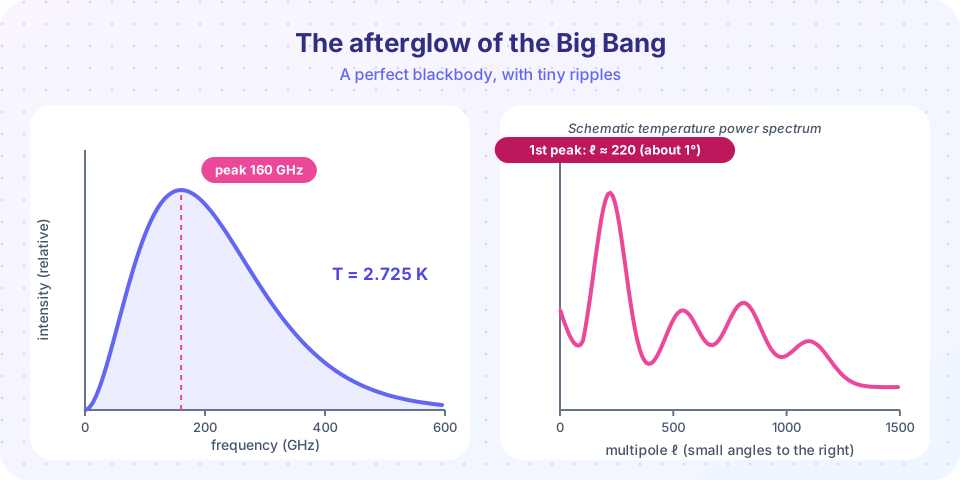
Planck's law gives the spectrum, and the peak in frequency space lies at ν_peak ≈ 58.8 GHz/K × T = 160 GHz (wavelength about 1.9 mm at that frequency, or 1.06 mm for the peak of intensity per unit wavelength). A blackbody spectrum is expected for matter and radiation in thermal equilibrium, and the expansion preserves its shape: every photon is redshifted by the same factor. It is the best blackbody ever measured.
The largest variation across the sky is the dipole: the CMB is about 3.4 mK hotter in one direction and cooler in the opposite one. That is a Doppler shift from our own motion, about 370 km/s relative to the CMB frame (the Sun's velocity combined with that of the Local Group). After subtracting it, the sky is uniform to about 1 part in 100,000: ΔT ≈ 30 μK.
Acoustic peaks
Where do the ripples come from? Before recombination the photons and baryons were tightly coupled. Dark matter, being unable to interact with light, made gravitational wells that grew from the early density seeds. The plasma fell into the wells, was heated and compressed, and then pressure from the photons pushed it back out: it oscillated like a sound wave, with a speed of about c/√3. At recombination the oscillations froze, with compressions and rarefactions printed as hot and cold spots.
The farthest a sound wave can travel before recombination is the sound horizon, r_s ≈ 147 Mpc (comoving). It acts as a standard ruler with a known physical size. Seen from a distance D_M ≈ 14,000 Mpc it subtends θ ≈ r_s / D_M ≈ 0.0105 rad ≈ 0.6°. The corresponding acoustic scale is ℓ_A = π/θ ≈ 300. Gravity's driving of the oscillations shifts the first peak to about 0.75 of that, ℓ ≈ 220 (an angle of about 0.8°, close to 1°). The position of this peak tells us the geometry: it matches a flat universe. The relative heights of the other peaks measure the baryon density (odd peaks rise with more baryons), the dark matter density, and the tilt of the primordial spectrum. The CMB has also measured the polarization of the light, which shows the same ripples and tests inflation.
The best-fit parameters, from Planck, give the ΛCDM model: H₀ ≈ 67.4 km/s/Mpc, Ω_b h² ≈ 0.0224, Ω_c h² ≈ 0.120, Ω_m ≈ 0.315, and an age of 13.8 billion years.
Common misconceptions
"The CMB is leftover light from stars." It is older than stars and has a perfect blackbody spectrum that stars cannot produce.
"The CMB comes from the edge of the universe." It comes from a sphere around every observer, from the time of recombination. A distant observer would see a different sphere.
"The ripples are variations in the radiation itself." They are variations in the density and temperature of the plasma at recombination, which later grew into galaxies and clusters.
"The CMB is just visible light that has faded." It is microwave radiation, which is light stretched by a factor of about 1,100.
Try it
Press Run (or Ctrl + Enter) to see the result here.
Program input · what you'd type while the program runs
Type the answers before you press Run, one per line. Each time the program reads a line (with input()), it gets the next line from this box.
Press Run (or Ctrl + Enter) to see the console output here.
No output.
Check your understanding
Quick check · 5 questions
of 5 answered You scored / 5 · perfect!
-
1. What is the temperature of the CMB today?
COBE FIRAS measured 2.725 K. -
2. Why did recombination occur at 3,000 K and not at the ionization temperature of hydrogen (about 150,000 K)?
With a billion photons per atom, a tiny fraction in the high-energy tail suffices to ionize atoms until about 3,000 K. -
3. What causes the CMB dipole?
A Doppler shift from our velocity of about 370 km/s. -
4. The first acoustic peak at about 1 degree tells us mainly:
The sound horizon as a standard ruler subtends the angle expected in a flat universe. -
5. By what factor have CMB photons been redshifted since last scattering?
z of about 1,100 corresponds to a stretch factor 1 + z of about 1,100.
Summary
- The CMB is relic radiation from recombination at
z ≈ 1,100(380,000 years), found by Penzias and Wilson in 1965. - It is a perfect blackbody at
T = 2.725 Kwith about 411 photons per cm³; the dipole gives our speed, about 370 km/s. - Anisotropies of about 1 part in 100,000 come from acoustic oscillations in the photon-baryon plasma.
- The first peak at
ℓ ≈ 220shows that space is flat; the peaks giveΩ_b,Ω_c,H₀and the age.
Next: Inflation
Track your progress
Create a free account to tick off lessons and pick up where you left off on any device.
of Astrophysics and Cosmology lessons completed