


















Lesson 31 of 48 · Cosmological Models
The Friedmann Equations
Derive the Friedmann equation from a Newtonian shell, learn how matter, radiation and dark energy dilute, and compute the age and expansion history of the universe in Python.
The Hubble law says space is expanding. The Friedmann equations say why, and how the expansion changes with time. They were found by Alexander Friedmann in 1922 as solutions of Einstein's field equations for a homogeneous, isotropic universe, and independently by Lemaître in 1927. Einstein first resisted them: he had added a "cosmological constant" to keep the universe static, and later wished he had not.
The full derivation needs general relativity, but a surprisingly good version comes from Newtonian physics, and it gives the same central equation. This lesson shows that derivation, the meaning of the density parameters, and how the scale factor evolves in different universes.
What you will learn
- The Friedmann equation and the meaning of critical density and
Ω. - How matter, radiation and a cosmological constant dilute as the universe expands.
- Why dark energy causes acceleration.
- How to compute the expansion history and the age of the universe numerically.
Key terms
Critical density (ρ_c): the density for which space is flat, ρ_c = 3H²/(8πG).
Density parameter (Ω): a density divided by the critical density today.
Equation of state (w): the ratio P/(ρc²) of pressure to energy density.
Cosmological constant (Λ): a constant energy density of empty space, with w = −1.
Deceleration: slowing of the expansion; the opposite is acceleration.
A Newtonian derivation
Take a sphere of radius r = a χ containing mass M = (4π/3) ρ r³ in a uniform universe. A galaxy of mass m on its surface has energy E = ½ m ṙ² − G M m / r. Substitute ṙ = ȧ χ and M ∝ ρ a³ χ³, and divide by m a² χ² / 2:
(ȧ/a)² = (8πG/3) ρ − k c² / a²
where k is set by the constant energy (a sign convention for curvature). General relativity gives exactly this equation, with ρ now meaning the total energy density divided by c², and adds the cosmological constant term + Λc²/3. This is the first Friedmann equation, and H = ȧ/a.
Critical density. If k = 0 (flat space) and Λ = 0, then ρ = ρ_c = 3H²/(8πG). For H₀ = 70 km/s/Mpc that is about 9.2×10⁻²⁷ kg/m³, only about 5 or 6 hydrogen atoms per cubic meter. Define
Ω_m = ρ_m / ρ_c, Ω_r = ρ_r / ρ_c, Ω_Λ = Λc²/(3H₀²), Ω_k = −k c² / (a₀H₀)²,
and the equation becomes the form used in practice:
H² = H₀² [ Ω_r a⁻⁴ + Ω_m a⁻³ + Ω_k a⁻² + Ω_Λ ], with Ω_r + Ω_m + Ω_k + Ω_Λ = 1.
How components dilute
Energy conservation in an expanding volume gives the fluid equation ρ̇ + 3H (ρ + P/c²) = 0. For a component with P = w ρ c², this gives ρ ∝ a^(−3(1+w)).
| Component | w | Dilution | Reason |
|---|---|---|---|
| Matter (dust) | 0 | a⁻³ |
Particle number per volume falls as volume grows |
| Radiation | 1/3 | a⁻⁴ |
Also loses energy per photon: wavelength stretches by a |
| Cosmological constant | −1 | constant | Energy density of space does not dilute |
| Curvature term | −1/3 | a⁻² |
Acts like a fluid with this equation of state |
Because radiation dilutes faster, there was a time when radiation dominated, then matter, and today (in our universe) the cosmological constant. The transitions are at redshifts of about 3,400 (radiation to matter) and about 0.3 (matter to dark energy), for the parameters now favored.
Acceleration
The second Friedmann equation gives the acceleration:
ä / a = −(4πG/3) (ρ + 3P/c²).
Matter and radiation have P ≥ 0, so they make ä < 0: gravity slows the expansion. Anything with P < −ρc²/3, such as the cosmological constant (P = −ρc²), makes ä > 0: gravity repels. In 1998 two teams, the High-z Supernova Search Team (Brian Schmidt, Adam Riess and others) and the Supernova Cosmology Project (Saul Perlmutter and others), found that distant Type Ia supernovae are fainter than expected, showing that the expansion is accelerating. The 2011 Nobel Prize in Physics went to Perlmutter, Schmidt and Riess.
Model universes
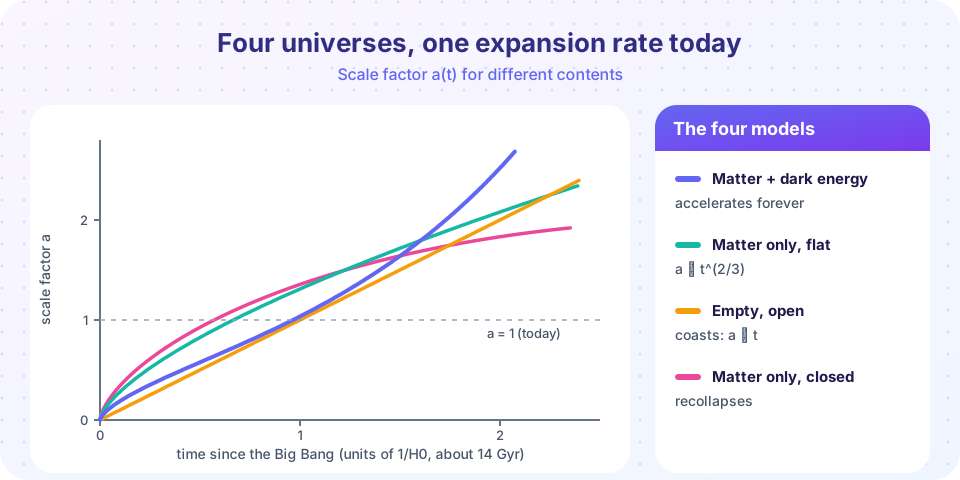
- Einstein–de Sitter (flat, matter only):
a ∝ t^(2/3), aget₀ = 2/(3H₀), about 9.3 billion years forH₀ = 70. This is too young compared with the oldest stars. - Radiation only:
a ∝ t^(1/2). This is the early universe. - Empty open (Milne):
a ∝ t, age1/H₀. - Closed, matter only: expansion stops and the universe recollapses (a "big crunch").
- De Sitter (only Λ):
a ∝ e^(Ht), exponential growth. Our universe approaches this in the far future, and in the earliest instants of inflation (chapter 7). - ΛCDM: matter plus Λ, flat, with
Ω_m ≈ 0.3andΩ_Λ ≈ 0.7. Its age is about 13.8 billion years, consistent with the oldest stars. This is the standard model of cosmology.
The age follows from integrating dt = da / (a H): t₀ = (1/H₀) ∫₀¹ da / (a E(a)), where E(a) = H/H₀.
Common misconceptions
"Critical density is a fixed number." It changes with time, because H does. At early times it was far higher.
"Dark energy is the energy of the galaxies' motion." It is a separate component with negative pressure, or the vacuum's energy.
"A flat universe is also a static one." Flat means zero spatial curvature; it can expand, decelerate or accelerate.
"Acceleration means the universe expands faster at every moment." It means ä > 0: the speed of recession of a given galaxy grows with time.
Try it
Press Run (or Ctrl + Enter) to see the result here.
Program input · what you'd type while the program runs
Type the answers before you press Run, one per line. Each time the program reads a line (with input()), it gets the next line from this box.
Press Run (or Ctrl + Enter) to see the result here.
Program input · what you'd type while the program runs
Type the answers before you press Run, one per line. Each time the program reads a line (with input()), it gets the next line from this box.
Check your understanding
Quick check · 5 questions
of 5 answered You scored / 5 · perfect!
-
1. How does the matter density scale with the scale factor?
The same number of particles fills a volume that grows as a^3. -
2. Why does radiation dilute faster than matter?
Number density falls as a^-3, and each photon's energy falls as a^-1, giving a^-4. -
3. For H0 = 70 km/s/Mpc, the critical density is about:
rho_c = 3H0^2/(8 pi G) is about 9.2×10^-27 kg/m^3, a few protons per cubic meter. -
4. A component with w = -1 does what to the expansion?
P = -rho c^2 gives a negative value of rho + 3P/c^2, so the acceleration is positive. -
5. What is the age of an Einstein-de Sitter universe with H0 = 70?
For a ∝ t^(2/3), H = 2/(3t), so t0 = 2/(3 H0).
Summary
- The Friedmann equation
H² = (8πG/3)ρ − kc²/a² + Λc²/3governs expansion; the critical density isρ_c = 3H²/(8πG). - Matter dilutes as
a⁻³, radiation asa⁻⁴, the cosmological constant not at all. ä/a = −(4πG/3)(ρ + 3P/c²): negative pressure makes the expansion accelerate.- ΛCDM (
Ω_m ≈ 0.3,Ω_Λ ≈ 0.7) has an age of about 13.8 billion years.
Track your progress
Create a free account to tick off lessons and pick up where you left off on any device.
of Astrophysics and Cosmology lessons completed