


















Lesson 12 of 48 · Stellar Structure and Evolution
Chapter 3 overview: the lives of stars
An overview of chapter 3: how stars balance gravity and pressure, shine by fusion, populate the Hertzsprung-Russell diagram and live very different lives depending on mass.
A star is a ball of gas that holds itself together with gravity and holds itself up with heat. That is the whole story, and nearly everything about stars follows from it. Heat has to be supplied from somewhere, and fusion in the core does it for billions of years. When the fuel runs low the balance shifts, and the star changes. The most important variable is simply how much gas the star starts with.
What you will learn
- The big picture of stellar life cycles and why mass decides almost everything.
- Which question each lesson in this chapter answers.
- How a few simple scaling laws give lifetimes and luminosities.
Key terms
Hydrostatic equilibrium: the balance between the inward pull of gravity and the outward push of pressure at every depth in a star.
Main sequence: the long phase when a star fuses hydrogen to helium in its core.
Mass-luminosity relation: the rule that more massive main-sequence stars are far more luminous.
Stellar remnant: the compact core left after a star dies: a white dwarf, neutron star or black hole.
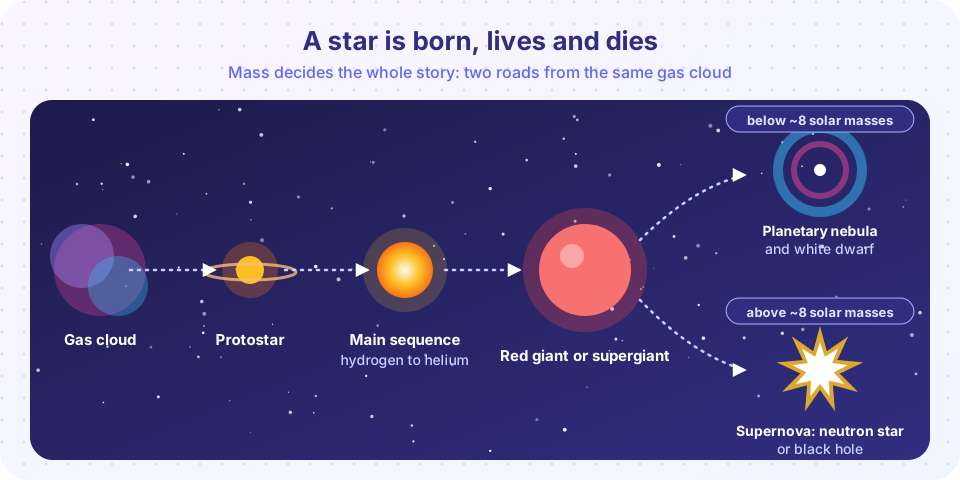
The big picture
Birth
A long, steady life
Middle age
Endings
The roadmap
- Stellar structure: hydrostatic equilibrium, the layers of the Sun and how energy escapes.
- Nuclear fusion in stars: the proton-proton chain, the CNO cycle, quantum tunnelling and heavier fuels.
- The HR diagram and the main sequence: how luminosity and temperature sort stars.
- Stellar evolution paths: red giants, planetary nebulae, supernovae and the origin of the elements.
- Chapter 3 review: cheat sheet and quiz.
Why mass is destiny
A more massive star has a hotter core, fuses faster, and shines much more brightly. Over most of the range of masses, luminosity rises as roughly the cube or fourth power of mass, while the fuel supply rises only in proportion to mass. So heavy stars burn out sooner: a star of 20 solar masses lives for some millions of years, a Sun-like star for about 10 billion years, and a small red dwarf for hundreds of billions of years or more. Mass also decides the ending: below roughly 8 solar masses, a star becomes a white dwarf; above, its core collapses into a neutron star or black hole.
Common misconceptions
"Stars burn fuel like a fire." Burning is chemistry. Stars shine by nuclear fusion, which releases millions of times more energy per kilogram of fuel than chemical burning.
"The Sun will explode as a supernova." Our Sun is far too light. It will swell into a red giant and end as a white dwarf.
"Big stars live longer because they have more fuel." They have more fuel but burn it much faster, so they die young.
Try it
The mass-luminosity relation turns a mass into a luminosity and a rough lifetime. The program uses a standard piecewise fit, then estimates the lifetime as t ≈ 10 Gyr × (M / L), which is crude: it treats every star as burning the same fraction of its mass as the Sun does.
Press Run (or Ctrl + Enter) to see the console output here.
No output.
This plot shows the same relation graphically and marks where the Sun sits.
Press Run (or Ctrl + Enter) to see the result here.
Program input · what you'd type while the program runs
Type the answers before you press Run, one per line. Each time the program reads a line (with input()), it gets the next line from this box.
Check your understanding
Quick check · 4 questions
of 4 answered You scored / 4 · perfect!
-
1. What holds a star up against gravity?
Gas and radiation pressure from the hot interior balance gravity at every depth. -
2. Which star lives longest?
Luminosity falls with mass faster than fuel does, so the smallest stars burn very slowly and live the longest. -
3. Our Sun will end as
The Sun is far below the threshold of roughly 8 solar masses for core collapse. -
4. Stars shine mainly because of
Fusion of hydrogen into helium releases far more energy than chemistry could.
Summary
- Stars are in hydrostatic equilibrium: gravity inward, pressure outward.
- Fusion in the core supplies the energy; mass sets the temperature, luminosity, lifetime and fate.
- Stars below about 8 solar masses become white dwarfs; heavier ones collapse in supernovae.
- The chapter proceeds from structure to fusion, the HR diagram and evolution paths.
Next: Stellar structure
Track your progress
Create a free account to tick off lessons and pick up where you left off on any device.
of Astrophysics and Cosmology lessons completed