


















Lesson 17 of 48 · Stellar Structure and Evolution
Chapter 3 review: stellar structure and evolution
Review chapter 3: hydrostatic equilibrium, fusion, the HR diagram and the life paths of stars, with a one-page cheat sheet, a stellar calculator and a ten-question quiz.
Chapter 3 told one connected story. A star is a self-gravitating ball whose pressure balances gravity (structure). Its core is hot enough for hydrogen to fuse by tunnelling (fusion). Its temperature and luminosity, set by mass, place it on the HR diagram (the main sequence). When the core fuel runs out, the balance shifts and the star evolves along a path fixed by its mass (evolution). This review gathers the formulas and the pictures.
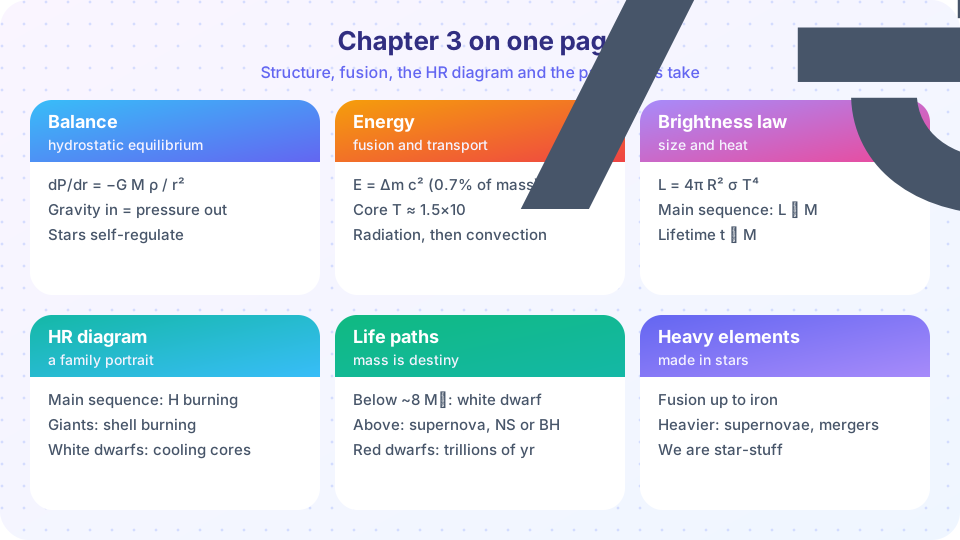
Recap table
| Lesson | Big idea | Formula to remember |
|---|---|---|
| Stellar structure | Gravity is balanced by pressure | dP/dr = −G m ρ / r², T_c ~ G M μ m_H / (k R) |
| Fusion | Mass becomes energy; tunnelling makes it possible | E = Δm c², 26.7 MeV per He-4 |
| HR diagram | Position encodes size and mass | L = 4π R² σ T⁴, L ∝ M^3.5, t ∝ M^−2.5 |
| Evolution paths | Mass decides the fate | below ~8 M☉ white dwarf; above, supernova |
Common misconceptions
"Hotter core means shorter life because the star is burning hotter." The cause is higher luminosity: massive stars shine much more brightly, so they exhaust fuel sooner.
"A star on the main sequence is stable because fusion is gentle." It is stable because of negative feedback: expansion cools the core and slows fusion.
"Supernovae make all the elements." They make many, but the lightest come from the Big Bang, and some heavy ones come from merging neutron stars and giant stars.
Try it
A one-stop calculator: give it a mass and it returns the main-sequence luminosity, lifetime, approximate radius, surface temperature and fate. Radius and temperature come from approximate main-sequence scalings (R ∝ M^0.8 above one solar mass, R ∝ M^0.9 below), so they are good to tens of percent.
Press Run (or Ctrl + Enter) to see the result here.
Program input · what you'd type while the program runs
Type the answers before you press Run, one per line. Each time the program reads a line (with input()), it gets the next line from this box.
Check your understanding
Quick check · 9 questions
of 9 answered You scored / 9 · perfect!
-
1. In hydrostatic equilibrium, the pressure of a star's gas
The pressure gradient must support the weight of the layers above, so P falls outward. -
2. Roughly what fraction of its rest mass does hydrogen fusion release as energy?
26.7 MeV out of 3.7 GeV for four protons: about 0.7%. -
3. Which describes the Sun's position on the HR diagram today?
It fuses hydrogen in its core, so it is a main-sequence G-type star. -
4. A star has twice the Sun's mass. Using L proportional to M^3.5, its luminosity is about
2^3.5 = 11.3 (the better fit near 2 solar masses gives 16). -
5. A cluster's turn-off point is at the Sun's luminosity. The cluster's age is about
The main-sequence lifetime of a Sun-like star is about 10 billion years. -
6. A massive star's core stops producing energy when it becomes mostly
Iron-group nuclei have the highest binding energy per nucleon. -
7. Which remnant does the Sun leave?
Stars below about 8 solar masses leave white dwarfs. -
8. Why is the Sun's core much hotter than its surface?
Heat flows from hot to cold, so the temperature must fall outward from the fusion region. -
9. Fusion at 15 million kelvin works because of
Tunnelling lets protons fuse at energies well below the barrier height.
Summary
- Gravity versus pressure sets a star's structure; negative feedback keeps it steady.
- Fusion converts 0.7% of hydrogen's mass to energy; tunnelling makes it work at 10⁷ K.
- The HR diagram sorts stars by luminosity and temperature; the main sequence is a mass sequence.
- Mass decides everything: lifetime, remnant and what elements the star makes.
Track your progress
Create a free account to tick off lessons and pick up where you left off on any device.
of Astrophysics and Cosmology lessons completed