


















Lesson 45 of 48 · Projects and Practice
Practice Problems: Galaxies and Cosmology
Eight worked practice problems on redshift, rotation curves, galaxy types, black hole accretion, critical density, nucleosynthesis and supernova distances, with Python answers to check against.
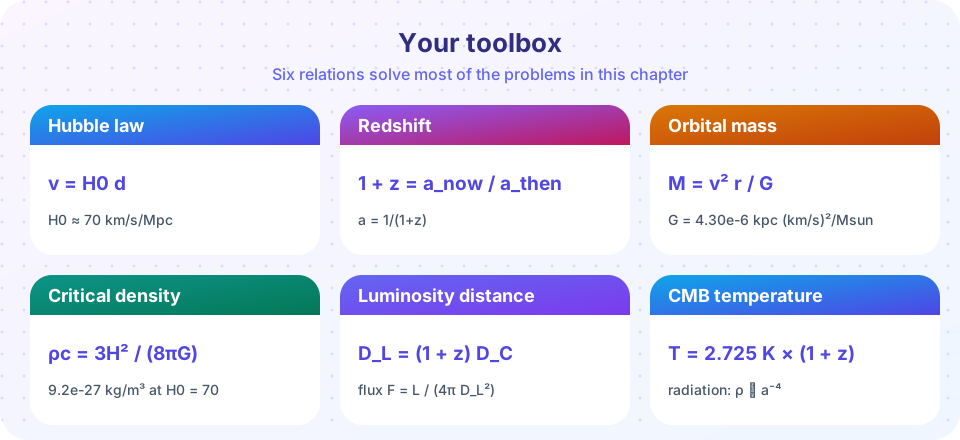
You learn cosmology by calculating. This set has eight problems that use the tools from chapters 5 to 8. Try each one on paper first: write down the formula, plug in the numbers with units and estimate the answer before you compute. Then run the code in the second block to check yourself. Do not skip the estimate: a quick order-of-magnitude check will save you from the most common mistakes (a factor of 1,000 in a unit).
What you will learn
- How to choose the right relation for a cosmology problem.
- How to keep track of units (km/s, Mpc, kpc, solar masses).
- How to check an answer by estimating its size first.
Key terms
Order of magnitude: the power of ten of a quantity, used for quick estimates.
Unit conversion: changing between units without changing the quantity, such as Mpc to km.
Sanity check: testing whether an answer is physically plausible.
Given and unknown: the quantities supplied by a problem and the quantity you must find.
Dimensional analysis: checking that both sides of an equation have the same units.
The problems
Problem 1 (Hubble law). A galaxy is 150 Mpc away. With H₀ = 70 km/s/Mpc, what is its recession speed, and what redshift would you expect (use z ≈ v/c)?
Problem 2 (rotation curve). A star at 15 kpc from the center of a galaxy moves at 210 km/s in a circular orbit. Estimate the mass inside 15 kpc. Use G = 4.30×10⁻⁶ kpc (km/s)² / M☉.
Problem 3 (Hubble types). An elliptical galaxy has apparent axes of 50 arcseconds and 25 arcseconds. What is its Hubble type?
Problem 4 (quasar). A quasar has a luminosity of 3×10³⁹ W. If the radiative efficiency is 0.1, what accretion rate in solar masses per year is needed, and what is the smallest black hole mass for which this luminosity is below the Eddington limit (L_Edd = 1.26×10³¹ W × M/M☉)?
Problem 5 (scale factor). Light from a galaxy has z = 3. How large was the universe then compared with today, what was the CMB temperature and how much denser was matter?
Problem 6 (critical density). Compute the critical density for H₀ = 73 km/s/Mpc in kg/m³ and compare it with the value for H₀ = 67.4.
Problem 7 (nucleosynthesis). If the neutron-to-proton ratio at the start of helium formation were 1/8 instead of 1/7, what would the helium mass fraction be?
Problem 8 (supernova). A Type Ia supernova (M = −19.3) has peak apparent magnitude 24.0. What is its luminosity distance in Gpc? (μ = m − M = 5 log₁₀(d / 10 pc)).
Check your answers
Press Run (or Ctrl + Enter) to see the result here.
Program input · what you'd type while the program runs
Type the answers before you press Run, one per line. Each time the program reads a line (with input()), it gets the next line from this box.
Talking through the answers
1. Speed 70 × 150 = 10,500 km/s, redshift about 0.035. Since z is much less than 1, the simple approximation is fine.
2. About 1.5×10¹¹ M☉. If the curve is flat out to larger radius, the mass grows in proportion to radius, as in chapter 5.
3. b/a = 0.5, so n = 10 × 0.5 = 5: E5.
4. About 5 solar masses per year, a modest rate compared with the 18 solar masses per year needed for a quasar of 10⁴⁰ W. A mass of at least 2.4×10⁸ M☉ keeps this quasar below the Eddington limit. Note the unit trap: c must be in m/s inside ηṀc² with L in watts.
5. a = 0.25, T = 10.9 K, matter is 64 times denser. The temperature scales as 1 + z, the density as (1 + z)³.
6. ρ_c ∝ H², so a higher H₀ raises it by (73/67.4)² = 1.17. The fractions Ω depend on which H₀ you use, which is why H₀ and the densities are fitted together.
7. Y = 2(1/8)/(9/8) = 0.222. A smaller neutron fraction gives less helium; neutron decay during a longer delay has the same effect.
8. μ = 43.3, so d ≈ 4.6 Gpc. In a flat ΛCDM universe with H₀ = 70, that corresponds to a redshift of about 0.75.
Common misconceptions
"Plug in numbers until it works." Choose the relation first; check units and the order of magnitude before computing.
"A calculator answer is right because it has many digits." The inputs here have two or three significant figures, so the answer does too.
"Redshift and speed are always related by v = cz." Only for z much less than 1.
Try it
Press Run (or Ctrl + Enter) to see the result here.
Program input · what you'd type while the program runs
Type the answers before you press Run, one per line. Each time the program reads a line (with input()), it gets the next line from this box.
Check your understanding
Quick check · 5 questions
of 5 answered You scored / 5 · perfect!
-
1. A galaxy at 300 Mpc recedes at 21,000 km/s. How many times the speed of light is that?
21,000 / 299,792 is about 0.07. -
2. A star orbits at 200 km/s at 10 kpc. The mass inside is about:
M = v^2 r / G = 40,000 × 10 / 4.3e-6 = 9.3e10. -
3. A source at z = 1 emitted light when the universe was what fraction of its present size?
a = 1/(1+z) = 1/2. -
4. A supernova with apparent magnitude 24 and absolute magnitude -19.3 has mu equal to:
mu = 24 + 19.3 = 43.3. -
5. What is the main reason to estimate before calculating?
An order-of-magnitude estimate tells you whether the exact answer is plausible.
Summary
- Choose the relation first: Hubble law, redshift, orbital mass, critical density, distances or temperature scaling.
- Track units (km/s, Mpc, kpc, M☉) and estimate the order of magnitude before computing.
- Use
v = czonly for smallz; use the integral for comoving distance otherwise. - Quote answers with the precision your inputs justify.
Next: Glossary
Track your progress
Create a free account to tick off lessons and pick up where you left off on any device.
of Astrophysics and Cosmology lessons completed