


















Lesson 26 of 48 · Galaxies
Galaxy Rotation Curves and Dark Matter
See why stars in galaxies orbit too fast for their visible mass: derive the Keplerian prediction, meet Vera Rubin's flat curves, and model disk plus dark halo in Python.
In the solar system, planets far from the Sun move slowly: Mercury at about 48 km/s, Neptune at about 5 km/s. That is no accident. The Sun holds nearly all of the mass at the center, and gravity weakens with distance. One might expect the same in a galaxy, where most of the light comes from the center. The stars and gas in the outer parts of galaxies ought to move slowly.
They do not. Measurements of galaxy rotation, made from the 1970s on, show that outer parts move about as fast as inner ones. This is one of the strongest observations in all of astronomy, and it tells us that galaxies contain much more matter than we can see. In this lesson you will derive the expectation, see the measurement, and build a simple model that fits.
What you will learn
- How rotation speed relates to enclosed mass.
- Why visible matter predicts a falling curve at large radius.
- What Vera Rubin and others measured, and how (the 21 cm line).
- How a dark matter halo flattens the curve; what the alternatives are.
Key terms
Rotation curve: a plot of circular orbital speed against distance from the center.
Keplerian decline: the v ∝ 1/√r fall of speed outside most of the mass.
21 cm line: radio emission from neutral hydrogen, used to measure rotation far beyond the visible disk.
Dark matter halo: an extended, roughly spherical distribution of unseen matter.
NFW profile: a halo density profile proposed by Navarro, Frenk and White (1996) from simulations.
From orbits to mass
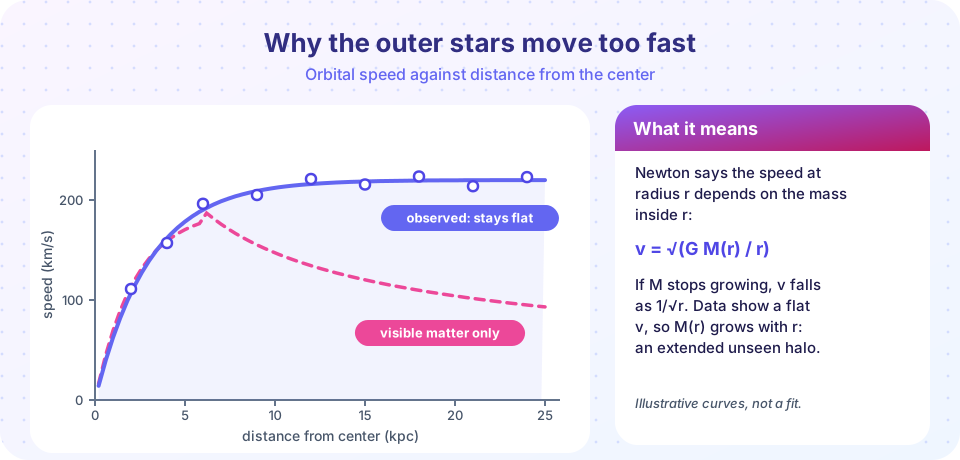
For a circular orbit, gravity supplies the centripetal force. A star of mass m at radius r obeys m v²/r = G m M(r)/r², where M(r) is the mass inside radius r (for a spherical distribution; disks are close enough for an estimate). So
v(r) = √( G M(r) / r ) and M(r) = v² r / G.
Now look at the two cases.
- Mass concentrated at the center (
M(r)constant at larger):v ∝ 1/√r. This is the Keplerian fall. If a galaxy's mass followed its light, which is concentrated and then falls roughly exponentially, speed should peak and then drop at large radius. - A flat curve (
vconstant) needsM(r) ∝ r: the enclosed mass keeps growing in proportion to radius, even where there is hardly any starlight.
The measurement
Early evidence came from Fritz Zwicky (1933), who noticed that galaxies in the Coma cluster move too fast to stay bound by the visible mass, and from Jan Oort (1932) with stars near the Sun. In 1970 Vera Rubin and Kent Ford measured the rotation of Andromeda from emission lines of ionized gas. The outskirts did not slow down. In the late 1970s Rubin, Ford and Norbert Thonnard extended this to many spirals. At the same time radio astronomers (such as Albert Bosma, and Morton Roberts) used the 21 cm line of neutral hydrogen to follow gas far beyond the visible disk, to two or three times the optical radius. Flat curves turned up everywhere.
The method relies on the Doppler effect. The gas on one side of a galaxy approaches us and on the other side recedes; the shift of a spectral line gives the line-of-sight velocity, which is corrected for the galaxy's tilt.
A model: disk plus halo
An exponential stellar disk with mass M_d and scale length R_d has a rotation curve (Freeman, 1970) of
v_d² = 4π G Σ₀ R_d y² [ I₀(y) K₀(y) − I₁(y) K₁(y) ], with y = r / (2 R_d), Σ₀ = M_d / (2π R_d²),
where I and K are modified Bessel functions. It rises, peaks near r ≈ 2.2 R_d and then falls.
A dark halo with the NFW density ρ(r) = ρ₀ / [ (r/r_s)(1 + r/r_s)² ] has enclosed mass M(r) = 4π ρ₀ r_s³ [ ln(1 + x) − x/(1 + x) ] with x = r/r_s. Its speed v_h² = G M(r) / r rises slowly and levels out. The two components add in quadrature: v² = v_d² + v_h². In the TryIt below you can see how the halo lifts the outer curve to a plateau. The parameters are illustrative, chosen to mimic a Milky-Way-like galaxy, not fitted to data.
Other explanations
Dark matter is not the only proposal. Mordehai Milgrom suggested in 1983 that gravity itself changes at very low accelerations, below about a₀ ≈ 1.2×10⁻¹⁰ m/s² (MOND). MOND describes spiral rotation curves well and explains the Tully–Fisher relation (the baryonic mass of a spiral scales as v⁴, found by Tully and Fisher in 1977). But it struggles with galaxy clusters and with the cosmic microwave background, where dark matter does very well. Most astrophysicists favor dark matter; chapter 8 covers the other evidence.
Common misconceptions
"Flat rotation curves prove dark matter is made of a particular particle." They show that unseen mass exists, not what it is.
"The curve is flat because the galaxy rotates like a rigid wheel." A rigid wheel gives v ∝ r, which rises. A flat curve is something else: differential rotation with M(r) ∝ r.
"Dark matter is a ring or disk." A roughly spherical halo fits the data; a disk would not give the right speeds.
Try it
Press Run (or Ctrl + Enter) to see the result here.
Program input · what you'd type while the program runs
Type the answers before you press Run, one per line. Each time the program reads a line (with input()), it gets the next line from this box.
Press Run (or Ctrl + Enter) to see the console output here.
No output.
Check your understanding
Quick check · 5 questions
of 5 answered You scored / 5 · perfect!
-
1. If almost all of a galaxy's mass were concentrated at its center, how would speed change with radius far outside?
With M(r) constant, v = √(GM/r) falls as 1/√r, the Keplerian decline. -
2. A flat rotation curve implies that the enclosed mass M(r) is:
v² = GM/r is constant when M is proportional to r. -
3. Which observation extended rotation curves beyond the optical disk?
Neutral hydrogen extends far beyond the stars; its 21 cm line gives rotation speeds out to large radii. -
4. What is MOND?
Modified Newtonian Dynamics (Milgrom, 1983) changes the law of gravity below a0, instead of adding unseen mass. -
5. A galaxy has a flat rotation speed of 220 km/s. About how much mass lies within 10 kpc?
M = v² r / G = 220² × 10 / 4.3×10⁻⁶ is about 1.1×10¹¹ solar masses.
Summary
- Circular orbits give
v = √(G M(r)/r), so the speed measures the enclosed mass. - Visible matter alone predicts a Keplerian decline; Rubin, Ford and the 21 cm radio surveys found flat curves.
- A flat curve needs
M(r) ∝ r: an extended dark halo, modeled for example by the NFW profile. - MOND offers an alternative, but dark matter explains more observations.
Next: Active galactic nuclei
Track your progress
Create a free account to tick off lessons and pick up where you left off on any device.
of Astrophysics and Cosmology lessons completed