


















Lesson 13 of 48 · Stellar Structure and Evolution
Stellar structure: hydrostatic equilibrium and energy transport
Learn how a star balances gravity against pressure, estimate the Sun's central temperature, and see how energy escapes by radiation and convection from the core to the surface.
You cannot cut open a star, yet we know the temperature, density and pressure at every depth inside the Sun. The reason is that a star obeys a small set of physical equations. The first and most important says that every layer is balanced: gravity pulls it inward, and the pressure difference across it pushes outward. This lesson builds the idea, uses it for a simple but effective estimate of the Sun's central temperature, and then follows the energy on its slow trip to the surface.
What you will learn
- The equation of hydrostatic equilibrium and what it says physically.
- How to estimate a star's central temperature and pressure from its mass and radius.
- The layers of the Sun and how energy is carried through each.
- Why stars regulate themselves, and how a polytrope model works.
Key terms
Hydrostatic equilibrium: dP/dr = −G m(r) ρ / r², the balance of pressure gradient and gravity.
Mean molecular weight (μ): the average mass per particle in units of the proton mass; about 0.6 for a fully ionised solar mixture.
Radiative zone: a region where energy flows outward by photons.
Convective zone: a region where hot gas rises and cool gas sinks, carrying energy with it.
Polytrope: a simple model with pressure related to density by P = K ρ^(1 + 1/n).
Hydrostatic equilibrium
Take a thin shell of gas at radius r, thickness dr and density ρ. Gravity from the mass m(r) inside pulls it down. For the shell to stay put, the pressure below must exceed the pressure above by exactly the weight of the shell per unit area:
dP/dr = − G m(r) ρ(r) / r²
Here m(r) is the mass within radius r, and P falls as r increases. This one equation, together with dm/dr = 4π r² ρ, already tells you a lot. A star cannot be much hotter than gravity allows, because higher pressure would push it out; it cannot be much cooler, because it would collapse.
The balance is stable. Suppose fusion speeds up. The core heats, pressure rises, the star expands slightly, and the expansion cools the core and slows fusion again. This is a thermostat, and it is why stars burn steadily for billions of years rather than flaring and dying.
A quick estimate of the core
Replace the derivative with a typical value: P_c / R ≈ G M ρ̄ / R², with the mean density ρ̄ = 3M / (4π R³). That gives a central pressure of order P_c ~ G M² / R⁴. For the Sun it comes to about 10¹⁵ Pa; the detailed model says 2.5×10¹⁶ Pa, which is why we call such an estimate "order of magnitude".
For a temperature, use the ideal gas law P = ρ k T / (μ m_H) with the same scalings:
T_c ~ G M μ m_H / (k R)
With μ = 0.6 this gives about 1.4×10⁷ K, remarkably close to the accepted 1.57×10⁷ K. The estimate shows something deep: the central temperature of a star depends on its mass and radius, not on how it makes energy. Fusion fixes the radius, via the thermostat, at the size where the core is just hot enough to run.
The layers of the Sun
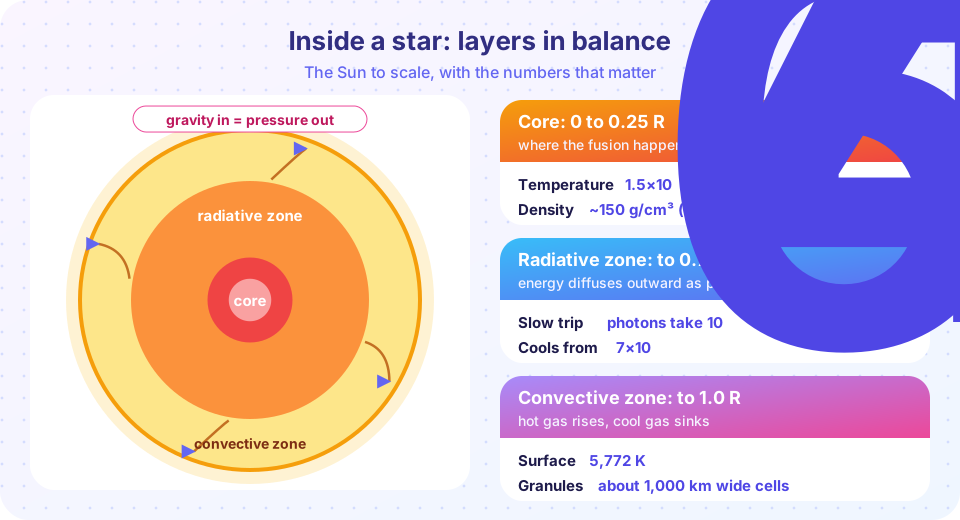
- Core (0 to about 0.25 R☉). Temperature 1.5×10⁷ K, density about 1.5×10⁵ kg/m³ (150 g/cm³). Over 99% of the Sun's fusion power is made here.
- Radiative zone (to about 0.7 R☉). The gas is so dense that a photon travels only a fraction of a centimetre before being absorbed and re-emitted in a random direction. This random walk takes the energy of one gamma-ray photon tens of thousands of years or longer to reach the next layer, as the photon degrades into many lower-energy ones.
- Convective zone (0.7 to 1.0 R☉). Here the gas is cooler and more opaque, and radiation can no longer carry the energy. Hot blobs rise, release heat near the surface and sink again. The tops of these cells are the bright "granules", about 1,000 km wide, seen on the Sun's surface.
- Photosphere. A thin layer a few hundred kilometres deep where the gas turns transparent. It emits the light we see, at an effective temperature of 5,772 K.
Convection takes over when the temperature falls too steeply with depth for radiation to carry the flux. Stars of about 1.3 solar masses or more have the reverse arrangement: a convective core (the fusion is so temperature-sensitive that the heat flux is huge) and a radiative envelope. Stars below about 0.35 solar masses are convective throughout.
In contrast to photons, neutrinos made in the core escape almost unimpeded, in a couple of seconds. Seeing the solar neutrinos is how we confirm directly that the Sun fuses hydrogen.
Polytropes
To model a whole star without a computer, assume pressure depends on density by P = K ρ^(1 + 1/n). Hydrostatic equilibrium becomes the dimensionless Lane-Emden equation, which can be solved numerically. For n = 3 (a good match to stars dominated by radiation pressure and to Eddington's "standard model") the star's central density is 54.2 times its mean density. The real Sun is more centrally concentrated: its central density is about 106 times the mean. Models like this show how realistic profiles come from the physics.
Common misconceptions
"The Sun is a ball of fire." There is no combustion; the Sun is a plasma, and energy comes from fusion.
"The Sun's surface is its hottest part." The surface is about 5,800 K; the core is 1.5×10⁷ K. The corona above the surface is hotter (millions of kelvin) for reasons connected to magnetic fields, but it is extremely thin.
"Energy from the core reaches the surface in minutes." The light we see now was made by fusion tens of thousands of years or more ago, though neutrinos escape quickly.
Try it
First, estimates for the Sun, a red dwarf and a massive star using the scalings above. The temperature estimate uses μ = 0.6; massive stars have different μ and radiation pressure, so treat results as rough.
Press Run (or Ctrl + Enter) to see the result here.
Program input · what you'd type while the program runs
Type the answers before you press Run, one per line. Each time the program reads a line (with input()), it gets the next line from this box.
Second, solve the Lane-Emden equation for n = 3 and compare the polytrope's density profile with the Sun's. The Sun's profile here is only a rough guide made of a few approximate values, not a solar model.
Press Run (or Ctrl + Enter) to see the result here.
Program input · what you'd type while the program runs
Type the answers before you press Run, one per line. Each time the program reads a line (with input()), it gets the next line from this box.
Check your understanding
Quick check · 5 questions
of 5 answered You scored / 5 · perfect!
-
1. Hydrostatic equilibrium means that at every depth
The pressure gradient balances the weight of the overlying gas. -
2. Why does a star act like a thermostat?
Because the star can expand or contract, any change in fusion rate is cancelled by a change in core temperature. -
3. Energy is carried by convection mainly in the
In the Sun the outer 30% by radius is convective. -
4. Estimating T_c ~ G M mu m_H / (k R) shows that central temperature depends on
The estimate depends only on M/R, which is why compact massive stars are hotter in the core. -
5. Neutrinos from the Sun escape in seconds while photons take much longer because
Photons are repeatedly absorbed and re-emitted; neutrinos almost never interact.
Summary
- Hydrostatic equilibrium,
dP/dr = −G m ρ / r², balances gravity and pressure and makes stars stable thermostats. - Dimensional estimates give
T_c ~ G M μ m_H / (k R), about 10⁷ K for the Sun. - The Sun has a fusion core, a radiative zone and a convective zone; neutrinos escape quickly, photons take tens of thousands of years or more.
- Polytropes turn the equations into simple models; real stars are more centrally concentrated.
Next: Nuclear fusion in stars
Track your progress
Create a free account to tick off lessons and pick up where you left off on any device.
of Astrophysics and Cosmology lessons completed