


















Lesson 20 of 48 · Compact Objects
Neutron stars and pulsars
Explore neutron stars: how a collapsing core reaches nuclear density, why pulsars flash like lighthouses, and how spin-down gives a pulsar's age and magnetic field.
In November 1967 a graduate student named Jocelyn Bell, working with a radio telescope near Cambridge, noticed a faint "scruff" on her chart recordings: a signal that repeated every 1.337 seconds, as regular as a clock. At first the team half-jokingly labelled it LGM-1, for "little green men". Within months, more such sources were found, and Thomas Gold proposed the right explanation: they are rotating neutron stars, objects predicted by Walter Baade and Fritz Zwicky back in 1934. This lesson shows how a star becomes a ball of neutrons, why it pulses, and how the pulses reveal its age and magnetism.
What you will learn
- How a neutron star forms and what its extreme density means.
- The lighthouse model of pulsars.
- How to compute a pulsar's characteristic age, magnetic field and spin-down power from its period and period derivative.
- What magnetars, millisecond pulsars and binary pulsars teach us.
Key terms
Neutron star: the collapsed core of a massive star, about 1.4 solar masses packed into a radius of roughly 12 km.
Pulsar: a rotating neutron star whose beam crosses our line of sight.
Period derivative (Pdot): how fast the spin period grows, in seconds per second.
Characteristic age: τ = P / (2 Pdot).
Magnetar: a neutron star with an ultra-strong field of 10¹⁴ to 10¹⁵ gauss.
Formation and structure
When the iron core of a massive star collapses (chapter 3), its electrons are squeezed into protons, forming neutrons and neutrinos (p + e⁻ → n + ν). The collapse halts when neutron degeneracy pressure and the short-range nuclear force resist further compression. The result has a mass of about 1.4 solar masses and a radius of about 12 km. The mean density is
ρ = M / (4/3 π R³) ≈ 2.8×10³⁰ kg / 7.2×10¹² m³ ≈ 4×10¹⁷ kg/m³
similar to the inside of an atomic nucleus. A teaspoon would weigh billions of tonnes. Surface gravity is about 10¹¹ times Earth's, and the escape velocity is about 60% of the speed of light.
A neutron star has a thin solid crust of nuclei and electrons, a liquid interior of mostly neutrons (probably superfluid) with some protons and electrons, and perhaps an exotic core whose composition is unknown. The maximum mass is set by the Tolman-Oppenheimer-Volkoff (TOV) limit, which depends on the unknown equation of state of dense matter and lies somewhere near 2.2 to 3 solar masses. The heaviest neutron stars measured so far are about 2.0 to 2.3 solar masses, which rules out many soft equations of state. Neutron stars are therefore natural laboratories for nuclear physics.
Why pulsars pulse
Because the core's angular momentum and magnetic flux are conserved during the collapse, neutron stars are born spinning rapidly and with very strong magnetic fields. A core of radius 3,000 km rotating once a day, shrunk to 12 km, would spin up by a factor of (3×10⁶/1.2×10⁴)² ≈ 6×10⁴, to a period of about 1.4 seconds. Magnetic fields strengthen the same way, reaching 10⁸ to 10¹⁵ gauss (typically 10¹² G, a trillion times Earth's).
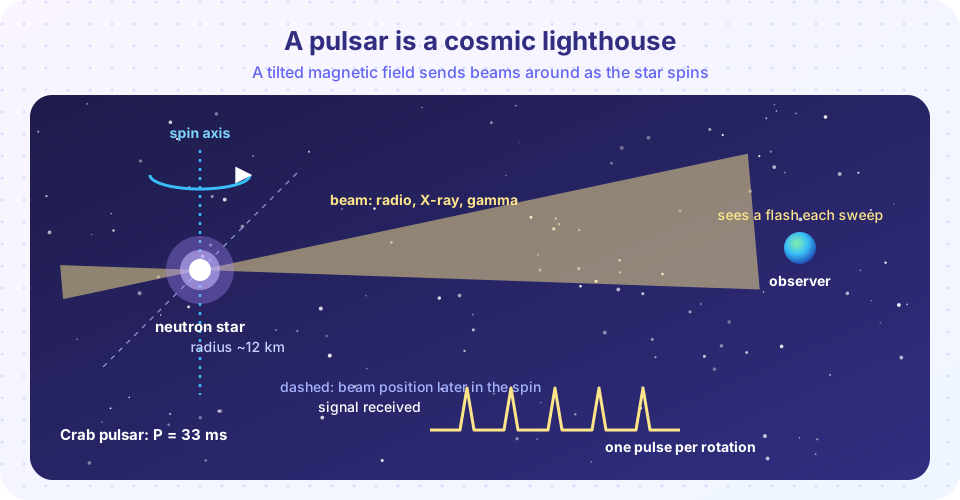
The rotating magnet accelerates charged particles that radiate beams of radio waves, and sometimes X-rays and gamma rays, from near the magnetic poles. The magnetic axis is tilted relative to the spin axis, so the beams sweep around like the light of a lighthouse. If a beam crosses Earth, we see a pulse once per rotation. The Crab pulsar, at the heart of the Crab Nebula (the remnant of the supernova recorded by Chinese astronomers in 1054), spins 30 times per second.
Spin-down: reading a pulsar's age and field
Pulsars lose rotational energy and slow down. The period grows by Pdot, tiny but measurable. If the braking comes from a rotating magnetic dipole, two useful quantities follow:
τ = P / (2 Pdot) (characteristic age)
B ≈ 3.2×10¹⁹ √(P Pdot) gauss (surface field strength, with P in seconds)
The rate at which rotational energy is lost, with a typical moment of inertia I = 10³⁸ kg m², is Ė = 4π² I Pdot / P³. For the Crab, P = 0.0335 s and Pdot = 4.2×10⁻¹³, so τ ≈ 1,260 years (the true age is about 970 years), B ≈ 3.8×10¹² G, and Ė ≈ 4×10³¹ W, about 100,000 times the luminosity of the Sun, powering the whole nebula.
The zoo
- Millisecond pulsars have periods of 1 to 10 ms (the fastest known spins 716 times per second). They are old neutron stars spun up by gas from a companion ("recycled"), and have weak fields (10⁸ G). Their clock-like regularity rivals atomic clocks, and arrays of them are used to search for gravitational waves.
- Magnetars have fields of 10¹⁴ to 10¹⁵ G, rotate slowly (2 to 12 s), and produce giant flares. Their magnetic energy powers their emission.
- Binary pulsars test gravity. In 1974 Russell Hulse and Joseph Taylor found a pulsar orbiting another neutron star. Over decades its orbit shrank at exactly the rate general relativity predicts for gravitational-wave emission, a result honoured by the 1993 Nobel Prize.
- Neutron-star mergers. In August 2017 the LIGO and Virgo detectors recorded gravitational waves from two merging neutron stars, followed within seconds by a gamma-ray burst and then a glowing "kilonova", observed by telescopes around the world.
Common misconceptions
"A pulsar blinks on and off." The beam is steady; it is the rotation that sweeps it across us. A neutron star whose beam misses Earth is invisible as a pulsar.
"Neutron stars are rare." The Galaxy probably holds hundreds of millions, but we detect only those that are pulsars pointed at us or have other signatures.
"The characteristic age is the true age." It assumes a specific braking law and a negligible initial spin period; the Crab shows it can be off by tens of percent.
Try it
First, compute the characteristic age, magnetic field and spin-down power of four well-known pulsars. The period values are from the literature; check how different they are.
Press Run (or Ctrl + Enter) to see the result here.
Program input · what you'd type while the program runs
Type the answers before you press Run, one per line. Each time the program reads a line (with input()), it gets the next line from this box.
Second, the pulsar P-Pdot diagram, with lines of constant magnetic field and characteristic age. A pulsar is born at the upper left, slows along a line of constant field, and fades below the "death line". The five points are literature values, not a full catalogue.
Press Run (or Ctrl + Enter) to see the result here.
Program input · what you'd type while the program runs
Type the answers before you press Run, one per line. Each time the program reads a line (with input()), it gets the next line from this box.
Check your understanding
Quick check · 5 questions
of 5 answered You scored / 5 · perfect!
-
1. Why do neutron stars spin so fast and have strong magnetic fields at birth?
Shrinking from thousands of km to 12 km spins the core up and concentrates the field lines. -
2. A pulsar's period is 0.5 s and its Pdot is 1e-15. Its characteristic age is
tau = P / (2 Pdot) = 0.5 / 2e-15 = 2.5e14 s = about 7.9 million years. -
3. What do we see in the lighthouse model when the beam sweeps across Earth?
The beam is fixed to the star, so a distant observer sees a flash each time it passes. -
4. Millisecond pulsars are thought to be old neutron stars that
Accretion transfers angular momentum, spinning an old neutron star up to periods of milliseconds. -
5. The Hulse-Taylor binary pulsar provided evidence for
Its orbit shrank at the rate predicted by general relativity for gravitational-wave emission.
Summary
- A neutron star packs about 1.4 solar masses into a radius of about 12 km, with a density of 4×10¹⁷ kg/m³, supported by neutron degeneracy and nuclear forces.
- Pulsars are spinning, magnetised neutron stars whose beams sweep past us like lighthouses.
- Spin-down gives age
P / (2 Pdot)and field3.2×10¹⁹ √(P Pdot)gauss. - Millisecond pulsars, magnetars and binary pulsars test nuclear physics, magnetism and general relativity.
Next: Black holes
Track your progress
Create a free account to tick off lessons and pick up where you left off on any device.
of Astrophysics and Cosmology lessons completed