


















Lesson 47 of 48 · Projects and Practice
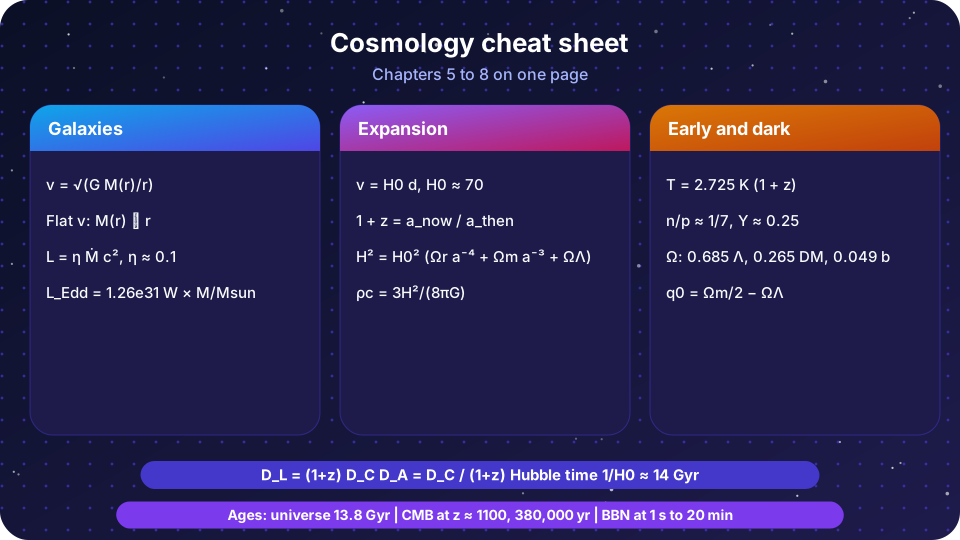
Cheat Sheet: Galaxies and Cosmology on One Page
A one-page recap of the key formulas, constants and numbers from galaxies, cosmological models, the early universe and the dark sector, plus a quick cosmology calculator in Python.
Here is everything from chapters 5 to 8 compressed onto one page: the formulas, the numbers to remember and a calculator that turns a redshift into the quantities you most often need. Print it, or keep it open while solving problems. Use it to recall, not to replace understanding: if a line looks unfamiliar, follow the lesson link in the table.
What you will learn
- The central formulas of each chapter and when to use them.
- The numbers worth memorizing, and the constants for calculations.
- How to compute many cosmological quantities for any redshift.
Key terms
Ω (omega): a density divided by the critical density.
H₀: the Hubble constant, about 70 km/s/Mpc.
a: the scale factor, 1/(1+z).
w: the equation-of-state ratio P/(ρc²).
ΛCDM: the standard cosmological model.
Formulas
| Topic | Formula | Notes |
|---|---|---|
| Orbital mass | M(r) = v² r / G |
Flat curve: M ∝ r |
| Elliptical type | n = 10 (1 − b/a) |
Type En |
| Accretion luminosity | L = η Ṁ c² |
η ≈ 0.1 |
| Eddington luminosity | L_Edd = 1.26×10³¹ W × (M/M☉) |
Radiation pressure = gravity |
| Schwarzschild radius | r_s = 2.95 km × (M/M☉) |
|
| Hubble law | v = H₀ d |
Small z |
| Redshift | 1 + z = a_now / a_emit |
Also T = 2.725 K (1+z) |
| Friedmann | H² = H₀² [Ω_r a⁻⁴ + Ω_m a⁻³ + Ω_k a⁻² + Ω_Λ] |
ΣΩ = 1 |
| Critical density | ρ_c = 3H² / (8πG) |
9.2×10⁻²⁷ kg/m³ at 70 |
| Acceleration | ä/a = −(4πG/3)(ρ + 3P/c²) |
w < −1/3 accelerates |
| Deceleration | q₀ = Ω_m/2 − Ω_Λ |
Flat, matter plus Λ |
| Comoving distance | D_C = c ∫ dz / H(z) |
|
| Luminosity distance | D_L = (1+z) D_C |
F = L / (4π D_L²) |
| Angular-diameter distance | D_A = D_C / (1+z) |
θ = s / D_A |
| Distance modulus | μ = m − M = 5 log₁₀(d/10 pc) |
|
| Neutron fraction | n/p = exp(−1.293 MeV / kT) |
Freeze-out about 1/6 |
| Helium fraction | Yₚ = 2x/(1 + x) |
x = n/p |
| Radiation era | T ≈ 1.5×10¹⁰ K / √(t/s) |
|
| Inflation | a ∝ e^(Ht), N ≥ 60 |
|
| Virial mass | M ≈ 3σ²R/G |
Clusters |
| Einstein radius | θ_E = √(4GM/c² · D_LS/(D_L D_S)) |
Numbers to remember
| Quantity | Value |
|---|---|
| Milky Way disk | about 30 kpc across; Sun at 8.2 kpc; 230 km/s; period 220 Myr |
| Sagittarius A* | about 4×10⁶ M☉ |
| Hubble constant | 67.4 (CMB) to 73.0 (local) km/s/Mpc; 1/H₀ ≈ 14 Gyr |
| Age of the universe | 13.8 Gyr |
| CMB | 2.725 K, z ≈ 1,100, 380,000 yr, 411 photons/cm³ |
| Helium | Yₚ ≈ 0.245; D/H ≈ 2.5×10⁻⁵ |
| Budget | Λ 0.685, dark matter 0.265, baryons 0.049 |
| Spectral index | nₛ ≈ 0.965 |
| Observable universe | radius 46 Gly (14 Gpc) |
| Constants | G = 6.674×10⁻¹¹ N m²/kg²; c = 2.998×10⁸ m/s; 1 M☉ = 1.989×10³⁰ kg; 1 pc = 3.086×10¹⁶ m |
A cosmology calculator
Press Run (or Ctrl + Enter) to see the result here.
Program input · what you'd type while the program runs
Type the answers before you press Run, one per line. Each time the program reads a line (with input()), it gets the next line from this box.
Press Run (or Ctrl + Enter) to see the console output here.
No output.
Common misconceptions
"A cheat sheet replaces understanding." The formulas hold only under stated conditions (for example v = H₀ d only for small z).
"All distances in cosmology are the same." Comoving, luminosity and angular-diameter distances differ by powers of 1 + z.
"The numbers are exact." Many (H₀, Ω, ages) have uncertainties and depend on the data set used.
Check your understanding
Quick check · 4 questions
of 4 answered You scored / 4 · perfect!
-
1. Which relation gives the mass inside an orbit?
From v^2 / r = G M / r^2. -
2. What is the CMB temperature at z = 9?
T = 2.725 x 10 = 27.25 K. -
3. Which pair of numbers gives the primordial helium mass fraction and the neutron-proton ratio used for it?
Y = 2x/(1+x) with x = 1/7 gives 0.25. -
4. Which is the correct pairing for the angular-diameter distance?
D_A = D_C / (1+z).
Summary
- The key formulas:
M = v²r/G,L = ηṀc²,v = H₀d, the Friedmann equation,ρ_c = 3H²/(8πG),D_L = (1+z)D_C,Y = 2x/(1+x). - Numbers:
H₀ ≈ 70, age 13.8 Gyr, CMB 2.725 K atz ≈ 1,100, Ω budget 0.685/0.265/0.049. - A short script can turn any redshift into distances, temperature and ages.
Next: Further study
Track your progress
Create a free account to tick off lessons and pick up where you left off on any device.
of Astrophysics and Cosmology lessons completed