


















Lesson 18 of 48 · Compact Objects
Chapter 4 overview: compact objects
An overview of chapter 4: how the dead cores of stars become white dwarfs, neutron stars or black holes, what holds them up, and how compactness measures their gravity.
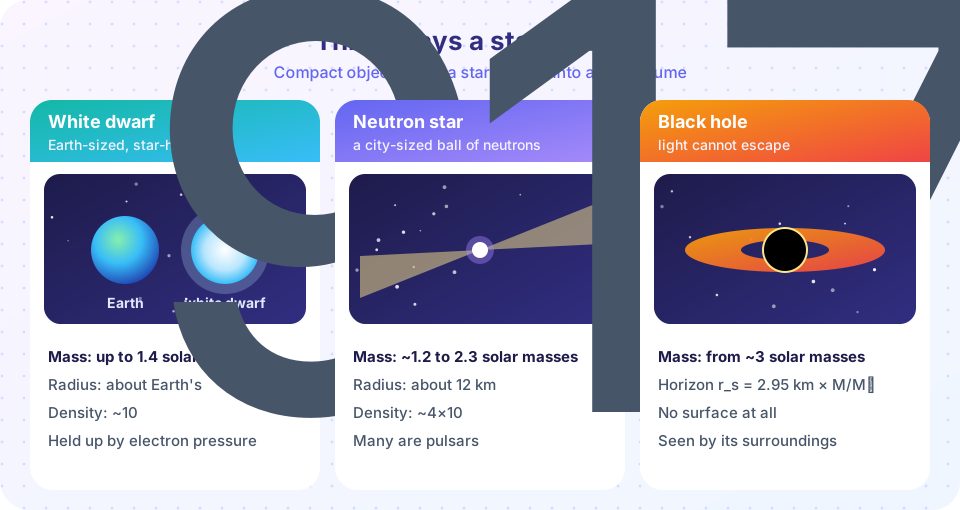
When a star runs out of fuel, thermal pressure can no longer hold it up, and gravity wins. What stops the collapse depends on the mass left behind. A core of about the Sun's mass is halted when electrons refuse to be squeezed any closer: a white dwarf. A heavier core is halted only when neutrons are packed shoulder to shoulder: a neutron star. If even that fails, nothing known stops the collapse, and the result is a black hole. These three objects are the subject of this chapter, and they are the places where gravity, quantum mechanics and relativity meet.
What you will learn
- What halts the collapse in each kind of remnant.
- How to measure how "compact" an object is.
- What each lesson of this chapter covers.
Key terms
Compact object: a stellar remnant much smaller than a normal star of the same mass.
Degeneracy pressure: pressure from the quantum rule that no two identical fermions (electrons, neutrons) can occupy the same state.
Compactness: the ratio 2GM / (R c²), which is 1 for a black hole.
Escape velocity: v = √(2GM/R); at the horizon of a black hole it equals c.
The big picture
White dwarf
Neutron star
Black hole
How we know
The roadmap
- White dwarfs: electron degeneracy, the Chandrasekhar limit and Type Ia supernovae.
- Neutron stars and pulsars: extreme density, magnetic fields, spin-down and what pulsars teach us.
- Black holes: the Schwarzschild radius, how we find them and how they are imaged.
- Chapter 4 review: cheat sheet and quiz.
Compactness: how strong is the gravity?
Compare each object's gravity through the dimensionless ratio 2GM / (R c²), the Schwarzschild radius divided by the actual radius. For the Sun it is 4×10⁻⁶. For a typical white dwarf it is a few times 10⁻⁴. For a neutron star it is about 0.3, so Newtonian physics is no longer good enough. A black hole has a compactness of 1 by definition, so its escape velocity equals the speed of light. The next TryIt computes it.
Common misconceptions
"A black hole is a hole in space." It is a region of spacetime bounded by a horizon, with a real mass that you can orbit just like any other mass.
"A neutron star is a giant atomic nucleus." It resembles one in density, but is held together by gravity, not the strong force, and has a crust, a superfluid interior and a magnetic field.
"White dwarfs are tiny stars still burning." They have no fusion; they only cool.
Try it
First, a table of compactness and escape velocity for the Sun and the three remnants. The masses and radii are typical values.
Press Run (or Ctrl + Enter) to see the console output here.
No output.
Second, a mass-radius map of cosmic objects. The black-hole line marks the radius R = 2GM/c²: nothing can be smaller than its own horizon and still be seen from outside.
Press Run (or Ctrl + Enter) to see the result here.
Program input · what you'd type while the program runs
Type the answers before you press Run, one per line. Each time the program reads a line (with input()), it gets the next line from this box.
Check your understanding
Quick check · 4 questions
of 4 answered You scored / 4 · perfect!
-
1. What supports a white dwarf against gravity?
Fusion has stopped; electrons crowded into a small volume resist further squeezing by the Pauli exclusion principle. -
2. Which of these is the most compact?
A neutron star has 2GM/(Rc^2) of about 0.3, far larger than a white dwarf's few times 10^-4 or the Sun's 4 x 10^-6. -
3. The escape velocity at a black hole's event horizon equals
That is the definition of the horizon: even light cannot escape from inside it. -
4. About how large is a typical neutron star?
Observations give radii of about 10 to 13 km.
Summary
- Stellar cores end as white dwarfs (electron pressure), neutron stars (neutron pressure) or black holes (nothing stops the collapse).
- Compactness
2GM/(Rc²)ranges from 10⁻⁶ for the Sun to 1 for a black hole. - Each lesson studies one remnant and how astronomers detect it.
- Gravity here is strong enough that general relativity is needed.
Next: White dwarfs
Track your progress
Create a free account to tick off lessons and pick up where you left off on any device.
of Astrophysics and Cosmology lessons completed