


















Lesson 21 of 48 · Compact Objects
Black holes: horizons, orbits and how we find them
Learn what a black hole is: the Schwarzschild radius, event horizon, photon sphere and innermost stable orbit, Hawking temperature, and how X-rays, gravitational waves and imaging reveal them.
A black hole is the answer to a question: what if you squeeze a mass into so small a region that the escape velocity exceeds the speed of light? The idea goes back to John Michell in 1783, but its modern form arrived in 1916, a few months after Einstein published general relativity, when Karl Schwarzschild solved his equations for the empty space around a point mass. For decades black holes were regarded as mathematical curiosities. Today we have weighed them with orbits, heard them collide through gravitational waves, and photographed the glowing gas around two of them.
What you will learn
- The Schwarzschild radius and what happens at the event horizon.
- The photon sphere and the innermost stable circular orbit (ISCO).
- How the sizes, densities and tidal forces of stellar and supermassive black holes differ.
- Hawking radiation and the temperature of black holes.
- How we find black holes: X-ray binaries, stellar orbits, gravitational waves and imaging.
Key terms
Schwarzschild radius (r_s): 2GM / c², the radius of the event horizon of a non-rotating black hole.
Event horizon: the one-way boundary beyond which nothing, not even light, can reach a distant observer.
Accretion disk: a hot, swirling disk of gas spiralling onto a compact object.
ISCO: the innermost stable circular orbit, at 3 r_s for a non-spinning black hole.
Singularity: the point where general relativity predicts infinite density, the limit of the theory's validity.
The Schwarzschild radius
Set the Newtonian escape velocity equal to c: √(2GM/r) = c, so r_s = 2GM/c². This simple argument happens to give the right answer from general relativity as well. Numerically, r_s = 2.95 km × (M / M☉). The Sun would become a black hole if squeezed to a radius of 2.95 km, and Earth if squeezed to 9 mm.
The surface at r_s is the event horizon. It is not a material surface. A freely falling astronaut crossing it would notice nothing special locally, but the future then points only inward: every path leads to smaller r, as inevitably as time moves forward. A distant observer sees the infalling object slow down and redden, never quite reaching the horizon, because of gravitational time dilation and redshift. Inside, general relativity predicts a singularity, where the theory breaks down and a quantum theory of gravity would be needed.
A black hole is remarkably simple: the "no-hair" results say that it is fully described by its mass, spin and charge. A rotating (Kerr) black hole drags spacetime around with it, and its horizon is smaller, with the ISCO shrinking from 3 r_s to as little as r_s / 2 for a maximally spinning hole orbited in the direction of the spin.
Orbits near a black hole
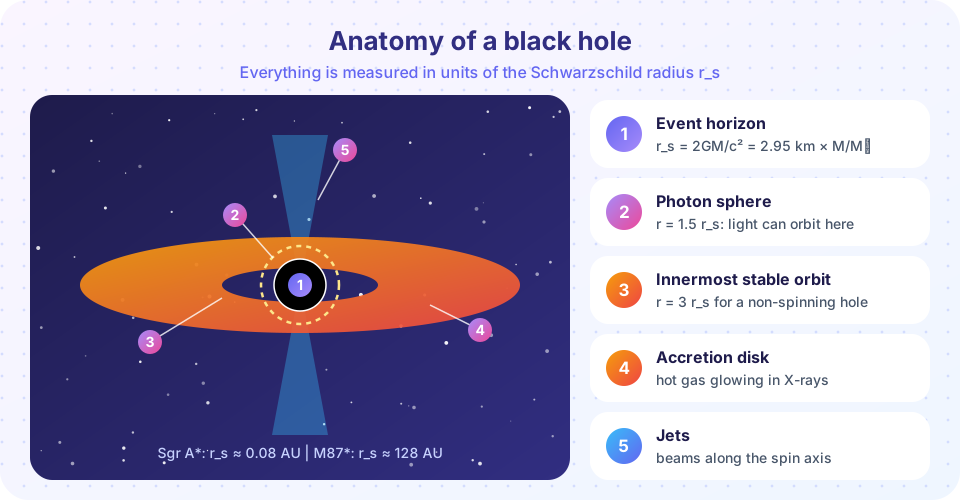
Newtonian orbits can have any radius. In general relativity, two special radii appear around a non-rotating black hole:
- Photon sphere, at
1.5 r_s: light can orbit there, in an unstable circular orbit. It sets the size of the shadow seen in images. - ISCO, at
3 r_s(that is,6GM/c²): inside it no stable circular orbits exist, and gas spirals rapidly inward. Matter in an accretion disk heats to millions of kelvin by friction and glows brightly in X-rays; this is why accreting black holes are among the most luminous objects in the universe, converting up to about 6% (non-spinning) or 30% or more (spinning) of the infalling rest mass into radiation, far better than the 0.7% from hydrogen fusion.
Some of the infalling gas is channelled by magnetic fields into narrow jets that can extend for thousands of light-years.
Stellar and supermassive black holes
The size of the horizon scales with mass, but the density does not:
ρ̄ = M / (4/3 π r_s³) ∝ 1 / M²
A 10-solar-mass black hole has a mean density of about 2×10¹⁷ kg/m³, close to nuclear matter. A black hole of 4 million solar masses has about 10⁶ kg/m³, roughly a thousand times the density of water. One with 6.5 billion solar masses, like the one in M87, has a mean density below that of air.
Tidal forces matter too. The stretching across a 2 m tall object at the horizon is about c² L / r_s². For a stellar black hole it is around 10⁷ times Earth's gravity, fatal long before you reach the horizon ("spaghettification"). For the 4-million-solar-mass black hole in the centre of the Milky Way, it is about a thousandth of a metre per second squared: you would cross the horizon unharmed.
Hawking radiation
In 1974 Stephen Hawking showed that quantum effects make a black hole radiate like a blackbody with temperature
T = ħ c³ / (8π G M k) = 6.2×10⁻⁸ K × (M☉ / M)
For a stellar-mass hole this is far colder than the 2.7 K cosmic microwave background, so such black holes absorb more than they emit and are growing. The effect has never been observed, but it hints at a deep link between gravity, quantum theory and thermodynamics.
How we find black holes
- X-ray binaries. Gas from a companion forms a hot disk that shines in X-rays. When the unseen compact object's mass, found from the companion's orbit with Kepler's third law, exceeds the neutron-star limit of about 3 solar masses, it is a black hole. Cygnus X-1, discovered in 1964 and identified as a black hole in the early 1970s, is the classic example, with a mass of about 20 solar masses.
- Stellar orbits. For more than two decades, teams led by Reinhard Genzel and Andrea Ghez tracked stars orbiting the invisible Sagittarius A* at the Galactic centre. The star S2 completes an orbit in 16 years, implying 4.2 million solar masses packed inside a region smaller than the Solar System. They shared the 2020 Nobel Prize in Physics with Roger Penrose.
- Gravitational waves. On 14 September 2015, LIGO detected ripples from two black holes of about 36 and 29 solar masses merging into one of about 62, radiating around 3 solar masses of energy in a fraction of a second (GW150914). Dozens of such mergers have been seen since.
- Imaging. The Event Horizon Telescope linked radio dishes around the world into an Earth-sized interferometer. In April 2019 it published the glowing ring and central shadow of M87's black hole (about 6.5 billion solar masses), and in 2022 the corresponding image of Sagittarius A*.
Common misconceptions
"Black holes suck everything in." Far away, a black hole attracts like any object of the same mass. If the Sun became a black hole of the same mass, the planets would keep orbiting.
"A black hole is a hole." It is a region of spacetime, with a mass that can be measured.
"We have seen the inside." Nothing inside can be observed. We see the effects of the surroundings, outside the horizon.
Try it
First, compare four black holes: a 10-solar-mass one, the 62-solar-mass remnant of GW150914, Sagittarius A* and M87*. The tidal acceleration is across 2 metres at the horizon.
Press Run (or Ctrl + Enter) to see the result here.
Program input · what you'd type while the program runs
Type the answers before you press Run, one per line. Each time the program reads a line (with input()), it gets the next line from this box.
Second, weigh the Galactic-centre black hole with Kepler's third law, as Genzel and Ghez did, using published orbital values for the star S2. Then look at how the escape velocity climbs toward the speed of light.
Press Run (or Ctrl + Enter) to see the result here.
Program input · what you'd type while the program runs
Type the answers before you press Run, one per line. Each time the program reads a line (with input()), it gets the next line from this box.
Check your understanding
Quick check · 5 questions
of 5 answered You scored / 5 · perfect!
-
1. The Schwarzschild radius of a 10-solar-mass black hole is about
r_s = 2.95 km per solar mass, so 10 solar masses gives 29.5 km. -
2. Which is true of the density of black holes?
r_s grows with M, so the mean density M / r_s^3 falls as 1 / M^2. -
3. At the photon sphere (1.5 r_s) light can
The photon sphere is the radius at which light can circle the hole; it sets the apparent size of the shadow. -
4. We know Sagittarius A* is a black hole of about 4 million solar masses because
S2's 16-year orbit gives the mass inside a region smaller than the Solar System. -
5. The Sun were replaced by a black hole of the same mass. Earth would
Gravity far from a mass depends only on the mass, not on how compact it is, apart from lost sunlight.
Summary
- A black hole has an event horizon at
r_s = 2GM/c² = 2.95 km × M/M☉; the photon sphere is at1.5 r_sand the ISCO at3 r_sfor a non-spinning hole. - Mean density falls as
1/M²: supermassive black holes are not dense, and their horizons are gentle; stellar ones are lethal. - Hawking radiation gives a temperature
6×10⁻⁸ K × (M☉/M), far below the CMB for any known black hole. - We find black holes from X-ray binaries, orbiting stars, gravitational waves and images of their glowing surroundings.
Next: Chapter 4 review
Track your progress
Create a free account to tick off lessons and pick up where you left off on any device.
of Astrophysics and Cosmology lessons completed