


















Lesson 10 of 48 · Observational Tools
The cosmic distance ladder
Follow the rungs of the distance ladder from radar and parallax to Cepheid variables, Type Ia supernovae and Hubble's law, with worked calculations for each step.
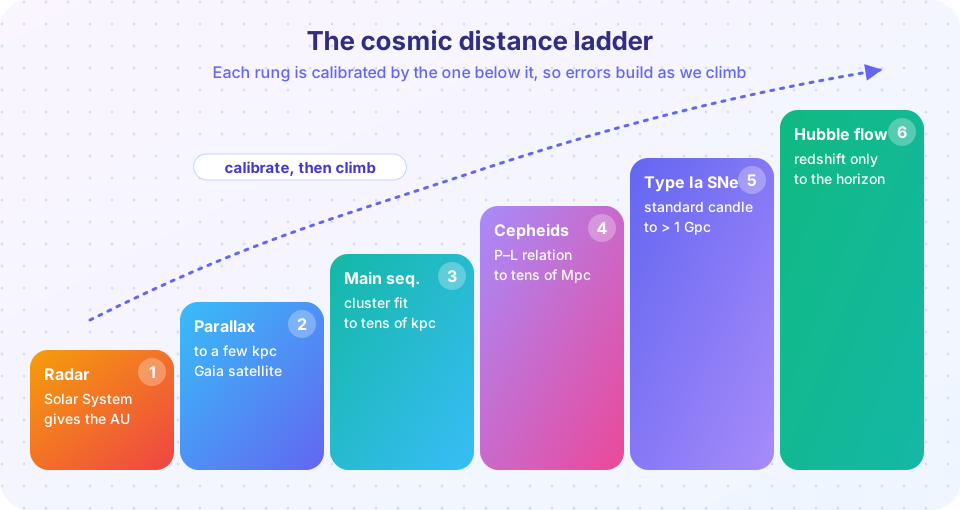
No single method measures distances from the Moon to the edge of the universe. Instead astronomers use a ladder: each method works over a limited range, overlaps with the next, and is calibrated by the one below. Radar fixes the astronomical unit, parallax uses the AU to measure nearby stars, nearby stars calibrate pulsating stars called Cepheids, Cepheids calibrate exploding white dwarfs, and those reach the distant galaxies that map the expansion of the universe. The weak point of any ladder is the error that accumulates from rung to rung.
What you will learn
- How each rung works and what range it covers.
- How to compute distances from parallax, from a Cepheid's period and from a supernova's peak brightness.
- What a standard candle is and why Type Ia supernovae are so useful.
- How Hubble's law
v = H₀ dturns redshifts into distances.
Key terms
Standard candle: an object whose true luminosity is known, so its apparent brightness gives its distance.
Cepheid variable: a pulsating supergiant whose pulsation period is tied to its luminosity.
Type Ia supernova: the thermonuclear explosion of a white dwarf, with a nearly uniform peak luminosity.
Hubble constant (H₀): the proportionality between recession velocity and distance, about 70 km/s per megaparsec.
Peculiar velocity: a galaxy's motion relative to the smooth expansion.
Rung 1: radar and the AU
Bouncing radar off Venus gives the distance in light-travel time, with d = c t / 2. Combined with Kepler's third law, which gives relative orbit sizes, this fixes the length of the astronomical unit in metres. Today spacecraft ranging gives it exactly: 1 AU = 149,597,870,700 m.
Rung 2: trigonometric parallax
As Earth orbits, a nearby star shifts against the background by p arcseconds, and d = 1/p parsecs. Friedrich Bessel made the first successful measurement in 1838, for 61 Cygni, a parallax of about 0.3″, a distance of around 11 light-years. The Hipparcos satellite (1989–1993) measured about 118,000 stars to roughly a thousandth of an arcsecond. Its successor Gaia (launched 2013) measures positions of well over a billion stars with parallaxes accurate to a few tens of microarcseconds, which makes good distances possible across much of the Milky Way. Parallax is geometry, not physics, and it is the anchor of the whole ladder.
Rung 3: main-sequence fitting and other methods
Many stars in a cluster lie at the same distance. If you know the Hertzsprung-Russell diagram of nearby stars from parallax (chapter 3), you can slide a cluster's main sequence up or down until it fits; the shift is the distance modulus. Pulsating RR Lyrae stars, with a nearly constant luminosity, and the tip of the red giant branch work the same way for older stellar populations.
Rung 4: Cepheids
In 1912 Henrietta Leavitt noticed that brighter Cepheids in the Small Magellanic Cloud have longer periods. All of them are at roughly the same distance, so apparent brightness ordered true luminosity. Calibrated with parallax, the period-luminosity relation is approximately
M_V ≈ −2.43 (log₁₀ P − 1) − 4.05 (P in days)
A Cepheid with a 30-day period has M_V ≈ −5.2, about 10,000 times the Sun's luminosity in visible light. If it appears at m = 22, the distance modulus is m − M = 27.2, so d = 10^((27.2 + 5)/5) = 2.7×10⁶ pc, about 2.7 Mpc. Edwin Hubble used Cepheids in 1923–24 to show that Andromeda lies far outside the Milky Way, which settled the "Great Debate" over whether spiral nebulae were separate galaxies. The Hubble and James Webb telescopes detect Cepheids out to some tens of megaparsecs.
Rung 5: Type Ia supernovae
When a white dwarf in a binary gains enough mass to approach the Chandrasekhar limit (chapter 4), it explodes. The explosions reach a peak absolute magnitude of about M ≈ −19.3 with a spread that a correction based on how fast the light fades (the Phillips relation) reduces to about 0.1–0.15 mag. They are bright enough to be seen across billions of light-years. A supernova that peaks at m = 19.3 has m − M = 38.6, so d = 10^(43.6/5) = 5.3×10⁸ pc, about 530 Mpc. Calibration relies on Cepheids in nearby galaxies where a supernova has been seen.
Rung 6: the Hubble flow
Edwin Hubble, building on Vesto Slipher's measurements of galaxy redshifts and Georges Lemaître's earlier theoretical work, found that galaxies recede faster the farther they are:
v = H₀ d
With H₀ ≈ 70 km/s/Mpc, a galaxy at 100 Mpc recedes at about 7,000 km/s, and at low redshift v ≈ c z, so d ≈ c z / H₀. Beyond about 50–100 Mpc, random "peculiar" velocities of a few hundred km/s become small compared with the expansion, so redshift gives a good distance. Careful measurements give values of H₀ between about 67 and 73 km/s/Mpc depending on the method, a disagreement known as the Hubble tension that chapter 8 returns to.
Common misconceptions
"Astronomers measure the distance to galaxies directly." Beyond a few kiloparsecs every distance relies on a calibrated chain of methods.
"A redshift is a distance." It is a distance only after you assume a cosmological model and a value of H₀; nearby galaxies' peculiar velocities spoil it.
"Standard candles are all identical." They are standardisable: a correction relating peak brightness to light-curve shape or period is needed.
Try it
First, a calculator for three rungs: parallax, a Cepheid and a supernova.
Press Run (or Ctrl + Enter) to see the result here.
Program input · what you'd type while the program runs
Type the answers before you press Run, one per line. Each time the program reads a line (with input()), it gets the next line from this box.
Second, a Hubble diagram for simulated data. We generate fake supernovae from H₀ = 70, add the typical scatter of 0.15 magnitudes, and fit a line to recover H₀. This is a simulation, not real data.
Press Run (or Ctrl + Enter) to see the result here.
Program input · what you'd type while the program runs
Type the answers before you press Run, one per line. Each time the program reads a line (with input()), it gets the next line from this box.
Check your understanding
Quick check · 5 questions
of 5 answered You scored / 5 · perfect!
-
1. Which method is purely geometric and anchors the distance ladder?
Parallax uses only geometry (the Earth's orbit baseline), not any assumption about a star's luminosity. -
2. Henrietta Leavitt discovered that brighter Cepheids have
The period-luminosity relation: long-period Cepheids are more luminous. -
3. A standard candle works because
With M known, the distance modulus m - M gives d. -
4. With H0 = 70 km/s/Mpc, a galaxy at 200 Mpc recedes at about
v = H0 d = 70 x 200 = 14,000 km/s. -
5. Why is redshift a poor distance indicator for very nearby galaxies?
At small distances the expansion velocity is small, so random motions of hundreds of km/s dominate.
Summary
- The distance ladder chains methods: radar → parallax → cluster fitting → Cepheids → Type Ia supernovae → Hubble flow.
- Standard candles turn apparent brightness into distance through
m − M = 5 log₁₀ d − 5. - Hubble's law
v = H₀ d(about 70 km/s/Mpc) gives distances from redshift for distant galaxies. - Errors accumulate up the ladder, which is why the value of
H₀is still debated.
Next: Chapter 2 review
Track your progress
Create a free account to tick off lessons and pick up where you left off on any device.
of Astrophysics and Cosmology lessons completed