


















Lesson 38 of 48 · The Early Universe
Chapter 7 review: The early universe
Review chapter 7 with a one-picture summary, a recap table, practice calculations on temperature, helium and the CMB, and a ten-question quiz.
Chapter 7 followed the universe from a fraction of a second to 380,000 years. Three pillars stood out: the light-element abundances from nucleosynthesis, the cosmic microwave background, and the idea of inflation that sets the stage. Use the table, the practice code and the quiz to check that you can connect them.
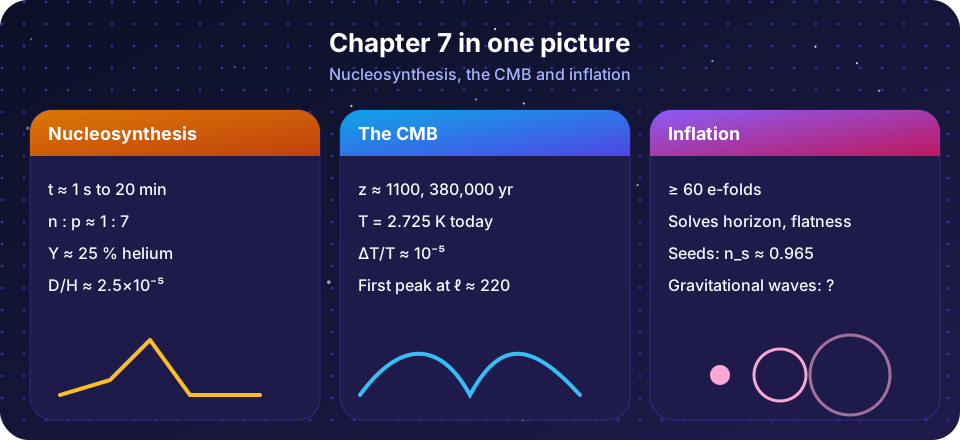
Recap table
| Idea | Key statement | Lesson |
|---|---|---|
| Temperature | T ≈ 1.5×10¹⁰ K/√(t/s); T = 2.725 K (1 + z) |
Overview |
| Freeze-out | n/p = exp(−1.293 MeV/kT); about 1/6 at 1 s |
Nucleosynthesis |
| Helium | Yₚ = 2x/(1+x) ≈ 0.25, D/H ≈ 2.5×10⁻⁵ |
Nucleosynthesis |
| Baryon density | Ω_b h² ≈ 0.022 from D/H and from the CMB |
Nucleosynthesis |
| CMB | Blackbody at 2.725 K, z ≈ 1,100, 411 photons/cm³ |
The CMB |
| Acoustic peaks | First peak ℓ ≈ 220: flat universe |
The CMB |
| Inflation | a ∝ e^(Ht), N ≥ 60; solves horizon, flatness |
Inflation |
| Seeds | nₛ ≈ 0.965; B-modes not yet seen |
Inflation |
Try it
Press Run (or Ctrl + Enter) to see the result here.
Program input · what you'd type while the program runs
Type the answers before you press Run, one per line. Each time the program reads a line (with input()), it gets the next line from this box.
Press Run (or Ctrl + Enter) to see the console output here.
No output.
Check your understanding
Quick check · 10 questions
of 10 answered You scored / 10 · perfect!
-
1. At t = 100 s, roughly what is the temperature of the universe?
T = 1.5×10^10 K / sqrt(100) = 1.5×10^9 K. -
2. Why is the primordial helium fraction about 25 percent by mass?
Y = 2x/(1+x) with x = 1/7 gives 0.25. -
3. If the neutron lifetime were shorter, the helium fraction would be:
Faster neutron decay leaves fewer neutrons by the time deuterium survives. -
4. What was the temperature at recombination?
Atoms formed at about 3,000 K, at z of about 1,100. -
5. The CMB blackbody peaks at roughly:
58.8 GHz/K x 2.725 K = 160 GHz. -
6. The CMB dipole is caused by:
It is a Doppler effect from a velocity of about 370 km/s. -
7. The first acoustic peak near 1 degree indicates that space is:
The sound horizon appears at the angle expected in a flat universe. -
8. Inflation after 60 e-folds enlarges lengths by about:
e^60 is about 10^26. -
9. Which problem is NOT solved by inflation?
The lithium problem is a nucleosynthesis issue and unrelated to inflation. -
10. What would a detection of primordial B-mode polarization support?
B-modes would be produced by primordial gravitational waves from inflation.
Summary
- The universe cooled from enormous temperatures;
T ≈ 1.5×10¹⁰ K/√tandT ∝ 1/a. - Nucleosynthesis made about 25 percent helium and traces of D, He-3 and Li-7; it fixes the baryon density.
- The CMB is a 2.725 K blackbody released at
z ≈ 1,100with ripples whose first peak shows flat space. - Inflation explains uniformity, flatness and seeds, and awaits tests.
Next: Chapter 8 overview: Dark matter, dark energy and frontiers
Track your progress
Create a free account to tick off lessons and pick up where you left off on any device.
of Astrophysics and Cosmology lessons completed