


















Lesson 29 of 48 · Cosmological Models
Chapter 6 overview: Cosmological models
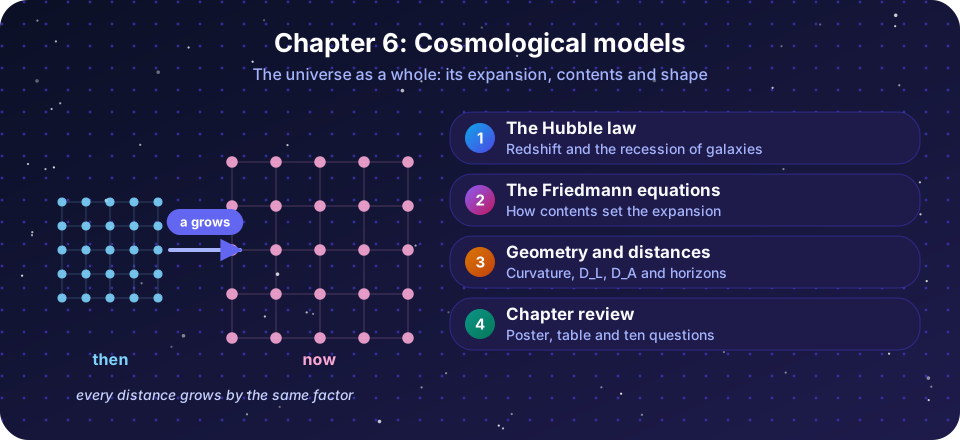
A map of chapter 6: the cosmological principle, the expanding universe, the Friedmann equations and the geometry of space, with a first estimate of the age of the universe.
Chapter 5 treated galaxies as objects. Chapter 6 treats the whole universe as a single physical system. This sounds absurd: how can you write equations for everything? The answer is that on large enough scales the universe is surprisingly simple. Average over regions a few hundred megaparsecs across and every region looks the same. That simplicity lets Einstein's general relativity be reduced to a pair of short equations, which predict how the universe expands.
In this overview you will meet the assumptions behind cosmology, the evidence that space is expanding, and the questions that the next three lessons answer.
What you will learn
- The cosmological principle and why it is a good first assumption.
- The basic observational facts that a cosmological model must explain.
- The meaning of the scale factor, redshift and the age of the universe.
Key terms
Cosmological principle: on large scales the universe is homogeneous (the same everywhere) and isotropic (the same in every direction).
Scale factor a(t): the factor by which distances between distant galaxies have grown; a = 1 today.
Redshift z: the fractional stretch of light's wavelength, 1 + z = a_now / a_then.
Big Bang model: the description of the universe as expanding from a hot, dense early state.
Hubble time: 1/H₀, a rough age of the universe.
The assumptions
The cosmological principle is not obvious. Locally the universe is very lumpy: planets, stars, galaxies and clusters. But when you average over cubes about 100 to 300 Mpc across, the galaxy counts become the same in all places. The cosmic microwave background (next chapter) is the same temperature in every direction to about one part in 100,000. These support isotropy, and since we do not occupy a special place (the Copernican idea), isotropy for us implies isotropy for every observer, hence homogeneity.
With these assumptions, the geometry of spacetime can have only a few forms. The Friedmann–Lemaître–Robertson–Walker (FLRW) metric describes them with one function of time, the scale factor a(t), and one constant, the curvature k.
Observations to explain
A cosmological model must account for at least these facts.
- The night sky is dark. In an infinite, eternal, static universe filled with stars every line of sight would end on a star's surface and the sky would glow like a star (Olbers' paradox). A universe with a finite age and expansion fixes this.
- Galaxies recede. Spectra of distant galaxies are redshifted in proportion to their distances (Slipher, Lemaître, Hubble, 1912 to 1929).
- A relic glow. In 1965 Arno Penzias and Robert Wilson found microwave radiation filling the sky at about 2.7 K, predicted as a relic of a hot early universe.
- Light element abundances. About 25 percent of ordinary matter by mass is helium, and there are traces of deuterium and lithium, all of which match early-universe nuclear reactions.
- Structure. Galaxies and clusters form a cosmic web that grew from tiny early irregularities.
A first estimate of age
If galaxies move apart at speeds v = H₀ d, then running time backwards, a galaxy at distance d was at the same place as us a time t = d / v = 1/H₀ ago. This Hubble time is a rough age. With H₀ = 70 km/s/Mpc it is about 14 billion years.
Press Run (or Ctrl + Enter) to see the result here.
Program input · what you'd type while the program runs
Type the answers before you press Run, one per line. Each time the program reads a line (with input()), it gets the next line from this box.
What the four lessons do
Chapter 6 in four steps
The big assumptions
True when averaged over 100 Mpc or more.
Three numbers
| Lesson | Question it answers |
|---|---|
| The Hubble law and the expanding universe | How do we know space expands, and how fast? |
| The Friedmann equations | How do density and curvature set the expansion? |
| Geometry and cosmic distances | What shape is space and how do we measure distances? |
| Chapter review | A recap and a ten-question quiz. |
Common misconceptions
"The Big Bang was an explosion at a point in space." It happened everywhere. Space itself expanded, and there is no center of the expansion.
"Galaxies move through space away from us." Mostly space between them stretches. Their motion through space (peculiar velocity) is small.
"The universe is expanding into something." The model needs no outside; expansion means that distances between galaxies increase.
Try it
Press Run (or Ctrl + Enter) to see the console output here.
No output.
Check your understanding
Quick check · 4 questions
of 4 answered You scored / 4 · perfect!
-
1. What does the cosmological principle state?
The principle is homogeneity plus isotropy on large scales; on small scales matter is clumped. -
2. If light from a galaxy has z = 1, how large was the universe then compared with today?
1 + z = a_now / a_then = 2, so a_then = 0.5. -
3. A Hubble constant of 70 km/s/Mpc gives a Hubble time of about:
1/H0 = 3.086×10^19 km / 70 km/s is about 4.4×10^17 s, or 14 billion years. -
4. Which observation did Penzias and Wilson make in 1965?
They found a uniform microwave glow at about 2.7 K filling the sky.
Summary
- Cosmology rests on the cosmological principle: homogeneity and isotropy on large scales.
- A model must explain the dark night sky, recession of galaxies, the cosmic microwave background, light elements and cosmic structure.
- The scale factor
a(t)and redshift are linked by1 + z = a_now / a_then. - The Hubble time
1/H₀is about 14 billion years.
Track your progress
Create a free account to tick off lessons and pick up where you left off on any device.
of Astrophysics and Cosmology lessons completed