


















Lesson 11 of 48 · Observational Tools
Chapter 2 review: telescopes, spectra and distances
Review chapter 2 with a one-page cheat sheet, a recap table, a signal-to-noise planner and a ten-question quiz on telescopes, spectra, Doppler shifts and distances.
Chapter 2 showed how information gets from a star to you. Telescopes collect and focus the light; the diffraction limit and the atmosphere set how sharp the picture can be; detectors count the photons; spectrographs sort them by wavelength; and the distance ladder converts brightness into distance. Together they turn "a faint dot" into a temperature, a composition, a speed and a place in space.
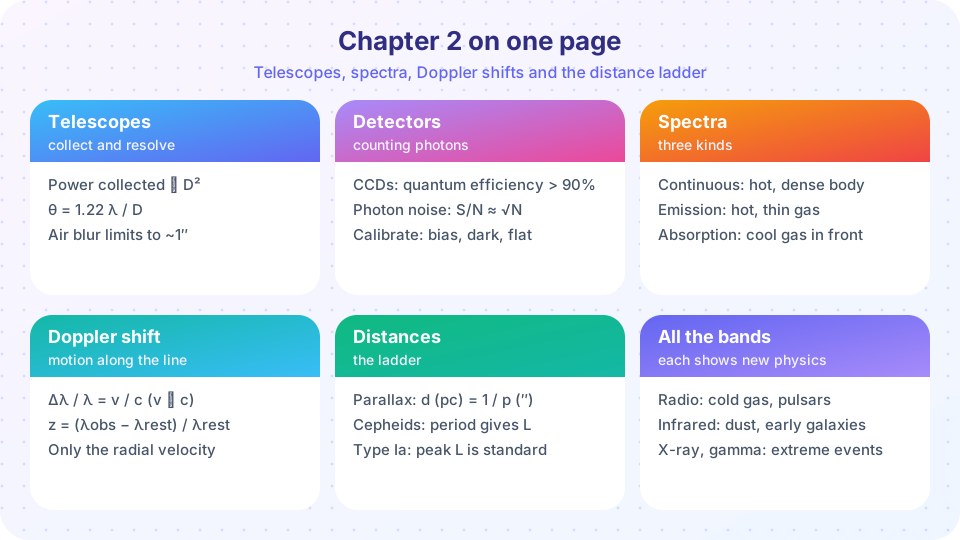
Recap table
| Lesson | Big idea | Formula to remember |
|---|---|---|
| Telescopes and resolution | Aperture sets light gathering and sharpness | θ = 1.22 λ / D, power ∝ D² |
| Spectroscopy and the Doppler shift | Lines reveal composition, temperature, motion | Δλ / λ = v / c |
| The distance ladder | Chain calibrated methods | d = 1 / p, m − M = 5 log₁₀ d − 5, v = H₀ d |
Common misconceptions
"More magnification means better observing." Collecting area and resolution matter; extra magnification only enlarges the blur.
"An absorption line means the element is missing from the star." It means the element is present in the cooler layers and absorbing.
"Hubble's law means galaxies move away from us because we are at the centre." Every observer sees the same pattern; distances between all galaxies grow.
Try it
An observing planner: given a source's flux and a telescope, it estimates the exposure time for a target signal-to-noise using the photon-noise formula S/N = N / √(N + B + R²). The numbers are illustrative, not from a real instrument, but the behaviour is realistic: faint sources are dominated by the sky, so time grows quickly.
Press Run (or Ctrl + Enter) to see the result here.
Program input · what you'd type while the program runs
Type the answers before you press Run, one per line. Each time the program reads a line (with input()), it gets the next line from this box.
Check your understanding
Quick check · 9 questions
of 9 answered You scored / 9 · perfect!
-
1. A telescope has twice the diameter of another. Its collecting area is
Area is proportional to D squared. -
2. Which observation always requires going to space?
The atmosphere absorbs X-rays, so they can only be observed above it. -
3. The diffraction limit gets worse (a larger angle) when
theta = 1.22 lambda / D grows with wavelength. -
4. Dark lines on a rainbow background in a star's spectrum are formed by
This is Kirchhoff's third law. -
5. A line observed 1% longer than its rest wavelength implies a velocity of about
v = c x 0.01 = 3,000 km/s, and a longer wavelength is a redshift (receding). -
6. A Type Ia supernova peaks at absolute magnitude about -19.3. If it appears at m = 14.7, the distance modulus is
m - M = 14.7 - (-19.3) = 34, corresponding to about 63 Mpc. -
7. Why can parallax not be used for distant galaxies?
At megaparsec distances the parallax is smaller than a millionth of an arcsecond. -
8. S/N for a photon-limited source grows with exposure time t as
Signal grows as t and noise as the square root of t, so S/N grows as the square root of t. -
9. Hubble's law says recession velocity is proportional to
v = H0 d.
Summary
- Telescopes: area
∝ D²collects light;θ = 1.22 λ / Dlimits detail; the atmosphere adds blur and absorption. - Spectra: continuum, emission and absorption lines reveal composition and temperature; the Doppler shift gives radial velocity.
- Distances: a calibrated ladder from parallax through Cepheids and supernovae to Hubble's law.
- Good measurements always come with calibration and an honest error budget.
Track your progress
Create a free account to tick off lessons and pick up where you left off on any device.
of Astrophysics and Cosmology lessons completed