


















Lesson 37 of 48 · The Early Universe
Cosmic Inflation
Understand the horizon and flatness problems, how a period of exponential expansion solves them, how quantum fluctuations seed galaxies, and the tests that could confirm inflation.
The hot Big Bang model works wonderfully from one second onward. But it leaves some deep questions about the initial conditions. Why is the CMB at the same temperature in directions that have never been in contact? Why is space so close to flat? Where did the seeds of galaxies come from? In 1980 and 1981 Alexei Starobinsky and Alan Guth proposed an answer: a brief period of extremely rapid expansion, inflation, before the hot Big Bang. Andrei Linde, Andreas Albrecht and Paul Steinhardt improved the idea.
Inflation is not yet proven, but it is the leading framework, and it makes testable predictions that match observations well. This lesson explains the problems, the mechanism and the evidence.
What you will learn
- The horizon, flatness and monopole problems of the standard hot Big Bang.
- How exponential expansion solves them.
- How quantum fluctuations become the seeds of structure.
- Which predictions have been tested, and which remain open.
Key terms
Horizon: the boundary of the region from which light could have reached us since the beginning.
Inflaton: a hypothetical scalar field whose potential energy drives inflation.
e-fold (N): an expansion by a factor of e; inflation needs at least about 60.
Slow roll: the slow decrease of the inflaton's field value, during which its energy density is nearly constant.
Spectral index (nₛ): the tilt of the primordial fluctuation spectrum; nₛ = 1 means scale-invariant.
Problems with the standard model
The horizon problem. The CMB has nearly the same temperature, 2.725 K to one part in 100,000, in all directions. Yet when the CMB was released, light could have traveled only about 0.3 Mpc (the age of the universe times c, modified by expansion). That corresponds to about 1 to 2 degrees on the sky today. Two points on the sky separated by more than that never exchanged signals, so why are they at the same temperature?
The flatness problem. From the Friedmann equation, the departure of Ω from 1 grows with time in a decelerating universe: |Ω − 1| ∝ 1/(aH)², which grows as t in the radiation era. Today |Ω − 1| is below 0.01, so at nucleosynthesis it was below about 10⁻¹⁶ and at earlier times smaller still. The universe must have started with Ω equal to 1 to extraordinary precision, which seems like fine tuning.
The monopole problem. Grand unified theories predict heavy magnetic monopoles produced in the early universe. They should be so abundant that they would dominate the mass, yet none are observed.
The idea
Suppose that for a short time the energy density of the universe was dominated by a nearly constant energy ρ, such as the potential energy of a scalar field in a flat part of its potential. Then P ≈ −ρc² (like a cosmological constant), and the Friedmann equation gives H nearly constant, so
a(t) ∝ e^(Ht).
If this lasts for N e-folds, lengths grow by e^N. For N ≈ 60, that is a factor of about 10²⁶. A region smaller than a proton becomes larger than the observable universe today. How does this help?
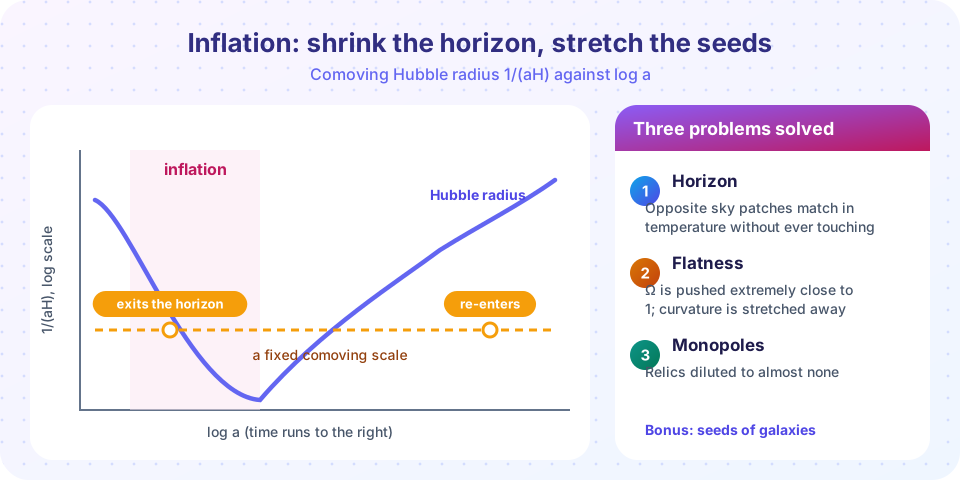
- Horizon. Our entire observable universe came from a tiny patch that was in causal contact before inflation, so it had time to reach a uniform temperature. After inflation, the comoving Hubble radius grows, and the stretched regions re-enter the horizon in a state that is uniform.
- Flatness. Because
|Ω − 1| ∝ 1/(aH)²andaHgrows bye^Nduring inflation,|Ω − 1|is reduced bye^(−2N). ForN = 60that is 10⁻⁵², whatever it was before. - Monopoles. If they were created before inflation, they are diluted to essentially zero.
Inflation must end, and the energy must go into the hot plasma of ordinary particles ("reheating"). The hot Big Bang then begins. The energy scale of inflation is unknown, but a typical guess is near 10¹⁵ to 10¹⁶ GeV, with inflation lasting from about 10⁻³⁶ to 10⁻³² seconds.
Seeds of structure
Quantum mechanics makes the inflaton field fluctuate slightly from place to place. Inflation stretches these fluctuations to macroscopic scales, and they freeze when their wavelengths exceed the Hubble radius. They become small density variations of about one part in 100,000. After inflation they re-enter the horizon and gravity makes them grow into galaxies and clusters. The CMB ripples are the picture of these seeds.
Inflation predicts specific properties:
- The fluctuations are nearly scale-invariant and slightly red-tilted:
nₛa little below 1. Planck measuresnₛ = 0.965 ± 0.004. - They are Gaussian and adiabatic (all components fluctuate together). Observations are consistent with both.
- The universe is flat:
Ω_kconsistent with zero. - It also produces primordial gravitational waves, with an amplitude given by the tensor-to-scalar ratio
r. These would leave a special swirling (B-mode) polarization pattern in the CMB. So far only upper limits exist,r < 0.036(BICEP/Keck 2021). Detecting B-modes would be strong evidence, and would reveal the energy scale of inflation.
Open questions
What is the inflaton? Why did inflation start? Many models fit the data, so inflation is a framework, not a single theory. Some critics point out that the very flat potentials needed are themselves a kind of fine-tuning. Alternatives such as bouncing universes exist but are less developed. Inflation also predicts that, once it starts, it may continue forever in other regions (eternal inflation), producing a "multiverse", which many physicists find untestable.
Common misconceptions
"Inflation was an expansion faster than light and violates relativity." Space itself expanded; no object moved through space faster than light.
"Inflation replaced the Big Bang." It precedes the hot Big Bang and sets its initial conditions; nucleosynthesis and the CMB are unchanged.
"Inflation is proven." Its predictions are consistent with data, but alternatives are not ruled out, and primordial gravitational waves have not been seen.
Try it
Press Run (or Ctrl + Enter) to see the result here.
Program input · what you'd type while the program runs
Type the answers before you press Run, one per line. Each time the program reads a line (with input()), it gets the next line from this box.
Press Run (or Ctrl + Enter) to see the result here.
Program input · what you'd type while the program runs
Type the answers before you press Run, one per line. Each time the program reads a line (with input()), it gets the next line from this box.
Check your understanding
Quick check · 5 questions
of 5 answered You scored / 5 · perfect!
-
1. What is the horizon problem?
Opposite parts of the sky were never in causal contact in the standard model, yet are at the same temperature. -
2. During inflation the scale factor grows as:
A nearly constant energy density gives a nearly constant H and exponential growth. -
3. If inflation lasts 60 e-folds, lengths grow by about:
e^60 is about 1.1×10^26. -
4. What did Planck find for the spectral index n_s?
n_s = 0.965 +/- 0.004, a small red tilt as predicted by simple inflation models. -
5. Which observation would give strong evidence for inflation?
Inflation predicts primordial gravitational waves that would leave B-mode polarization in the CMB.
Summary
- The standard Big Bang leaves the horizon, flatness and monopole problems unexplained.
- Inflation, a phase of nearly exponential expansion (
a ∝ e^(Ht), at least about 60 e-folds), solves all three. - Quantum fluctuations of the inflaton, stretched to large scales, seed galaxies; predictions include
nₛ ≈ 0.965, flat space and Gaussian fluctuations. - Primordial gravitational waves (B-modes) are the key untested prediction; inflation is a framework, not a single theory.
Next: Chapter 7 review
Track your progress
Create a free account to tick off lessons and pick up where you left off on any device.
of Astrophysics and Cosmology lessons completed