


















Lesson 8 of 48 · Observational Tools
Telescopes, detectors and resolution
Learn how telescopes gather light, why resolution is limited by diffraction and atmospheric seeing, and how CCD detectors and interferometers push those limits.
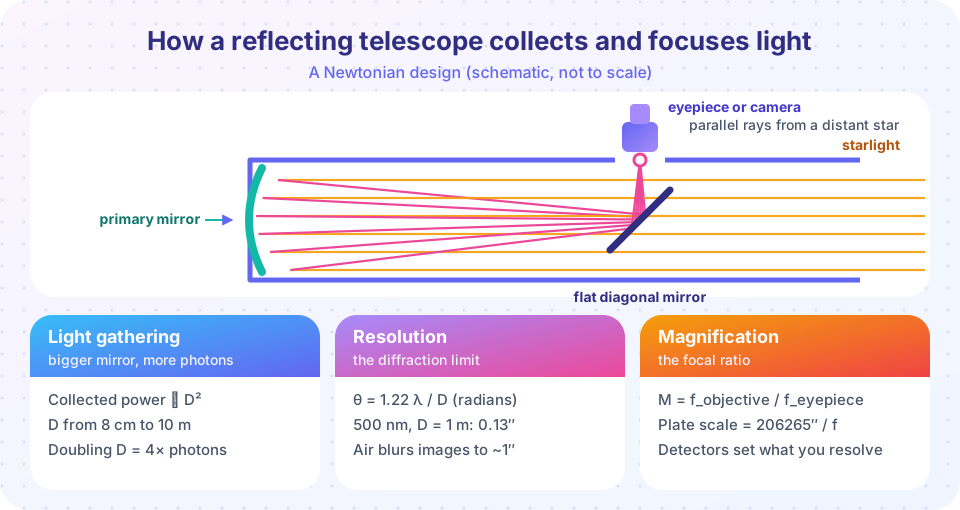
A telescope is a bucket for photons that also keeps track of where each one came from. Two properties matter more than any others: how much light it collects, which sets how faint an object it can detect, and how fine a detail it can separate, which is its resolution. Both depend on one number, the diameter of the main mirror. This lesson shows how, and what limits real instruments.
What you will learn
- How reflecting and refracting telescopes work, and why large telescopes use mirrors.
- Light-gathering power and the diffraction limit
θ = 1.22 λ / D. - How the atmosphere blurs images and how adaptive optics and space telescopes fix it.
- How CCD detectors and signal-to-noise decide what you can detect.
- How interferometers combine telescopes to get enormous baselines.
Key terms
Focal length (f): the distance from mirror to focus; longer f gives a larger image scale.
Diffraction limit: the smallest angle a perfect telescope can resolve, θ ≈ 1.22 λ / D radians.
Seeing: blurring from turbulence in the atmosphere, typically about 1 arcsecond at good sites.
Quantum efficiency (QE): the fraction of incoming photons a detector actually records.
Signal-to-noise ratio (S/N): the measured signal divided by its uncertainty.
Refractors, reflectors and why mirrors win
A refractor focuses light with a lens, as in Galileo's 1609 telescope. Big lenses sag under their own weight, can only be supported at the rim, and bend different colours by different amounts. The largest working refractor has a lens of about 1 m. A reflector uses a curved mirror, supported from the back, that treats all colours alike. Isaac Newton built the first one in 1668. Every major research telescope today is a reflector, from the 10-metre Keck telescopes to the 6.5-metre James Webb Space Telescope with its 18 hexagonal gold-coated segments. Extremely large telescopes of 30–40 m, built from hundreds of segments, are under construction.
Light-gathering power
Collecting area is A = π (D/2)², so the number of photons received in a given time is proportional to D². A 10 m mirror gathers (10 / 0.2)² = 2,500 times more light than a 20 cm amateur telescope. Put differently, one hour on the large mirror equals more than three months on the small one for the same faint source. This is why astronomers keep building bigger mirrors, and why exposures can be long: photons add up.
For a source that is limited by its own light, the faintest detectable magnitude improves by Δm = 5 log₁₀(D₂/D₁). Going from 20 cm to 10 m gives 5 log₁₀(50) = 8.5 magnitudes.
The diffraction limit
Light is a wave and spreads when it passes an aperture. A perfect circular telescope turns a point source into a bright disc surrounded by faint rings; the disc's angular radius is
θ = 1.22 λ / D (in radians; multiply by 206,265 for arcseconds)
For the Hubble Space Telescope (D = 2.4 m) at 550 nm, θ = 1.22 × 550×10⁻⁹ / 2.4 = 2.8×10⁻⁷ rad ≈ 0.058″. The human eye, with a 5 mm pupil, can separate about 28″ in theory (in practice about 1′ because of the retina). Diffraction explains why a 10 cm telescope cannot split a pair closer than about 1.4″, whatever its magnification.
Longer wavelengths blur more. At 21 cm (the hydrogen line, a favourite radio wavelength), a 100 m dish has θ ≈ 8.8′, about a quarter of the Moon's width. That is why radio astronomers link dishes into interferometers: two dishes separated by a baseline B behave like one huge telescope with resolution about λ / B. The Event Horizon Telescope used dishes around Earth (baseline up to about the planet's diameter, 1.3×10⁷ m) at λ = 1.3 mm and reached about 1.3×10⁻³ / 1.3×10⁷ = 10⁻¹⁰ rad ≈ 20 microarcseconds, enough to image the shadow of a black hole.
The atmosphere
Turbulent air bends starlight randomly, so a point source dances and smears over about 0.5–2″ ("seeing"). This is why very large ground telescopes do not reach their diffraction limit at visible wavelengths. Two cures exist. Adaptive optics measures the distortion hundreds of times a second (often using a laser guide star) and bends a thin deformable mirror to cancel it. And space telescopes avoid the atmosphere entirely, which also lets them see ultraviolet, X-rays and infrared that the air absorbs.
Detectors
Photographic plates had a quantum efficiency of about 1%. A modern CCD (charge-coupled device) or CMOS sensor records over 90% of visible photons, converts each to an electron, and counts them with very low noise. Careful astronomers calibrate by subtracting a bias frame (readout offset) and a dark frame (thermal electrons) and dividing by a flat field (pixel-to-pixel sensitivity).
When the dominant noise is the random arrival of photons, collecting N photons gives S/N ≈ √N. To double your S/N you need four times the exposure. Real data add sky background and detector noise, so the full formula is S/N = N* / √(N* + N_sky + N_read²).
Common misconceptions
"A telescope's power is its magnification." Magnification is f_objective / f_eyepiece and can be made arbitrarily high, but beyond the diffraction and seeing limits it only makes a bigger blur.
"Space telescopes are better because they are closer to the stars." The distance gained is negligible; they win by avoiding atmospheric blur and absorption.
"Radio telescopes take pictures like cameras." Single dishes have low resolution; images come from combining many dishes (aperture synthesis).
Try it
First, compare the diffraction limit and the typical seeing for several instruments. The "limit" is whichever is larger: you cannot beat diffraction, and ground telescopes cannot beat seeing without adaptive optics.
Press Run (or Ctrl + Enter) to see the result here.
Program input · what you'd type while the program runs
Type the answers before you press Run, one per line. Each time the program reads a line (with input()), it gets the next line from this box.
Second, count the cost of faintness in observing time. The program shows the exposure time needed to reach the same signal-to-noise for a fixed source on telescopes of different sizes, assuming photon-limited observing.
Press Run (or Ctrl + Enter) to see the console output here.
No output.
Check your understanding
Quick check · 5 questions
of 5 answered You scored / 5 · perfect!
-
1. Why do large research telescopes use mirrors instead of lenses?
A mirror can be supported across its whole back and has no chromatic aberration, so it scales to many metres. -
2. A telescope of diameter 4 m instead of 2 m collects
Collecting area is proportional to D squared. -
3. Which has the better diffraction-limited resolution at the same wavelength?
theta = 1.22 lambda / D, so a larger D gives a smaller angle. -
4. Adaptive optics is used to correct
A deformable mirror cancels the rapidly changing distortion of the atmosphere. -
5. If you want to double the signal-to-noise ratio in a photon-limited observation, you must
S/N is proportional to the square root of the number of photons, which is proportional to exposure time.
Summary
- Large telescopes are reflectors; collecting area
∝ D²sets how faint a source you can detect. - The diffraction limit
θ = 1.22 λ / Dsets the finest detail; the atmosphere typically limits ground telescopes to about 1″ unless adaptive optics is used. - CCDs record more than 90% of visible photons; S/N grows as
√Nfor photon noise. - Interferometers combine telescopes to reach resolutions
~λ / Bfor a baselineB.
Track your progress
Create a free account to tick off lessons and pick up where you left off on any device.
of Astrophysics and Cosmology lessons completed