


















Lesson 25 of 48 · Galaxies
Galaxy Types: The Hubble Sequence
Learn how galaxies are classified: elliptical, lenticular, spiral, barred and irregular types, what each shape says about age and history, and plot Sersic profiles.
If you photograph a thousand galaxies you will not find a thousand different shapes. You will find a few families. Some are smooth red blobs, some are flat disks with graceful arms, and a few are shapeless. Sorting objects into families is how most sciences start (think of the periodic table), and the sorting of galaxies by Edwin Hubble in 1926 is still the standard language of the field.
This lesson teaches you the classification and, more importantly, what the shapes mean: why a galaxy looks the way it does depends on how it formed and how it has been shaken since.
What you will learn
- The Hubble tuning fork and the meaning of E, S0, S, SB and Irr.
- How to read an elliptical's type from its axis ratio.
- What colors, gas content and star formation say about each type.
- How mergers and environment shape the population.
Key terms
Elliptical (E): a smooth, featureless, three-dimensional swarm of old stars with little gas.
Spiral (S): a flat rotating disk with spiral arms and a central bulge.
Lenticular (S0): a disk with a bulge but no spiral arms and little gas.
Barred spiral (SB): a spiral whose arms begin at the ends of a central bar.
Irregular (Irr): a galaxy with no regular shape, often rich in gas and young stars.
The tuning fork
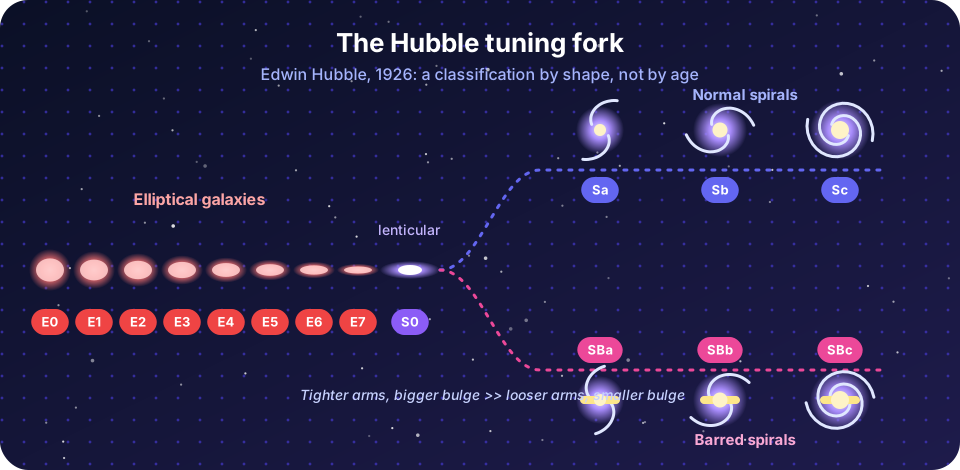
Ellipticals are labeled En, where n = 10 × (1 − b/a) and a and b are the apparent long and short axes. An E0 looks round, an E7 is flat like a lens. Because we see only one projection, an E0 may be an elongated galaxy viewed end-on. Ellipticals range from dwarfs (millions of solar masses) to giants with more than 10^13 solar masses.
Spirals come in the series Sa, Sb, Sc: a decreasing bulge and ever more loosely wound arms. A barred spiral carries the prefix SB. In near-infrared images about two thirds of disk galaxies show a bar, including the Milky Way. Lenticulars (S0) are the transition: a disk and a bulge but no arms.
Irregulars do not fit. The Large and Small Magellanic Clouds, about 50 and 60 kpc away, are the nearest examples.
A warning about names: Hubble believed the fork was an evolutionary sequence from left to right. That was wrong, but the terms "early-type" (ellipticals and S0) and "late-type" (spirals) survive. They describe the shape, not the age.
What shapes mean
| Property | Elliptical | Spiral | Irregular |
|---|---|---|---|
| Shape | 3D, smooth | Flat disk, arms | Patchy |
| Dominant motion | Random, all directions | Ordered rotation | Mixed |
| Stars | Old, red | Old bulge, young blue arms | Young, blue |
| Cold gas | Very little | Much | Much |
| Star formation | Almost none | Ongoing in arms | Often vigorous |
| Typical home | Clusters | Field, outskirts | Field, low mass |
This explains the colors. In a spiral, the arms contain hot young O and B stars, which are blue. In an elliptical, those stars died long ago, leaving only the long-lived red giants and dwarfs: the galaxy looks red, and is called "red and dead".
How shapes form
Ordered rotation in disks points to a quiet history: gas settled into a disk, and stars formed in it. Random motions in ellipticals point to violent histories. Mergers between galaxies scramble disks into spheroids. Computer simulations of a collision between two comparable spirals produce a galaxy that resembles an elliptical. Mergers also trigger bursts of star formation that use up the gas. Stars rarely collide in a merger, since they are so far apart, but their orbits are completely rearranged.
Environment matters too. In 1980, Alan Dressler showed the morphology-density relation: the denser the region, the larger the fraction of ellipticals and S0 galaxies. Galaxies in clusters lose gas by interactions and by moving through hot cluster gas, and so stop forming stars.
Surface brightness profiles
The brightness of a galaxy falls off with radius, and the shape of the fall-off distinguishes types. The Sérsic profile describes both:
I(r) = I_e exp{ −b_n [ (r/r_e)^(1/n) − 1 ] }
Here r_e is the effective radius (containing half the light), I_e is the intensity there, n is the Sérsic index, and b_n ≈ 2n − 1/3 + 4/(405 n) makes r_e the half-light radius. For n = 1 the profile is an exponential disk, typical of spirals. For n = 4 it is the de Vaucouleurs profile, typical of giant ellipticals, with a much brighter center and a more extended outer envelope.
Common misconceptions
"Hubble showed that galaxies evolve along the fork." He suggested it; it is not supported. Ellipticals are not old spirals that lost their arms in any simple way.
"An E0 is really round." Only its projection is round; it may be elongated along our line of sight.
"Spirals are made of arms that rotate like a rigid wheel." Arms are density waves; stars move through them, and the pattern is not a fixed set of stars (otherwise they would wind up within a few rotations).
Try it
Press Run (or Ctrl + Enter) to see the result here.
Program input · what you'd type while the program runs
Type the answers before you press Run, one per line. Each time the program reads a line (with input()), it gets the next line from this box.
Check your understanding
Quick check · 5 questions
of 5 answered You scored / 5 · perfect!
-
1. An elliptical galaxy has an apparent axis ratio b/a = 0.7. What is its Hubble type?
n = 10 (1 - 0.7) = 3, so the galaxy is E3. -
2. Why are elliptical galaxies red?
Hot blue stars die quickly; with little star formation, the long-lived red stars dominate. -
3. What does the morphology-density relation say?
Dressler (1980) found that the elliptical and S0 fraction rises with local galaxy density. -
4. Which Sersic index describes an exponential disk?
n = 1 gives an exponential profile; n = 4 is the de Vaucouleurs profile. -
5. Which statement about the Hubble tuning fork is correct today?
It is a morphological classification; the evolutionary reading was abandoned.
Summary
- Galaxies are classified by shape: ellipticals (En), lenticulars (S0), spirals (Sa to Sc), barred spirals (SBa to SBc) and irregulars.
- Elliptical type:
n = 10 (1 − b/a); disks show ordered rotation, ellipticals random motion. - Ellipticals are red with old stars; spiral arms are blue with star formation.
- Mergers build ellipticals; clusters hold the most ellipticals (the morphology-density relation).
- Sérsic profiles: n = 1 for disks, n = 4 for giant ellipticals.
Next: Rotation curves
Track your progress
Create a free account to tick off lessons and pick up where you left off on any device.
of Astrophysics and Cosmology lessons completed