


















Lesson 32 of 48 · Cosmological Models
Geometry of the Universe and Cosmic Distances
Learn the three possible geometries of space, how to compute comoving, luminosity and angular-diameter distances and look-back time, and why the observable universe is 46 billion light-years in radius.
"How far away is that galaxy?" has no single answer in an expanding universe. The galaxy was closer when it emitted the light we see, it is farther now, and the distance you infer from its brightness differs from the one you infer from its angular size. All these are correct answers to different questions. Cosmologists keep them apart with careful definitions.
This lesson also asks about the shape of the universe: is space flat like a sheet, curved like a sphere, or curved like a saddle? The answer is something we can measure.
What you will learn
- The three geometries: closed, flat and open, and how density fixes them.
- The definitions of comoving, luminosity and angular-diameter distances.
- How to compute them for a flat ΛCDM universe, and look-back time.
- What the particle horizon and the observable universe are.
Key terms
Curvature (k): +1 closed, 0 flat, −1 open (the sign convention).
Comoving distance: distance measured in coordinates that expand with the universe; it does not change with time for a galaxy at rest in the Hubble flow.
Luminosity distance D_L: the distance for which F = L / (4π D_L²).
Angular-diameter distance D_A: the distance for which an object of size s subtends θ = s / D_A.
Look-back time: how long ago the light we receive was emitted.
Three geometries
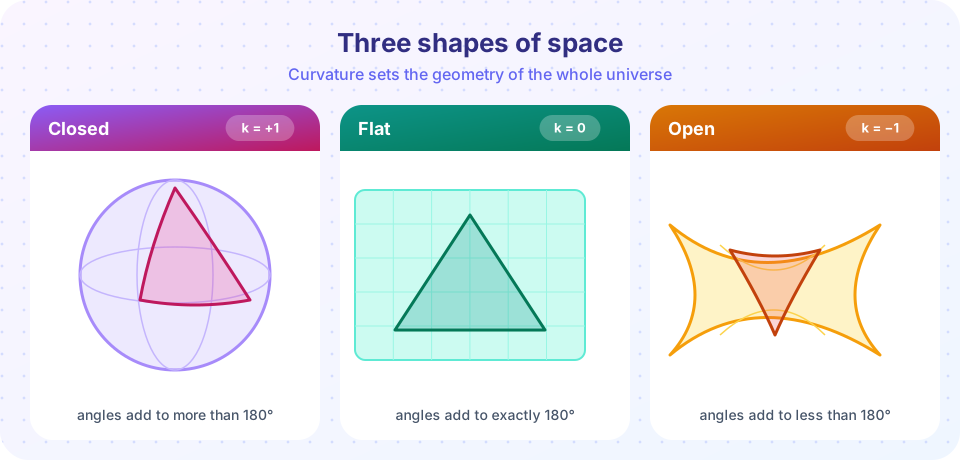
The curvature of the universe is tied to its density. For Ω_total = Ω_m + Ω_r + Ω_Λ:
| Ω_total | Curvature | Geometry | Triangle angles | Parallel lines |
|---|---|---|---|---|
| > 1 | k = +1 |
Closed (like a 3D sphere) | more than 180° | converge |
| = 1 | k = 0 |
Flat | exactly 180° | stay parallel |
| < 1 | k = −1 |
Open (hyperbolic) | less than 180° | diverge |
In the older, matter-only picture closed also meant "recollapse", and open meant "expands forever". With dark energy that link breaks: a closed universe with enough Λ still expands forever.
How could we test the geometry? Draw a big triangle. The CMB provides one: it contains hot and cold spots of a known physical size (the sound horizon, next chapter), a standard ruler. In a closed universe this ruler appears larger than in flat space, in an open one smaller. The measured angle of about 0.6° fits a flat universe. Planck and baryon acoustic oscillation data give Ω_k = 0.001 ± 0.002: space is flat to well under 1 percent. Whether it is exactly flat is unknown; inflation, which you will meet in chapter 7, predicts that it is nearly so.
Distances in expanding space
For a flat universe, the comoving distance to a source at redshift z is the integral of the light's path:
D_C = c ∫₀^z dz' / H(z'), with H(z) = H₀ √( Ω_m (1+z)³ + Ω_Λ ) (neglecting radiation).
Now the two observational distances follow:
D_L = (1 + z) D_C, D_A = D_C / (1 + z).
Why D_L has a factor 1 + z. The light spreads over a sphere of present radius D_C, but each photon is redshifted (energy reduced by 1 + z) and photons arrive less often (time dilation by 1 + z), so the flux is cut by (1 + z)² more than the naive value. Hence D_L² = (1+z)² D_C². Supernova cosmology uses D_L.
Why D_A has a factor 1/(1 + z). The galaxy emitted light when the universe was 1/(1+z) of its size, so its physical size s corresponds to a comoving size (1+z) s. The angle is θ = s / D_A. A remarkable consequence: in ΛCDM D_A reaches a maximum near z ≈ 1.6 and then falls, so more distant galaxies can look larger on the sky.
The two are related by D_L = (1+z)² D_A (Etherington's reciprocity relation).
Look-back time is t_lb = (1/H₀) ∫₀^z dz' / [(1+z') E(z')], where E(z) = H/H₀. For ΛCDM with H₀ = 70 and Ω_m = 0.3, light from z = 1 set out about 7.7 billion years ago.
The observable universe
Light has been traveling for the age of the universe, 13.8 billion years. But space expanded while it traveled, so the source's present comoving distance is far larger. The farthest source that we can in principle see (the particle horizon) is about 46 billion light-years away now, or about 14 Gpc. The observable universe is thus about 92 billion light-years in diameter, far larger than the naive "13.8 billion light-year" radius. The same fact explains how the CMB's source, at z ≈ 1,100, is now about 45 billion light-years away.
Common misconceptions
"The universe is 13.8 billion light-years in radius." The observable part has a comoving radius of about 46 billion light-years.
"Flat space means infinite space." A flat universe can be infinite or finite (for example a torus). The observable part is certainly finite.
"A galaxy at z = 2 is twice as far as one at z = 1." Distance is not proportional to redshift; the relation is the integral above.
"The distance to a galaxy is a unique number." Comoving, luminosity, angular-diameter and light-travel distances all differ, by design.
Try it
Press Run (or Ctrl + Enter) to see the result here.
Program input · what you'd type while the program runs
Type the answers before you press Run, one per line. Each time the program reads a line (with input()), it gets the next line from this box.
Press Run (or Ctrl + Enter) to see the result here.
Program input · what you'd type while the program runs
Type the answers before you press Run, one per line. Each time the program reads a line (with input()), it gets the next line from this box.
Check your understanding
Quick check · 5 questions
of 5 answered You scored / 5 · perfect!
-
1. Which geometry has triangles whose angles add to less than 180 degrees?
On a saddle-like (hyperbolic) surface the angles add to less than 180 degrees. -
2. What do CMB and baryon acoustic oscillation data say about the curvature?
Current limits are Omega_k = 0.001 +/- 0.002. -
3. How are luminosity distance and angular-diameter distance related?
Etherington's relation: D_L = (1+z)^2 D_A. -
4. Why is the observable universe about 46 billion light-years in radius, not 13.8?
The comoving distance to the horizon grows as space expands during the light's journey. -
5. In flat LCDM, what happens to the angular size of a fixed-size galaxy as z rises beyond about 1.6?
D_A peaks near z = 1.6 and then declines, so distant galaxies appear larger.
Summary
- Space is closed, flat or open as
Ω_totalis above, equal to or below 1; observations show it is flat to better than 1 percent. - Comoving distance is
D_C = c ∫ dz/H(z);D_L = (1+z) D_CandD_A = D_C/(1+z). - Look-back time differs from distance:
z = 1is about 7.7 Gyr ago in ΛCDM. - The observable universe has a comoving radius of about 46 billion light-years.
Next: Chapter 6 review
Track your progress
Create a free account to tick off lessons and pick up where you left off on any device.
of Astrophysics and Cosmology lessons completed