


















Lesson 27 of 48 · Galaxies
Active Galactic Nuclei and Quasars
Learn how accreting supermassive black holes power quasars, Seyferts and blazars, how the unified model explains their variety, and compute Eddington limits and accretion rates.
Most galaxies have a quiet center. In about one galaxy in ten or fewer, the nucleus outshines the entire rest of the galaxy by a factor of ten or a hundred, in a region smaller than the solar system's outer edge. Such a center is called an active galactic nucleus (AGN), and the brightest ones are quasars. They are visible across almost the whole observable universe, which makes them lighthouses for cosmology as well as a fascinating subject in their own right.
The engine is a supermassive black hole that is swallowing gas. This lesson explains how a black hole, which emits nothing itself, can be the brightest thing in a galaxy, and how one model explains many different-looking objects.
What you will learn
- How accretion converts mass into radiation, and what limits the brightness.
- The history: Seyfert galaxies, radio galaxies and quasars.
- The unified model and why viewing angle matters.
- How to compute the Eddington luminosity and an accretion rate.
Key terms
Accretion disk: a flattened spiral of hot gas falling onto a compact object.
Radiative efficiency (η): the fraction of the accreted rest-mass energy Ṁc² that escapes as light; about 0.1 is typical.
Eddington luminosity: the luminosity at which radiation pressure on ionized gas balances gravity.
Jet: a narrow, fast outflow of plasma along the rotation axis.
Blazar: an AGN whose jet points almost at us.
A short history
In 1943 Carl Seyfert found galaxies with unusually bright, star-like nuclei and broad emission lines. In the 1950s radio astronomers found strong radio sources identified with distant galaxies. In 1963 Maarten Schmidt looked at the optical spectrum of the radio source 3C 273, which looked like a faint star, and realized that the lines were hydrogen lines redshifted by z = 0.158. That put the object about 2 billion light-years away, so its luminosity was a hundred times that of a normal galaxy. These objects were named quasi-stellar radio sources, or quasars.
Brightness can vary within days. Information cannot cross a region faster than light, so the source must be smaller than the distance light travels in that time: a light-day, about 170 AU across. A luminosity of 10^12 Lsun or more from a region smaller than a few thousand AU needs an engine more efficient than nuclear fusion.
The engine: accretion
Gas that falls toward a black hole has angular momentum, so it cannot fall straight in. It forms a disk. Friction heats the gas to millions of degrees, and viscous torques let it spiral inward, converting gravitational energy into light. For a nonrotating black hole, about 6 percent of the rest-mass energy is radiated; for a rapidly spinning one, up to about 40 percent. Fusion in stars manages less than 1 percent. We write
L = η Ṁ c²
where Ṁ is the accretion rate. With η ≈ 0.1, a luminosity of 10⁴⁰ W (about 2.6×10¹³ solar luminosities, a bright quasar) needs Ṁ = L / (η c²) ≈ 1.1×10²⁴ kg/s, about 18 solar masses per year.
The Eddington limit. Photons push on electrons, and electrons drag protons along. Radiation pressure balances gravity at
L_Edd = 4π G M m_p c / σ_T ≈ 1.26×10³¹ W × (M / M☉)
(in cgs units 1.26×10³⁸ erg/s). A black hole of 10^9 solar masses can therefore shine steadily at up to about 1.3×10⁴⁰ W. A brighter object would blow away its own fuel.
The size scale is set by the Schwarzschild radius r_s = 2GM/c² ≈ 2.95 km × (M/M☉). For 10^9 solar masses that is about 3×10⁹ km, or around 20 AU, comparable to the orbit of Uranus.
The unified model
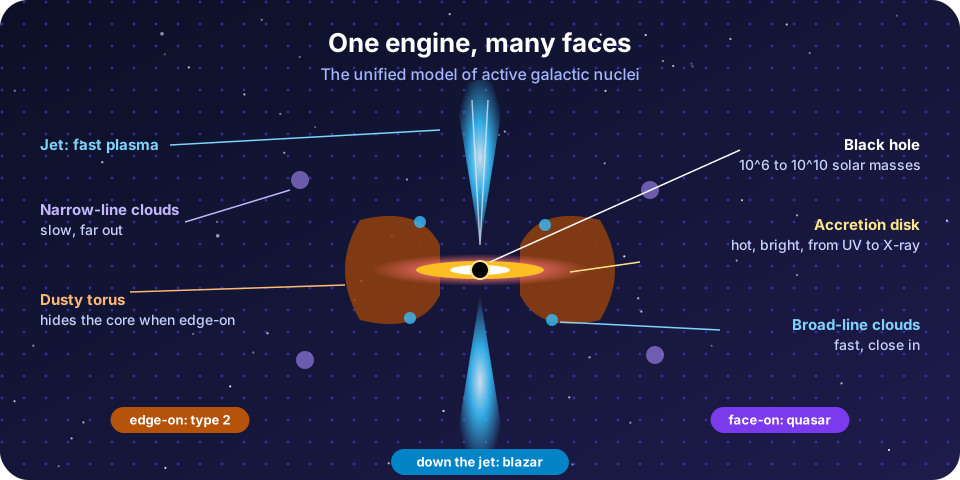
AGN come in many varieties: Seyfert 1 with broad emission lines, Seyfert 2 with only narrow lines, radio-loud quasars with jets, and blazars with rapid, extreme variability. The unified model (Antonucci and Miller, 1985; Urry and Padovani, 1995) says these are the same kind of object seen from different directions.
- Broad-line region: fast clouds (thousands of km/s) near the black hole, giving wide lines by Doppler broadening.
- Narrow-line region: slower clouds farther out.
- Dusty torus: a doughnut of dust and gas. If we look through it edge-on, it hides the disk and the broad-line clouds, and we see a type 2 object. Seen from above, we see everything: type 1 or quasar.
- Jets: in about 10 percent of AGN, jets of plasma carry energy out to hundreds of kiloparsecs. If a jet is aimed within a few degrees of our line of sight, we see a blazar, whose emission is boosted and highly variable.
An effect of looking down a jet is apparent superluminal motion. A blob moving at speed βc at angle θ to the line of sight appears to move across the sky at β_app = β sinθ / (1 − β cosθ). For β = 0.99 and θ = 10° this is about 7. Nothing is moving faster than light: the blob is nearly catching up with its own light.
Black holes and their galaxies
Today we know that most large galaxies host a central black hole, and the M–σ relation ties its mass to the random speed σ of stars in the bulge, roughly M ∝ σ⁴. This hints that the black hole and the galaxy grow together, and that AGN feedback can heat or expel gas and regulate star formation. In 2019 the Event Horizon Telescope imaged the shadow of the black hole in M87, whose mass is about 6.5 billion solar masses; in 2022 it imaged the Milky Way's Sagittarius A*.
Common misconceptions
"A black hole shines." The black hole itself is dark. The light comes from the hot gas just outside the event horizon.
"Quasars are rare because black holes are rare." Black holes are common. Quasars are rare because the black hole must be fed rapidly, and this was most common about 10 billion years ago.
"Superluminal jets violate relativity." The motion is an optical illusion from geometry and finite light speed.
Try it
Press Run (or Ctrl + Enter) to see the result here.
Program input · what you'd type while the program runs
Type the answers before you press Run, one per line. Each time the program reads a line (with input()), it gets the next line from this box.
Press Run (or Ctrl + Enter) to see the result here.
Program input · what you'd type while the program runs
Type the answers before you press Run, one per line. Each time the program reads a line (with input()), it gets the next line from this box.
Check your understanding
Quick check · 5 questions
of 5 answered You scored / 5 · perfect!
-
1. Why can't a quasar's energy come from nuclear fusion in stars?
Accretion onto a black hole can release up to tens of percent of rest mass; fusion releases less than 1 percent. -
2. What does the Eddington luminosity represent?
Beyond L_Edd the outward radiation force exceeds gravity on the infalling gas. -
3. In the unified model, what makes a Seyfert 2 look different from a Seyfert 1?
The torus hides the broad-line region when viewed edge-on. -
4. What is a blazar?
Looking down the jet boosts and varies the emission strongly. -
5. A black hole of 10^9 solar masses has a Schwarzschild radius of about:
r_s = 2.95 km x 10^9, about 3 billion km or 20 AU.
Summary
- An AGN is a supermassive black hole accreting gas through a hot disk, with
L = η Ṁ c²andη ≈ 0.1. - Quasars were identified by Maarten Schmidt in 1963 (3C 273,
z = 0.158). - The Eddington limit is
L_Edd ≈ 1.26×10³¹ W × (M/M☉). - The unified model explains types 1 and 2, radio galaxies and blazars by viewing angle.
- Black hole mass correlates with the bulge's stellar speeds, linking the black hole and its galaxy.
Next: Chapter 5 review
Track your progress
Create a free account to tick off lessons and pick up where you left off on any device.
of Astrophysics and Cosmology lessons completed