


















Lesson 4 of 48 · Getting Started
Magnitudes and luminosity
Learn the astronomical magnitude scale, apparent and absolute magnitude, the distance modulus and how to turn magnitudes into luminosities and distances.
Ancient astronomers sorted stars into six classes of brightness: the brightest were "first magnitude" and the faintest visible "sixth magnitude". That odd, backwards scale survived because it matches how the eye perceives light, and because modern astronomy turned it into a precise logarithmic system. Magnitudes are still the language of observing, so you have to be fluent in them, even though the idea is only a logarithm in disguise.
What you will learn
- How the magnitude scale is defined and why five magnitudes equal a factor of 100.
- The difference between apparent and absolute magnitude.
- How to use the distance modulus
m − M = 5 log₁₀(d) − 5. - How to convert between magnitude, luminosity and distance.
Key terms
Apparent magnitude (m): how bright an object looks from Earth.
Absolute magnitude (M): the apparent magnitude the object would have at a distance of 10 parsecs.
Distance modulus: the difference m − M, which depends only on distance.
Colour index: the difference between magnitudes in two filters, such as B − V, a measure of temperature.
Bolometric: counting radiation at all wavelengths, not just one filter.
The scale
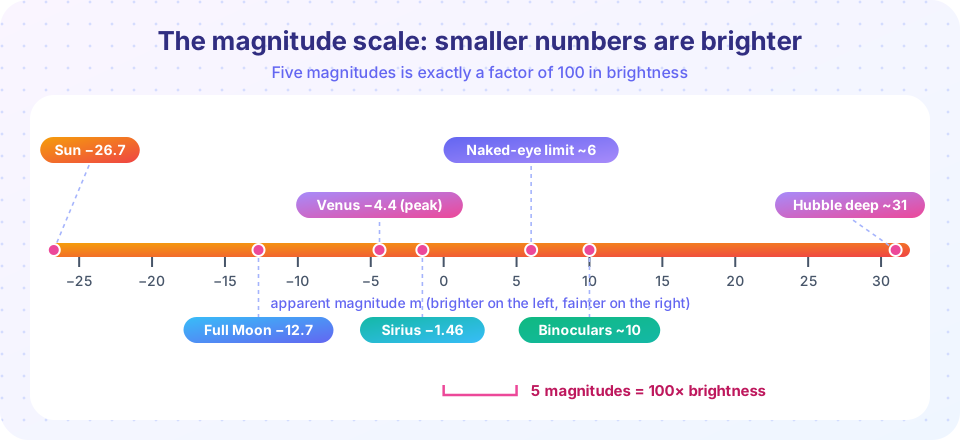
In 1856 Norman Pogson fixed the old scale: a difference of 5 magnitudes is exactly a factor of 100 in flux. One magnitude is therefore a factor of 100^(1/5) = 10^0.4 ≈ 2.512. For two objects with fluxes F₁ and F₂:
m₁ − m₂ = −2.5 log₁₀(F₁ / F₂)
The minus sign means brighter objects have smaller magnitudes. Vega was historically set close to magnitude 0. The Sun is about −26.74, the full Moon about −12.7, Venus at its brightest about −4.4, and Sirius, the brightest star, −1.46. The faintest stars seen by eye under a dark sky are near 6, and the Hubble Space Telescope's deepest exposures reach about 31, roughly 10¹² times fainter than a magnitude-0 star.
Example: how many times brighter is the full Moon than Venus at its brightest? The difference is −4.4 − (−12.7) = 8.3 magnitudes, so the ratio is 10^(0.4 × 8.3) = 10^3.32 ≈ 2,100.
Apparent versus absolute
Apparent magnitude mixes two things: how luminous the star is and how far away. To compare stars fairly, astronomers define absolute magnitude M as the apparent magnitude at 10 pc. The inverse-square law then gives the distance modulus:
m − M = 5 log₁₀(d / 10 pc) = 5 log₁₀(d) − 5
with d in parsecs. Rearranged: d = 10^((m − M + 5)/5) pc. The Sun's absolute (visual) magnitude is M ≈ 4.83: at 10 pc it would be a dim 5th-magnitude star.
Sirius has m = −1.46 and d = 2.64 pc. Then M = m − 5 log₁₀(d) + 5 = −1.46 − 2.11 + 5 = 1.43. Sirius is about 3.4 magnitudes brighter than the Sun in absolute terms, so by the scale it is 10^(0.4 × 3.4) ≈ 23 times as luminous in visible light. The bolometric value is about 25 L☉, close because Sirius is hot and radiates mostly in the visible.
From magnitude to luminosity
Because absolute magnitude is just a logarithm of luminosity, the relation to the Sun is
L / L☉ = 10^(−0.4 (M − M☉))
This works exactly only for bolometric magnitudes. A visual magnitude covers one band. A cool red dwarf like Proxima Centauri pours most of its energy into the infrared, so its visual luminosity is a tiny fraction of its bolometric one. Careful astronomers add a bolometric correction to account for the missing light.
Colour and temperature
Measure a star through a blue (B) and a visual (V) filter and subtract: B − V. Hot stars are brighter in blue, so their B − V is small or negative (Sirius about 0.0); cool stars are redder and have B − V above 1. The colour index is thus a thermometer, which chapter 3 uses to build the Hertzsprung-Russell diagram.
Common misconceptions
"A brighter star has a bigger magnitude." It is the opposite: the brightest objects have the smallest, even negative, numbers.
"Magnitude 2 is twice as bright as magnitude 4." Two magnitudes is a factor of 2.512² ≈ 6.3.
"Absolute magnitude is a measurement of a star's size." It measures luminosity in a band, which depends on both size and temperature.
Try it
First, a small toolkit that converts between magnitudes, distances and luminosities for real stars.
Press Run (or Ctrl + Enter) to see the result here.
Program input · what you'd type while the program runs
Type the answers before you press Run, one per line. Each time the program reads a line (with input()), it gets the next line from this box.
Second, watch the Sun fade as it moves away, and see where it crosses the naked-eye and Hubble limits.
Press Run (or Ctrl + Enter) to see the result here.
Program input · what you'd type while the program runs
Type the answers before you press Run, one per line. Each time the program reads a line (with input()), it gets the next line from this box.
Check your understanding
Quick check · 5 questions
of 5 answered You scored / 5 · perfect!
-
1. A star of magnitude 1 compared with a star of magnitude 6 is
A difference of 5 magnitudes is a factor of exactly 100 in flux, and the smaller magnitude is brighter. -
2. A star at exactly 10 parsecs has
Absolute magnitude is defined as the apparent magnitude at 10 pc, so the distance modulus is zero. -
3. A star has m = 8 and M = 3. Its distance is
m - M = 5 = 5 log d - 5, so log d = 2 and d = 100 pc. -
4. Why can visual luminosity badly underestimate the true luminosity of a cool red dwarf?
A visual magnitude only counts light in the V band; cool stars radiate most of their power at longer wavelengths. -
5. Which has the larger B - V colour index?
Red stars are brighter in V than in B, so B - V is large and positive.
Summary
- Magnitudes are a logarithmic brightness scale: 5 magnitudes = 100× in flux, and smaller means brighter.
- Absolute magnitude is the apparent magnitude at 10 pc; the distance modulus
m − M = 5 log₁₀ d − 5links distance and magnitude. L / L☉ = 10^(−0.4 (M − M☉))converts absolute magnitude to luminosity (bolometric for accuracy).- The colour index
B − Vis a temperature indicator.
Next: Gravity and orbits
Track your progress
Create a free account to tick off lessons and pick up where you left off on any device.
of Astrophysics and Cosmology lessons completed