


















Lesson 46 of 48 · Projects and Practice
Glossary of Astrophysics and Cosmology Terms
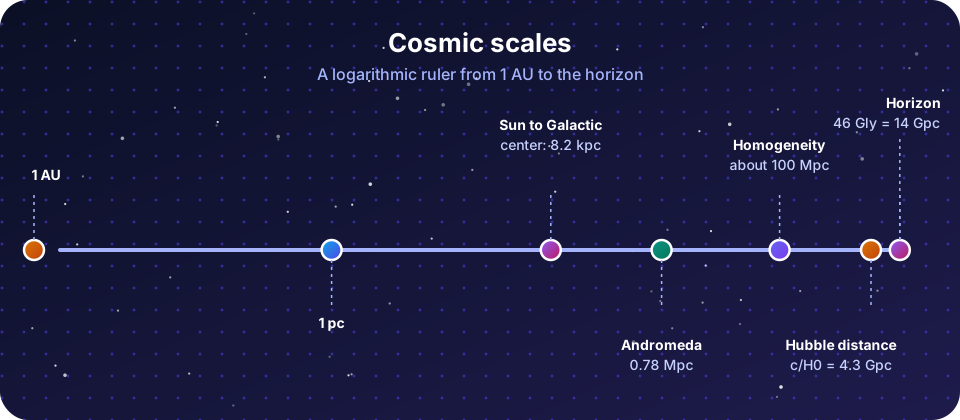
A searchable glossary of about fifty terms from galaxies, cosmological models, the early universe and the dark sector, with a cosmic scales ruler and unit converter.
Cosmology uses precise words that differ from everyday meanings: "dark" does not mean "black", a "tension" is not a force, "flat" does not mean "two-dimensional". This glossary collects the terms from chapters 5 to 8. Use the filter box to search it, then use the unit converter to move between the distances astronomers use.
What you will learn
- The meaning of the key terms, in one line each.
- Which lessons introduced each term.
- How the units of distance relate to each other.
Key terms
Parsec (pc): the distance at which a star has a parallax of 1 arcsecond; 3.086×10¹⁶ m, 3.26 light-years.
Light-year (ly): the distance light travels in a year; 9.461×10¹⁵ m.
Astronomical unit (AU): the mean Earth-Sun distance; 1.496×10¹¹ m.
Solar mass (M☉): 1.989×10³⁰ kg, the unit for masses of stars and galaxies.
Redshift (z): the fractional stretching of light's wavelength.
Try it: filter the glossary
Press Run (or Ctrl + Enter) to see the result here.
Program input · what you'd type while the program runs
Type the answers before you press Run, one per line. Each time the program reads a line (with input()), it gets the next line from this box.
Terms by chapter
| Chapter | Key terms |
|---|---|
| 5. Galaxies | galaxy, bulge, disk, halo, globular cluster, metallicity, elliptical, spiral, lenticular, Sérsic profile, rotation curve, active galactic nucleus, quasar, Eddington luminosity |
| 6. Cosmological models | cosmological principle, scale factor, Hubble law, Hubble constant, redshift, critical density, density parameter, equation of state, cosmological constant, comoving, luminosity and angular-diameter distance |
| 7. The early universe | freeze-out, nucleosynthesis, recombination, cosmic microwave background, blackbody, inflation |
| 8. Dark matter, dark energy and frontiers | dark matter, dark energy, gravitational lensing, WIMP, standard candle, Type Ia supernova, Hubble tension, standard siren, baryon acoustic oscillations |
Common misconceptions
"Dark" means invisible because it is black. Dark matter does not absorb light either; it is transparent and unseen, so "dark" means "does not interact with light".
"A parsec is a unit of time." It is a unit of distance.
"Flat means two-dimensional." Flat means that the geometry of three-dimensional space is Euclidean.
"Redshift is only the Doppler effect." For cosmological redshift, it is the stretching of space.
Check your understanding
Quick check · 4 questions
of 4 answered You scored / 4 · perfect!
-
1. What is a parsec?
1 pc is 3.086×10^16 m, about 3.26 light-years. -
2. Which term describes the ratio of pressure to energy density?
w = P/(rho c^2). -
3. What does 'standard siren' mean?
The waveform gives the luminosity distance directly. -
4. Which pair is correctly matched?
Matter has w = 0, radiation 1/3, and a cosmological constant -1.
Summary
- Key distance units: 1 pc = 3.086×10¹⁶ m = 3.26 ly; 1 AU = 1.496×10¹¹ m; 1 M☉ = 1.989×10³⁰ kg.
- The glossary lists about fifty terms; use it with the chapter reviews.
- Many cosmological terms (dark, flat, tension, redshift) have precise meanings that differ from everyday use.
Next: Cheat sheet
Track your progress
Create a free account to tick off lessons and pick up where you left off on any device.
of Astrophysics and Cosmology lessons completed