


















Lesson 1 of 48 · Getting Started
Course map: your route through the universe
Meet the nine chapters of this astrophysics and cosmology course, what you need to know first, and how to study it so the big ideas stick.
Astrophysics asks how stars, planets, galaxies and black holes work. Cosmology asks how the whole universe began, what it is made of and where it is going. The two fields share one big idea: everything we know about distant objects arrives as light, so careful physics lets us turn a faint smear of photons into a mass, a temperature, a distance or an age.
This course is built like a textbook you can run. Every lesson has a worked example, a picture of the idea, and live code you can change. It follows the common core of upper secondary and first-year university physics courses (Cambridge A Level, IB Physics options, US AP and introductory university astronomy), so it works for curious teenagers and for adults coming back to the subject.
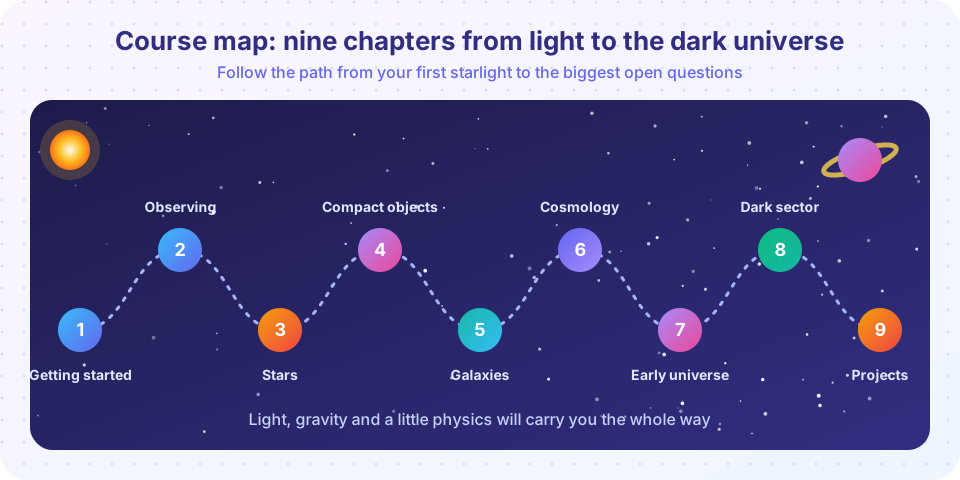
What you will learn
- What the course covers and how the nine chapters fit together.
- Which maths and physics you need, and how little calculus is required.
- A study routine that works for a quantitative science.
- How to use the runnable examples to test your own ideas.
Key terms
Astrophysics: the physics of astronomical objects such as stars, galaxies and black holes.
Cosmology: the study of the universe as a whole: its structure, history and fate.
Observable universe: the part of the universe whose light has had time to reach us since the Big Bang.
Model: a simplified description that makes predictions we can test with observations.
The nine chapters
Part one: tools
- Getting started
- Observing
Part two: stars
- Stars
- Compact objects
Part three: the big picture
- Galaxies
- Cosmological models
Part four: beginnings and puzzles
- Early universe
- Dark sector
- Projects
Chapters 1 and 2 give you the toolkit: units, light, magnitudes, gravity, telescopes and spectra. Chapters 3 and 4 use that toolkit on single stars, from the nuclear furnace in the core to the dense corpses they leave behind. Chapters 5 to 8 zoom out to galaxies, the expanding universe, its first minutes and its biggest mysteries. Chapter 9 gives you projects that combine everything.
What you need first
You need algebra, basic trigonometry (sine, cosine, small angles), powers of ten and logarithms, and an introduction to physics: force, energy, waves. When a calculus idea appears (such as an integral for the mass inside a star), the lesson explains it in words and in code, so you can follow without being fluent.
Do not worry about big numbers. Astronomers rarely care about the digits; they care about the order of magnitude and about the physics that sets it. Chapter 1 trains that habit on purpose.
How to study this course
- Read actively. After each section, close your eyes and explain it in one sentence.
- Do the numbers. Redo each worked example with a pencil before you look at the code.
- Break the code. Change a mass, a temperature or a distance and predict the result before pressing Run.
- Use the quizzes to find weak spots, then reread only those parts.
- Revisit. Every chapter ends with a review lesson. Skim the cheat sheet again a week later.
Common misconceptions
"Astronomy is mostly looking at pretty pictures." Pictures are the last step. The science is in measurements: how bright, which colour, how far, how fast it moves.
"The universe expands into empty space around it." Space itself stretches between galaxies; there is no outside edge we know of. Chapter 6 makes this precise.
"Black holes suck everything in." From far away a black hole gravitates like any object of the same mass. Chapter 4 shows where it becomes extreme.
Try it
Light takes time to travel, so looking far away means looking back in time. This console program turns distances into travel times. Change the list and see how the answers grow.
Press Run (or Ctrl + Enter) to see the console output here.
No output.
The next program draws the same numbers on a logarithmic bar chart, which is the only way to fit a second and ten million years on one page.
Press Run (or Ctrl + Enter) to see the result here.
Program input · what you'd type while the program runs
Type the answers before you press Run, one per line. Each time the program reads a line (with input()), it gets the next line from this box.
Check your understanding
Quick check · 4 questions
of 4 answered You scored / 4 · perfect!
-
1. What does cosmology study?
Cosmology treats the universe as a single system: how it began, what it contains and how it evolves. -
2. Why do astronomers care so much about orders of magnitude?
A quick estimate that is right to a factor of two or ten tells you which physics dominates; precision comes later. -
3. Looking at the Andromeda Galaxy, you are seeing it as it was about
It is about 2.5 million light-years away, so its light left it about 2.5 million years ago. -
4. Which statement about the expansion of the universe is the better picture?
Expansion is a stretching of the distances between distant galaxies, not an explosion into a pre-existing void.
Summary
- Astrophysics explains individual objects; cosmology explains the whole universe.
- The course goes from tools (light, gravity, telescopes) to stars, compact objects, galaxies, cosmological models, the early universe and the dark sector.
- Everything we know arrives as light, so measuring and modelling light is the core skill.
- Learn by doing the numbers and changing the code.
Next: Cosmic scales and units
Track your progress
Create a free account to tick off lessons and pick up where you left off on any device.
of Astrophysics and Cosmology lessons completed