


















Lesson 22 of 48 · Compact Objects
Chapter 4 review: white dwarfs, neutron stars and black holes
Review chapter 4 with a one-page cheat sheet, a recap table, a remnant classifier and a ten-question quiz on white dwarfs, neutron stars, pulsars and black holes.
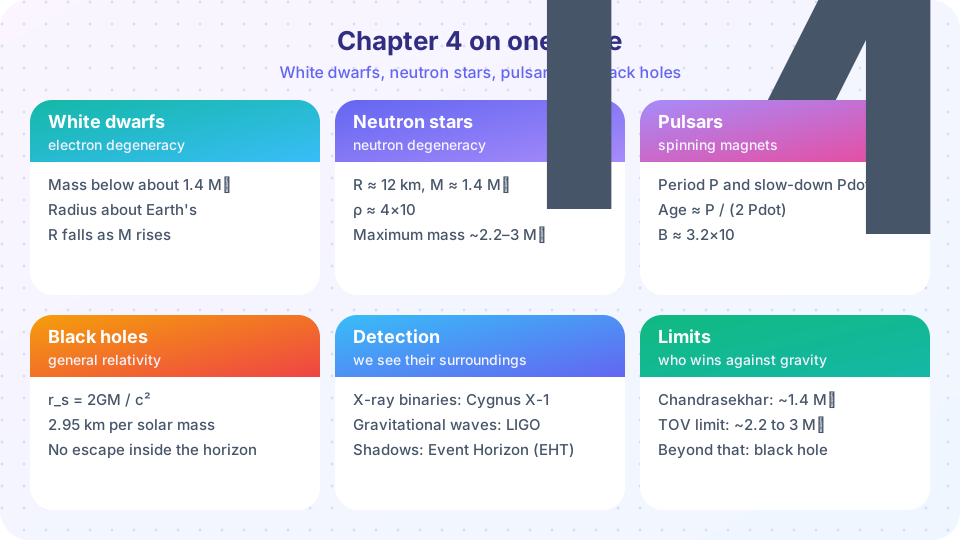
Chapter 4 followed what is left when a star dies. Degenerate electrons hold up white dwarfs, but only below about 1.4 solar masses. Degenerate neutrons and the nuclear force hold up neutron stars, to a maximum of roughly 2.2 to 3 solar masses. Beyond that, nothing stops the collapse, and the object becomes a black hole whose horizon grows in proportion to its mass. In each case the remnant is revealed by what it does to its surroundings: pulses, X-rays, orbits, gravitational waves and images.
Recap table
| Lesson | Big idea | Formula to remember |
|---|---|---|
| White dwarfs | Electron degeneracy; more mass, smaller radius | Limit M_Ch ≈ 1.4 M☉, R ∝ M^(−1/3) |
| Neutron stars and pulsars | Nuclear-density stars that spin and pulse | τ = P / (2 Pdot), B ≈ 3.2×10¹⁹ √(P Pdot) G |
| Black holes | Horizon at 2GM/c² |
r_s = 2.95 km × M/M☉, ISCO 3 r_s |
Common misconceptions
"Every dead star becomes a black hole." Only the heaviest cores do. Most stars end as white dwarfs.
"Neutron stars rotate because they are neutron-rich." They spin fast because angular momentum is conserved when the core shrinks from thousands of kilometres to about 12 km.
"Black holes are the densest objects, always." Their mean density falls with mass; a billion-solar-mass black hole is less dense than air.
Try it
A remnant classifier: give it a mass and a radius, and it computes the compactness and says what the object could be. Try the examples, then try a 1.4 solar-mass object with a 12 km radius, a 5 solar-mass one with a 15 km radius (impossible) or a 10 solar-mass one with a 30 km radius.
Press Run (or Ctrl + Enter) to see the result here.
Program input · what you'd type while the program runs
Type the answers before you press Run, one per line. Each time the program reads a line (with input()), it gets the next line from this box.
Check your understanding
Quick check · 9 questions
of 9 answered You scored / 9 · perfect!
-
1. Which pressure supports a white dwarf?
Electrons obey the Pauli exclusion principle and resist compression. -
2. As a white dwarf's mass approaches 1.4 solar masses, its radius
The mass-radius relation drops toward zero at the Chandrasekhar mass. -
3. A neutron star has about the density of
About 4 x 10^17 kg/m^3 is similar to nuclear density. -
4. A pulsar has P = 2 s and Pdot = 1e-14. Its characteristic age is about
tau = P / (2 Pdot) = 2 / 2e-14 = 1e14 s, which is 1e14 / 3.156e7 = about 3.2 million years. -
5. The event horizon of a 3-solar-mass black hole has a radius of about
r_s = 2.95 km x 3 = 8.9 km. -
6. The innermost stable circular orbit of a non-spinning black hole is at
That is 6GM/c^2, which equals 3 r_s. -
7. Which observation first imaged the shadow of a black hole?
EHT linked radio dishes worldwide to image M87's black hole in 2019. -
8. Why does a pulsar appear to pulse?
The tilted magnetic axis carries the beam around like a lighthouse. -
9. Type Ia supernovae happen when
A white dwarf near the Chandrasekhar limit ignites carbon and explodes.
Summary
- White dwarfs: electron degeneracy, below about 1.4 solar masses, Earth-sized, no fusion.
- Neutron stars: about 12 km, nuclear density; pulsars are spinning, magnetised neutron stars whose spin-down gives age and field.
- Black holes: horizon
r_s = 2GM/c²; detected by X-rays, orbits, gravitational waves and imaging. - The mass limits (about 1.4 and roughly 2.2 to 3 solar masses) separate the three fates.
Next: continue with chapter 5 on the course page
Track your progress
Create a free account to tick off lessons and pick up where you left off on any device.
of Astrophysics and Cosmology lessons completed