


















Lesson 35 of 48 · The Early Universe
Big Bang Nucleosynthesis
Learn how the first three minutes made helium: neutron-proton freeze-out, the deuterium bottleneck, predicted abundances, the baryon density and the lithium problem, with a Python model.
All the hydrogen in your body, and in water, is older than stars. About a quarter of the ordinary matter in the universe, by mass, is helium that was also not made in stars. Both were made in the first few minutes after the Big Bang, when the whole universe was a nuclear reactor. This is Big Bang nucleosynthesis (BBN), and its success in predicting the abundances is one of the strongest pieces of evidence for the hot Big Bang.
The calculation is a short chain of ideas that you can follow with arithmetic: neutrons and protons, a race against neutron decay, and the "deuterium bottleneck".
What you will learn
- Why the universe had one neutron for every six or seven protons.
- Why helium formation had to wait until about three minutes.
- How to calculate the helium mass fraction.
- What the predicted abundances tell us about ordinary matter, and what the lithium problem is.
Key terms
Freeze-out: the moment when a reaction becomes too slow to keep up with the expansion, so the abundances stop changing.
Neutron-to-proton ratio (n/p): the number of neutrons per proton.
Deuterium bottleneck: the delay in making helium until deuterium can survive destruction by photons.
Baryon-to-photon ratio (η): the number of baryons per photon, about 6×10⁻¹⁰.
Helium mass fraction (Yₚ): the fraction of ordinary matter's mass in helium-4, primordial value about 0.245.
Neutrons and protons in equilibrium
Early on, weak reactions such as n + νₑ ⇌ p + e⁻ constantly converted neutrons and protons into each other. A neutron is slightly heavier, by Δm c² = 1.293 MeV, so in thermal equilibrium the ratio is
n/p = exp(−Δm c² / kT).
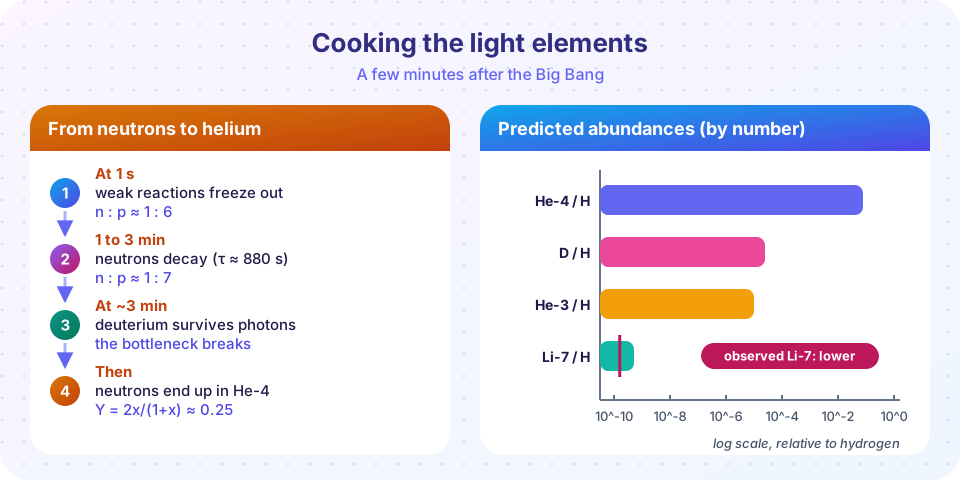
At high temperatures (kT much greater than 1.3 MeV) the ratio is near 1. As the universe cools, protons win. But the weak reactions depend on the density of neutrinos and electrons, which falls as the universe expands. At about 1 to 3 seconds, kT ≈ 0.8 MeV (about 10¹⁰ K), the reactions become slower than expansion and freeze out. The ratio is frozen near
n/p ≈ exp(−1.293/0.8) ≈ 1/5;
including the effect of continued reactions in the final stages this is about 1/6.
A race against time
After freeze-out, free neutrons still decay (n → p + e⁻ + ν̄ₑ) with a mean life of τ ≈ 880 s, so the ratio falls as exp(−t/τ). Why not make helium at once? Because to build helium-4 you need deuterium (p + n → D + γ) as a first step, and the binding energy of deuterium is only 2.22 MeV. The universe has more than a billion photons per baryon, so even when kT is far below 2.22 MeV, the high-energy tail of the photon distribution smashes deuterium apart as soon as it forms. Only when kT falls to roughly 0.07 to 0.1 MeV (T ≈ 10⁹ K, at about 2 to 3 minutes) does deuterium survive. This is the deuterium bottleneck.
By then the neutron-to-proton ratio is about 1/7. Once deuterium survives, reactions quickly build helium-4, which is extremely tightly bound (28.3 MeV), and nearly all neutrons end up in it. Each helium nucleus holds 2 neutrons and 2 protons. If there are x neutrons per proton, then per 1 proton there are x neutrons, which pair up into x/2 helium nuclei, with mass fraction
Yₚ = 2x / (1 + x).
For x = 1/7 this gives Yₚ = (2/7) / (8/7) = 1/4: 25 percent helium by mass. The measured value from metal-poor galaxies, extrapolated to zero heavy elements, is about 0.245. This number is remarkably robust: it depends only on freeze-out and the neutron lifetime, not on the detailed density.
Other light elements
The remainder of the matter is hydrogen (about 75 percent by mass). A trace of deuterium (D/H ≈ 2.5×10⁻⁵ by number) survives, along with helium-3 (about 10⁻⁵) and lithium-7 (about 5×10⁻¹⁰ predicted). There are no stable nuclei with mass number 5 or 8, so the chain stops: beryllium and heavier elements were made later, in stars (chapter 3).
The deuterium abundance is the best measure of the density of ordinary matter. More baryons per photon means deuterium is burned more completely, so a low D/H means a higher baryon density. Measured D/H in nearly pristine gas clouds in front of distant quasars gives a baryon-to-photon ratio η ≈ 6×10⁻¹⁰, which means Ω_b h² ≈ 0.022 and Ω_b ≈ 0.05. This agrees with the value from the cosmic microwave background, found by a completely different route.
BBN also counts neutrino types. Each extra light neutrino species would speed up the expansion, freeze out earlier and increase helium. The data prefer about three species, in agreement with particle colliders.
The lithium problem
Predicted lithium-7 is about three times higher than observed in the oldest stars. This lithium problem is unresolved. Possible explanations include nuclear reaction uncertainties, lithium destruction inside stars, or new physics.
Common misconceptions
"All the elements were made in the Big Bang." Only hydrogen, helium and trace lithium (and beryllium isotopes in tiny amounts) were. Carbon, oxygen, iron and the rest came from stars.
"The helium fraction depends on how much matter there is." Very weakly. It depends mostly on freeze-out and the neutron lifetime.
"The neutron is stable." A free neutron decays with a mean life of about 880 seconds; inside a nucleus it is protected.
Try it
Press Run (or Ctrl + Enter) to see the result here.
Program input · what you'd type while the program runs
Type the answers before you press Run, one per line. Each time the program reads a line (with input()), it gets the next line from this box.
Press Run (or Ctrl + Enter) to see the console output here.
No output.
Check your understanding
Quick check · 5 questions
of 5 answered You scored / 5 · perfect!
-
1. Why are there more protons than neutrons at freeze-out?
n/p = exp(-1.293 MeV / kT) falls as the temperature falls. -
2. What is the deuterium bottleneck?
The huge number of photons per baryon delays helium formation until about three minutes. -
3. If n/p = 1/7 when helium forms, what is Y?
Y = 2x/(1+x) = (2/7)/(8/7) = 0.25. -
4. What does the primordial deuterium abundance measure best?
Deuterium is destroyed more completely at higher baryon density, so D/H is sensitive to it. -
5. Which element is the 'problem' in BBN, predicted too high?
Observed lithium-7 in old stars is about a third of the predicted value.
Summary
- Neutron-proton freeze-out at about 1 s fixes
n/p ≈ 1/6; neutron decay lowers it to about1/7by the time deuterium survives (about 3 min). - Almost all neutrons end up in helium-4:
Yₚ = 2x/(1+x) ≈ 0.25. - BBN produced hydrogen, helium, and traces of D, He-3 and Li-7; heavier elements came from stars.
- Deuterium gives the baryon density,
Ω_b h² ≈ 0.022, consistent with the CMB; the lithium-7 mismatch is unsolved.
Track your progress
Create a free account to tick off lessons and pick up where you left off on any device.
of Astrophysics and Cosmology lessons completed