


















Lesson 24 of 48 · Galaxies
The Milky Way: Structure of Our Galaxy
Explore the Milky Way's bar, bulge, thin and thick disks and halo, find the Sun's place and orbit, and estimate the mass inside the Sun's orbit in Python.
On a dark night the Milky Way is a faint band across the sky. Galileo saw in 1610 that the band is made of countless stars. We see it as a band because we live inside a disk: looking along the disk we see many stars, looking out of it we see few. Mapping a galaxy from the inside is hard, like drawing a map of a forest while standing among the trees, but astronomers have managed it with star counts, radio waves that pass through dust, and the precise motions of billions of stars.
In this lesson you will learn the main components of the Milky Way, where the Sun sits, and how to turn the Sun's own orbit into a measurement of the galaxy's mass.
What you will learn
- How the discovery that the Sun is off-center was made.
- The components: central black hole, bulge and bar, thin and thick disks, halo.
- How old and young stellar populations differ.
- How to use the Sun's orbital speed to estimate mass and orbital period.
Key terms
Bulge: the dense, roughly spheroidal swarm of mostly old stars around the center.
Disk: the flattened component holding most stars, gas and dust, in near-circular orbits.
Halo: a roughly spherical region around the disk with old stars, globular clusters and, mostly, dark matter.
Globular cluster: a ball of 10^4 to 10^6 old stars bound by gravity.
Metallicity: the fraction of a star's mass in elements heavier than helium.
How we found our place
In the early 20th century most astronomers placed the Sun near the center of the Galaxy, because star counts looked the same in all directions along the band. The count was misleading: dust blocks visible light. Harlow Shapley (1918) instead used the distances to globular clusters. These clusters are scattered in a sphere centered far from the Sun, in the direction of the constellation Sagittarius. The sphere's center must be the galaxy's center. The Sun is not at the center; it lies in the disk's outer parts. In 1927 Jan Oort showed that stars near the Sun orbit the galactic center, and the Galaxy rotates.
Anatomy
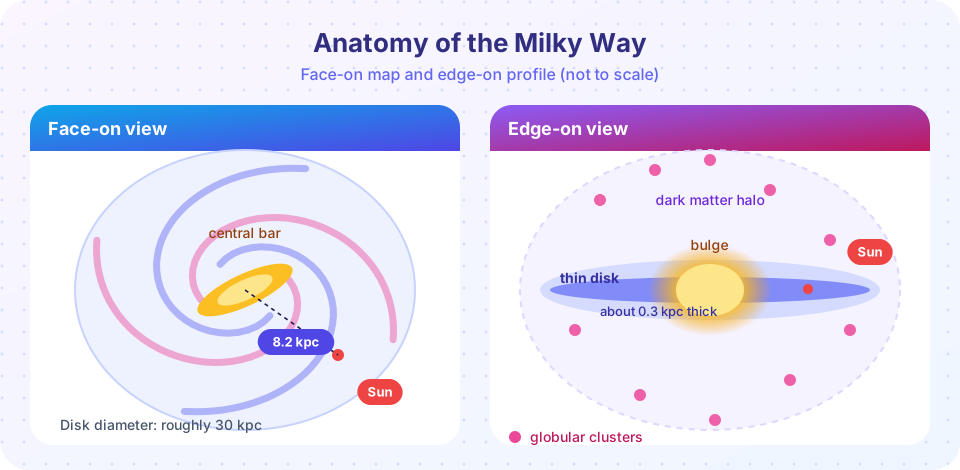
Center. At the very center is a compact radio source, Sagittarius A*, now known to be a black hole of about 4 million solar masses. Teams led by Reinhard Genzel and Andrea Ghez tracked stars orbiting it for decades. The fastest star, S2, circles in about 16 years. This work earned the 2020 Nobel Prize in Physics, shared with Roger Penrose.
Bulge and bar. The inner galaxy is a thick, boxy or peanut-shaped bulge of old stars, elongated into a bar a few kiloparsecs long. Infrared observations (which pass through dust) revealed the bar. So the Milky Way is a barred spiral, which is the most common type of large disk galaxy.
Thin disk. Most stars, gas and dust lie in a thin disk about 30 kpc across and only a few hundred parsecs thick (scale height about 0.3 kpc). It contains spiral arms, where gas is compressed and new stars form. Young, blue, luminous stars and regions of gas lighting up follow the arms. The Sun is about 20 parsecs above the midplane.
Thick disk. A second, puffier disk with a scale height of about 1 kpc holds older, slightly metal-poorer stars that move faster in the vertical direction. It is thought to be built by early mergers or by stirring up an earlier disk.
Halo. The stellar halo is a sparse, roughly spherical cloud of very old, metal-poor stars and globular clusters. It contains only a percent or two of the stars. The dark matter halo is far more massive and more extended: its total mass is roughly 10^12 solar masses, out to well beyond 100 kpc. You will meet the evidence in Rotation curves.
Stellar populations
Walter Baade noticed in the 1940s that stars come in two broad groups. Population I stars, in the disk and arms, are young to middle-aged and metal-rich, because they formed from gas enriched by earlier generations of stars. Population II stars, in the halo and bulge, are old and metal-poor. This is a time stamp: each generation of stars enriches the gas with heavy elements through stellar winds and supernovae (chapter 3), so a star's metallicity says roughly when it formed. The halo is a fossil record of the Galaxy's youth.
The Sun's orbit
The Sun lies about 8.2 kpc (roughly 27,000 light-years) from the center and moves at about 230 km/s around it (published values lie between about 220 and 240 km/s). If the orbit is roughly circular, the period is the circumference divided by speed.
Worked example. R = 8.2 kpc = 8.2 × 3.0857×10¹⁹ m = 2.53×10²⁰ m. Then T = 2πR/v = 2π × 2.53×10²⁰ / 2.3×10⁵ ≈ 6.9×10¹⁵ s, which is about 220 million years. Since the Sun is about 4.6 billion years old, it has gone round roughly twenty times.
The speed also gives the mass inside the orbit, by setting the centripetal acceleration equal to gravity. For a roughly spherical mass distribution, v² / R = G M / R², so
M = v² R / G
Using the numbers above gives about 2×10⁴¹ kg, or about 10¹¹ solar masses. That is the mass inside the Sun's orbit, and it is consistent with the sum of stars, gas and dark matter there.
Common misconceptions
"We have a photograph of the Milky Way from outside." We do not. Every top-down picture is an artist's illustration or a map assembled from data.
"The Sun is at the center." It is more than halfway out from the center to the edge of the disk.
"The halo is where the stars are." The halo is mostly dark matter; the stellar halo is only a percent or two of the stars.
Try it
Press Run (or Ctrl + Enter) to see the result here.
Program input · what you'd type while the program runs
Type the answers before you press Run, one per line. Each time the program reads a line (with input()), it gets the next line from this box.
Press Run (or Ctrl + Enter) to see the result here.
Program input · what you'd type while the program runs
Type the answers before you press Run, one per line. Each time the program reads a line (with input()), it gets the next line from this box.
Check your understanding
Quick check · 5 questions
of 5 answered You scored / 5 · perfect!
-
1. How did Harlow Shapley show that the Sun is not at the center of the Galaxy?
Globular clusters form a sphere centered far from the Sun toward Sagittarius; that center is the galactic center. -
2. About how long does the Sun take to orbit the galactic center?
T = 2πR/v is about 220 million years. -
3. Which component holds the oldest, most metal-poor stars?
The halo preserves ancient, metal-poor stars and globular clusters. -
4. The Milky Way's central black hole has a mass of about:
Orbits of stars such as S2 give about 4 million solar masses. -
5. What does v² R / G give for the Sun's orbit?
Equating v²/R with GM/R² gives the mass enclosed within the orbit radius.
Summary
- The Sun is about 8.2 kpc from the center, in the thin disk, orbiting at roughly 230 km/s with a period of about 220 million years.
- The Galaxy has a central black hole (about 4 million solar masses), a bulge and bar, thin and thick disks and a halo.
- Old, metal-poor stars (Population II) live in the halo and bulge; young, metal-rich stars (Population I) in the disk.
M = v² R / Ggives the mass inside an orbit, about 10^11 solar masses for the Sun.
Next: The Hubble sequence
Track your progress
Create a free account to tick off lessons and pick up where you left off on any device.
of Astrophysics and Cosmology lessons completed