


















Lesson 34 of 48 · The Early Universe
Chapter 7 overview: The early universe
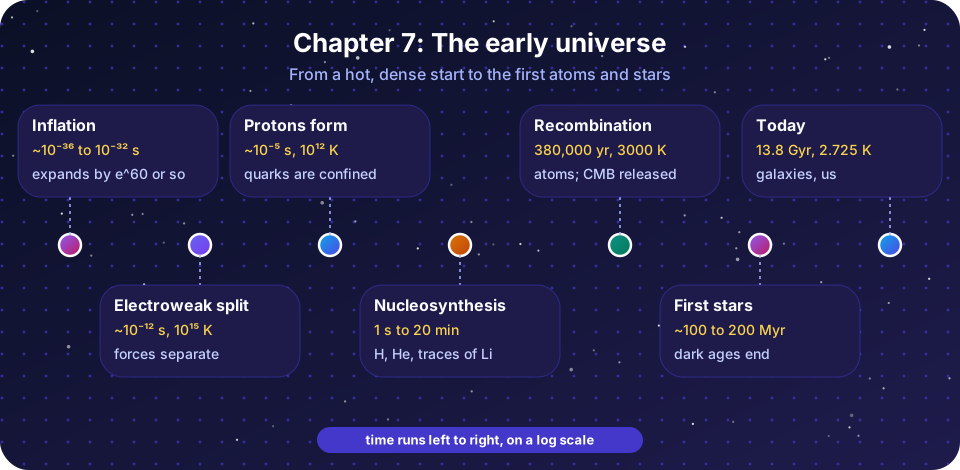
A timeline of the first 400,000 years: inflation, particle transitions, nucleosynthesis and recombination, with the temperature-time relation and what each lesson in chapter 7 covers.
Chapter 6 told you that the universe is expanding. Run the film backwards and everything gets denser and hotter. At some point matter was so hot that atoms could not exist, then nuclei could not exist, then even protons and neutrons dissolved into a plasma of quarks. The early universe is therefore a laboratory for particle physics at energies far beyond any accelerator, and at the same time a source of observable relics: light elements and a faint glow of microwaves that fills the sky.
This overview gives you the timeline and a simple rule connecting time and temperature. The next three lessons examine the three pillars of the hot Big Bang model: nucleosynthesis, the cosmic microwave background and inflation.
What you will learn
- The major epochs from inflation to the first stars.
- How temperature relates to time and to redshift.
- Which observations support the hot Big Bang model.
Key terms
Radiation era: the epoch when radiation dominated the energy density, for the first roughly 50,000 years.
Recombination: the time (about 380,000 years) when electrons and nuclei first formed neutral atoms.
Last scattering: the moment when photons last scattered off free electrons, leaving us the cosmic microwave background.
Plasma: a gas of charged particles.
Thermal equilibrium: a state in which particles share one temperature.
Temperature and time
In the radiation era the scale factor grows as a ∝ t^(1/2), and the temperature falls as T ∝ 1/a. A convenient rule, valid when we include the usual particle species, is
T ≈ 1.5×10¹⁰ K / √(t / 1 s).
At one second after the Big Bang the temperature is about 10¹⁰ K, at three minutes about 10⁹ K. Particle physicists prefer energy units: one electronvolt corresponds to about 11,600 K, so kT ≈ 1 MeV at 1.2×10¹⁰ K.
Since the CMB temperature scales as T = T₀ (1 + z) with T₀ = 2.725 K, there is a direct link to redshift: a temperature of 3,000 K corresponds to z ≈ 1,100.
Press Run (or Ctrl + Enter) to see the result here.
Program input · what you'd type while the program runs
Type the answers before you press Run, one per line. Each time the program reads a line (with input()), it gets the next line from this box.
The big picture
| Epoch | Time | Temperature | What happens |
|---|---|---|---|
| Inflation | 10⁻³⁶ to 10⁻³² s (uncertain) | enormous | Space expands exponentially; quantum ripples are stretched |
| Electroweak transition | ~10⁻¹² s | ~10¹⁵ K | The weak and electromagnetic forces separate |
| Quark confinement | ~10⁻⁵ s | ~10¹² K | Quarks bind into protons and neutrons |
| Nucleosynthesis | 1 s to 20 min | 10¹⁰ to 10⁸ K | Deuterium, helium, traces of lithium form |
| Matter-radiation equality | ~50,000 yr | ~10⁴ K | Matter starts to dominate |
| Recombination | ~380,000 yr | ~3,000 K | Neutral atoms form; photons stream free |
| Dark ages and first stars | to ~200 Myr | falling | Gravity builds the first stars and galaxies |
Particle physics is well tested at energies up to the Large Hadron Collider's roughly 10¹³ eV, which corresponds to about 10⁻¹² s. Earlier epochs, including inflation, rest on theory.
The three pillars
Three pillars of the Big Bang
And one extension
Inflation is well motivated but not yet proven.
The lessons
| Lesson | Question it answers |
|---|---|
| Big Bang nucleosynthesis | Why is a quarter of ordinary matter helium? |
| The cosmic microwave background | What is the afterglow and what do its ripples say? |
| Inflation | Why is the universe flat and uniform? |
| Chapter review | A recap and a ten-question quiz. |
Common misconceptions
"We know exactly what happened at time zero." Our theories break down at about the Planck time (10⁻⁴³ s). The "Big Bang" refers to the hot, dense expanding state, not a proven initial singularity.
"The early universe was a dense lump in empty space." It was uniformly hot and dense everywhere. There was no outside.
"The CMB comes from a distant place." It comes from everywhere, from the time of recombination; we see it from all directions.
Try it
Press Run (or Ctrl + Enter) to see the console output here.
No output.
Check your understanding
Quick check · 4 questions
of 4 answered You scored / 4 · perfect!
-
1. How does the temperature of the radiation scale with the scale factor?
Photon wavelengths stretch as a, so the temperature falls as 1/a. -
2. What was the approximate temperature of the universe at recombination?
Atoms formed at about 3,000 K, which is z of about 1,100. -
3. Which epoch is the earliest?
Inflation is the earliest, at about 10^-36 to 10^-32 s. -
4. At t = 1 s, the temperature is about:
T = 1.5×10^10 K / sqrt(t/1 s) gives 10^10 K.
Summary
- The early universe was hot and dense; it cooled as it expanded, with
T ∝ 1/aandT ≈ 1.5×10¹⁰ K/√(t/s)in the radiation era. - Key epochs: inflation, electroweak transition, quark confinement, nucleosynthesis, recombination, first stars.
- The hot Big Bang rests on the Hubble law, light-element abundances and the cosmic microwave background; inflation extends it.
Next: Big Bang nucleosynthesis
Track your progress
Create a free account to tick off lessons and pick up where you left off on any device.
of Astrophysics and Cosmology lessons completed