


















Lesson 3 of 48 · Getting Started
Light and radiation
Understand the electromagnetic spectrum, photon energy, blackbody radiation, Wien's law, the Stefan-Boltzmann law and the inverse-square law with astronomical examples.
Apart from a few meteorites, Moon rocks and a handful of neutrinos and cosmic rays, everything we know about the universe beyond Earth came to us as electromagnetic radiation. So the first tool of an astrophysicist is an understanding of light: what it is, how it carries energy and how hot objects produce it. The key insight of this lesson is that a star's colour and brightness together reveal its temperature and size.
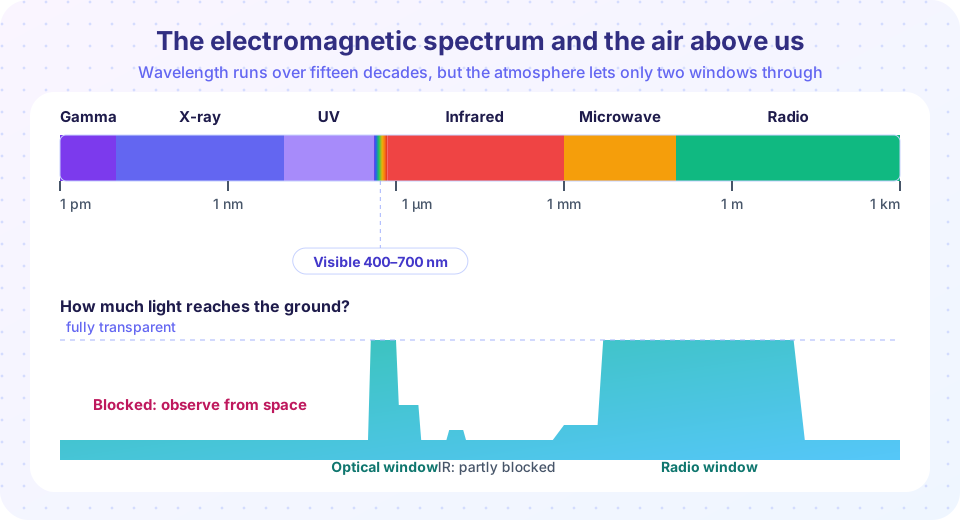
What you will learn
- The electromagnetic spectrum and why observing in each band needs different instruments.
- Photon energy
E = hf = hc/λand what it implies about the objects that emit each band. - Blackbody radiation, Wien's displacement law and the Stefan-Boltzmann law.
- The inverse-square law for brightness.
Key terms
Wavelength (λ) and frequency (f): related by c = λ f, where c = 299,792,458 m/s.
Photon: a packet of light with energy E = h f, where h = 6.626×10⁻³⁴ J·s.
Blackbody: an ideal object that absorbs all light and emits a spectrum that depends only on its temperature.
Luminosity (L): total power radiated by a star, in watts.
Flux (F): power received per unit area, in W/m².
Light as a wave and as particles
Light is an oscillating electric and magnetic field, a wave with wavelength λ and frequency f linked by c = λ f. It is also quantised into photons, each carrying E = h f = hc/λ. For a quick conversion, hc = 1239.84 eV·nm, so a 500 nm green photon has E = 1239.84 / 500 ≈ 2.48 eV.
Short wavelengths mean high energy. Radio photons have energies of micro-electronvolts and come from cold gas or relativistic electrons. Infrared photons (about 0.1–1 eV) trace warm dust. Visible photons (1.8–3.1 eV) come from stars like the Sun. X-rays (keV) come from million-degree gas and from matter falling onto compact objects, and gamma rays (MeV and above) from nuclear processes and the most violent events. This is why astronomers need telescopes in every band: each shows a different physical regime.
The atmosphere makes this practical. It absorbs gamma rays, X-rays and most ultraviolet and far-infrared, so satellites such as Chandra and JWST fly above it. Optical and radio waves pass through, which is why most observatories are on the ground and why they usually sit on dry mountain tops.
Blackbody radiation
Heat any dense object and it glows. A dense, opaque ball of gas such as a star radiates approximately as a blackbody, with a smooth spectrum described by Planck's law:
B(λ, T) = (2 h c² / λ⁵) / (exp(h c / (λ k T)) − 1)
Two simple results follow from it.
Wien's displacement law. The wavelength where the spectrum peaks is inversely proportional to temperature:
λ_max = b / T, b = 2.898×10⁻³ m·K
For the Sun, T ≈ 5,772 K, giving λ_max ≈ 502 nm, in the green. A cooler star such as Betelgeuse (about 3,600 K) peaks near 800 nm, at the edge of the infrared, so it looks red. Sirius A (about 9,900 K) peaks near 290 nm in the ultraviolet, though its visible light still looks blue-white.
Stefan-Boltzmann law. The power per unit surface area is σ T⁴, with σ = 5.670×10⁻⁸ W m⁻² K⁻⁴. For a spherical star of radius R:
L = 4π R² σ T⁴
Double the temperature and the luminosity rises sixteen-fold. With the Sun's R = 6.957×10⁸ m, this gives L ≈ 3.83×10²⁶ W, which matches the measured value. This formula is gold: if you know any two of L, R, T, you get the third. A faint but cool star must be small; a luminous but cool star must be enormous.
The inverse-square law
Light from a point source spreads over a sphere of area 4π d², so the flux received at distance d is
F = L / (4π d²)
At Earth, 1 AU from the Sun, F = 3.83×10²⁶ / (4π (1.496×10¹¹)²) ≈ 1,361 W/m², the "solar constant". Move to Jupiter at 5.2 AU and the flux falls by 5.2² ≈ 27. This law is the bridge between what we measure (flux) and what the star is (luminosity), provided we know d. The next lesson turns it into magnitudes.
Common misconceptions
"Red stars are hot because fire is red." The opposite: red stars are cool (about 3,000–4,000 K) and blue stars are hot (above 10,000 K).
"A star's colour is just one wavelength." A star emits a whole spectrum; the colour is its overall balance, with the peak given by Wien's law.
"Space is dark because there is no light." Light travels through space unseen; you see it only when it enters your eye or a detector.
Try it
First, see Planck's law for four temperatures. Notice that hotter blackbodies are brighter at all wavelengths and that the peak moves left as the temperature rises.
Press Run (or Ctrl + Enter) to see the result here.
Program input · what you'd type while the program runs
Type the answers before you press Run, one per line. Each time the program reads a line (with input()), it gets the next line from this box.
Now apply the Stefan-Boltzmann law to real stars. The radii are approximate; Betelgeuse varies and its size is uncertain.
Press Run (or Ctrl + Enter) to see the console output here.
No output.
Check your understanding
Quick check · 5 questions
of 5 answered You scored / 5 · perfect!
-
1. A star is hotter than the Sun. Compared with the Sun, its spectrum peaks at
Wien's law: λ_max = b / T, so higher temperature means a shorter peak wavelength. -
2. If a star's temperature doubles while its radius stays fixed, its luminosity increases by a factor of
L is proportional to T^4, so doubling T gives 2^4 = 16. -
3. Which type of radiation is almost entirely blocked by the atmosphere?
X-rays are absorbed high in the atmosphere, so X-ray telescopes fly in space. -
4. A source is moved to three times the distance. Its flux changes by
Flux falls as 1/d^2, so tripling the distance divides the flux by 9. -
5. The energy of a photon of wavelength 500 nm is about
E = 1239.84 eV·nm / 500 nm = 2.48 eV.
Summary
- Light is both a wave (
c = λ f) and a stream of photons (E = h f). - Each part of the spectrum traces a different physical regime, and the atmosphere limits ground-based observing to the optical and radio windows.
- Blackbody radiation gives Wien's law (
λ_max T = 2.898 mm·K) and the Stefan-Boltzmann law (L = 4πR²σT⁴). - Flux falls as
1/d², linking luminosity to what we measure.
Track your progress
Create a free account to tick off lessons and pick up where you left off on any device.
of Astrophysics and Cosmology lessons completed