


















Lesson 14 of 48 · Stellar Structure and Evolution
Nuclear fusion in stars
See how stars fuse hydrogen into helium: the proton-proton chain, the CNO cycle, quantum tunnelling and the Gamow peak, mass-energy conversion and the later burning stages up to iron.
For centuries nobody could explain how the Sun could shine for billions of years. Chemical burning would exhaust it in thousands of years; gravitational contraction (Kelvin and Helmholtz) in tens of millions. The answer, worked out in the 1920s and 1930s by Arthur Eddington, Hans Bethe and others, is nuclear fusion: the Sun converts a tiny part of its mass into energy through E = Δm c². This lesson shows how that conversion works and why it can happen at only 15 million kelvin.
What you will learn
- How mass turns into energy and how much the Sun converts each second.
- The steps of the proton-proton chain and the CNO cycle.
- Why fusion in stars relies on quantum tunnelling.
- What fuels stars burn after hydrogen, and why iron is the end of the line.
Key terms
Fusion: joining light nuclei into a heavier nucleus, releasing energy when the product is more tightly bound.
Mass defect: the mass lost when nuclei combine; it becomes energy via E = Δm c².
Coulomb barrier: the electric repulsion between positively charged nuclei.
Quantum tunnelling: passing through an energy barrier a particle classically could not cross.
Gamow peak: the energy range where most fusion reactions happen, set by the balance of tunnelling and thermal motion.
Mass becomes energy
Four free protons have a total mass of 4 × 1.007276 u = 4.029104 u. A helium-4 nucleus has a mass of 4.001506 u. The difference, 0.027598 u (about 0.7% of the original mass), is released as energy, once we account for the two positrons that also appear and annihilate with electrons. Using atomic masses, the full release is 26.73 MeV per helium nucleus.
On a per-kilogram basis, 0.7% × c² = 6.4×10¹⁴ J/kg, millions of times more than burning gasoline. The Sun radiates 3.828×10²⁶ W, so it converts L / c² ≈ 4.3×10⁹ kg of mass into light every second, and fuses about 6×10¹¹ kg of hydrogen per second. It has enough in its core for about 10 billion years.
The proton-proton chain
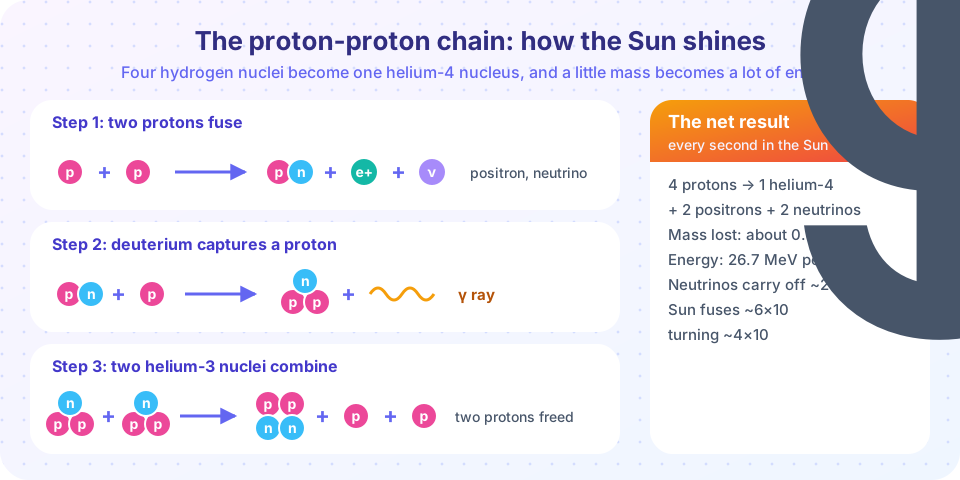
In stars like the Sun and smaller, three reactions dominate (the pp-I branch):
p + p → ²H + e⁺ + ν: two protons fuse. One turns into a neutron by the weak interaction, making a deuteron, a positron and a neutrino. This step is incredibly slow, with a typical proton waiting about 10 billion years, which is why the Sun burns steadily rather than explosively.²H + p → ³He + γ: the deuteron quickly captures another proton, within seconds.³He + ³He → ⁴He + p + p: two helium-3 nuclei fuse and release two protons.
Two completions of steps 1 and 2 are needed for every step 3, so the net result is 4 p → ⁴He + 2 e⁺ + 2 ν + energy. The neutrinos carry off about 2% of the energy. Small side branches (pp-II and pp-III) involve beryllium and boron; the rare boron-8 neutrinos were the first solar neutrinos ever detected, in the Homestake experiment.
The CNO cycle
In stars more massive than about 1.3 solar masses, carbon, nitrogen and oxygen nuclei act as catalysts: a carbon-12 nucleus captures protons in turn and eventually emits a helium-4 nucleus, becoming carbon-12 again. The net result is the same as the pp chain. Its rate depends on temperature approximately as T^16 to T^20, versus T^4 for the pp chain, so it dominates in hotter cores. The Sun makes only about 1% of its energy this way; the CNO neutrinos from the Sun were detected by the Borexino experiment in 2020.
Why tunnelling is needed
Two protons repel each other. To get within the reach of the strong force (about 10⁻¹⁵ m) they must overcome a Coulomb barrier of roughly 1 MeV. Matching that with thermal energy k T would need T ~ 10¹⁰ K, nearly a thousand times hotter than the Sun's core. Fusion at 1.5×10⁷ K is only possible through quantum tunnelling: a proton's wave function leaks through the barrier.
The probability of tunnelling falls steeply with decreasing energy, while the number of protons with high energy falls steeply with increasing energy. The product peaks at the Gamow peak energy
E₀ = (E_G (k T / 2)²)^(1/3), E_G = 2 μ c² (π α Z₁ Z₂)²
For p + p, E_G ≈ 493 keV and at the Sun's core k T ≈ 1.35 keV, giving E₀ ≈ 6 keV: reactions are driven by the lucky protons about four times above the average energy. This narrow window is why fusion rates depend so sharply on temperature.
Beyond hydrogen
| Stage | Ignition temperature | Main product | Duration for a 25 M☉ star (approx.) |
|---|---|---|---|
| Hydrogen burning | 1.5×10⁷ K (Sun) and up | helium | millions of years |
| Helium burning (triple alpha) | ~10⁸ K | carbon, oxygen | hundreds of thousands of years |
| Carbon burning | ~6×10⁸ K | neon, magnesium | hundreds of years |
| Neon, oxygen burning | 1.2–2×10⁹ K | oxygen, silicon | about a year |
| Silicon burning | 3×10⁹ K | iron-group nuclei | about a day |
Each stage is hotter, faster and less efficient, and neutrino losses accelerate the late stages. Iron-56 and nickel-62 are among the most tightly bound nuclei (about 8.8 MeV per nucleon), so fusing iron absorbs energy rather than releasing it. A massive star ends with an iron core, and the next lesson shows what happens next. The even heavier elements come from neutron capture in giant stars, supernovae and neutron-star mergers.
Common misconceptions
"The Sun is a giant hydrogen bomb." A bomb releases energy in a fraction of a second; the Sun's bottleneck reaction is so slow that its core makes only about 17 watts per cubic metre on average, about a small light bulb's worth. It adds up because the core is enormous.
"Stars fuse hydrogen at 10 billion degrees." The Sun's core is 15 million kelvin; tunnelling makes up the difference.
"Fusion always releases energy." Only up to iron. Beyond it fusion consumes energy.
Try it
First, the Sun's energy budget from the mass defect. All the constants are standard values. The calculation is a fine check on the numbers in the lesson.
Press Run (or Ctrl + Enter) to see the result here.
Program input · what you'd type while the program runs
Type the answers before you press Run, one per line. Each time the program reads a line (with input()), it gets the next line from this box.
Second, the Gamow peak for p + p at the Sun's core temperature. The thermal factor falls with energy, the tunnelling factor rises, and their product is narrow. The curves are normalised so they fit on one plot.
Press Run (or Ctrl + Enter) to see the result here.
Program input · what you'd type while the program runs
Type the answers before you press Run, one per line. Each time the program reads a line (with input()), it gets the next line from this box.
Check your understanding
Quick check · 5 questions
of 5 answered You scored / 5 · perfect!
-
1. About what fraction of the hydrogen mass is turned into energy when it fuses into helium?
Four protons (4.029 u) become a helium nucleus (4.002 u): about 0.7% of the mass is released as energy. -
2. Why can fusion occur at 15 million kelvin when the Coulomb barrier would need about 10 billion kelvin?
The barrier is crossed by tunnelling, so a small fraction of protons fuse even at modest energies. -
3. The first step of the pp chain is slow because
The weak interaction is very slow, setting the Sun's steady pace. -
4. Fusion stops being a net source of energy at
Iron-group nuclei have the highest binding energy per nucleon, so fusing them takes energy. -
5. In more massive stars (above about 1.3 solar masses) most energy comes from
The CNO cycle is far more temperature-sensitive and dominates in hotter cores.
Summary
- Fusion turns about 0.7% of hydrogen's mass into energy: 26.7 MeV per helium-4; the Sun converts 4 million tonnes per second.
- The pp chain powers Sun-like and smaller stars; the CNO cycle takes over in hotter, more massive cores.
- Quantum tunnelling and the Gamow peak explain why fusion works at 10⁷ K.
- Heavier fuels burn faster and hotter until an iron core cannot release more energy.
Track your progress
Create a free account to tick off lessons and pick up where you left off on any device.
of Astrophysics and Cosmology lessons completed