


















Lesson 39 of 48 · Dark Matter, Dark Energy and Frontiers
Chapter 8 overview: Dark matter, dark energy and frontiers
A map of chapter 8: the cosmic energy budget, why 95 percent of the universe is dark, how we know, and the open problems that drive modern cosmology.
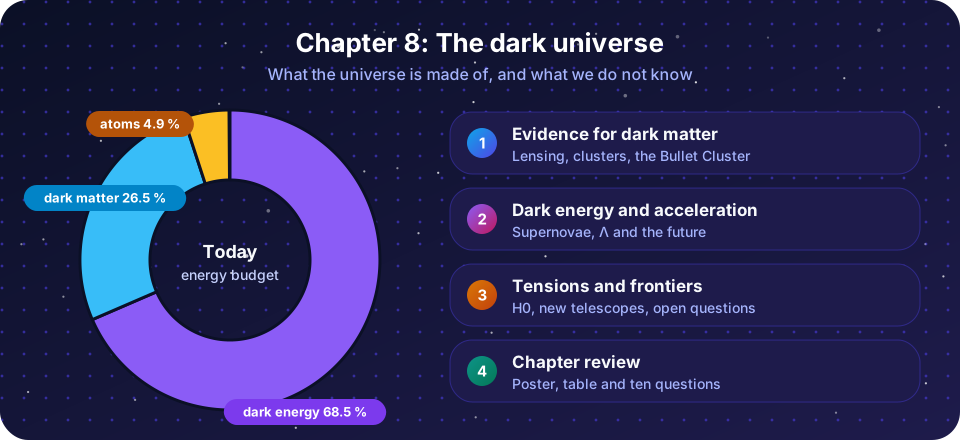
Here is the strangest result of modern cosmology. Add up everything you can see (stars, planets, gas, dust, black holes, neutrinos) and you reach about 5 percent of the universe's total energy. The other 95 percent is two components that we have never seen directly: dark matter, which pulls like ordinary matter but does not shine, and dark energy, which pushes space apart. We know them only through their gravity.
This chapter explains why cosmologists accept such startling statements, what the evidence is, what is still unknown, and where the research is heading.
What you will learn
- The composition of the universe in the standard ΛCDM model.
- Why dark matter and dark energy are different and how each was discovered.
- The main open questions: what they are, and whether the model is complete.
Key terms
Dark matter: non-luminous matter that clumps under gravity; about 85 percent of all matter.
Dark energy: the component, such as a cosmological constant, that makes the expansion accelerate.
ΛCDM: the standard model: a cosmological constant (Λ) and cold dark matter (CDM) in a flat universe.
Cold: moving slowly (non-relativistically) when structures began to form.
Baryonic matter: ordinary matter made of protons, neutrons and electrons.
The budget
The Planck satellite's analysis of the CMB, combined with other data, gives the following fractions of the critical density today.
| Component | Fraction | Behavior |
|---|---|---|
| Dark energy (Λ) | 0.685 | Constant energy density; accelerates expansion |
| Cold dark matter | 0.265 | Clumps; forms halos and the cosmic web |
| Ordinary (baryonic) matter | 0.049 | Stars, gas, planets; only about 1 percent is in stars |
| Radiation and neutrinos | about 0.0001 | Negligible now, dominant in the early universe |
Dark matter and ordinary matter together make up Ω_m ≈ 0.315. About five times as much dark matter as ordinary matter exists. Even among ordinary matter, most of the baryons are in diffuse gas rather than in stars.
Press Run (or Ctrl + Enter) to see the result here.
Program input · what you'd type while the program runs
Type the answers before you press Run, one per line. Each time the program reads a line (with input()), it gets the next line from this box.
Two different mysteries
Dark matter is a gravitational mystery. We see its effect in galaxies, clusters and the CMB, and it behaves like pressureless matter. It dilutes as a⁻³. Particle physicists have candidates but none has been detected.
Dark energy is a cosmological mystery. It appeared in 1998 when supernovae showed that the expansion is accelerating. It does not dilute. The simplest explanation is the cosmological constant, the energy of empty space. But the energy that quantum field theory predicts for empty space is vastly larger than what we see.
The dark universe
How we know
What is open
| Lesson | Question it answers |
|---|---|
| Evidence for dark matter | How do we know it exists, and what could it be? |
| Dark energy and acceleration | How did we discover acceleration? What is Λ? |
| Tensions and frontiers | What do we not yet understand, and what is next? |
| Chapter review | A recap and a ten-question quiz. |
Common misconceptions
"Dark matter is just dim ordinary matter." Searches for dim stars, planets and black holes (MACHOs) show that they cannot account for it, and the CMB and nucleosynthesis show that ordinary matter is only 5 percent.
"Dark energy and dark matter are the same." They behave oppositely: dark matter attracts and clumps, dark energy repels and is smooth.
"We have no idea what the universe is made of." We have precise measurements of how much of each there is. What we lack is the identity of the dark components.
Try it
Press Run (or Ctrl + Enter) to see the console output here.
No output.
Check your understanding
Quick check · 4 questions
of 4 answered You scored / 4 · perfect!
-
1. About what fraction of the universe's energy budget is ordinary matter?
Atoms make up about 4.9 percent. -
2. Which component does NOT dilute as the universe expands?
A cosmological constant has constant energy density. -
3. What is the ratio of dark matter to ordinary matter?
0.265 / 0.049 is about 5.4. -
4. What does the 'C' in LCDM stand for?
Cold dark matter moves slowly, so it clumps early and builds structure from small to large.
Summary
- The universe is about 68.5 percent dark energy, 26.5 percent dark matter and 4.9 percent ordinary matter.
- Dark matter attracts and clumps (
a⁻³); dark energy is smooth and accelerates the expansion. - Both are known only from their gravitational effects; their nature is unknown.
- ΛCDM fits a wide range of data, but tensions and open questions remain.
Next: Evidence for dark matter
Track your progress
Create a free account to tick off lessons and pick up where you left off on any device.
of Astrophysics and Cosmology lessons completed