


















Lesson 5 of 48 · Getting Started
Gravity and orbits
Use Newton's law of gravitation and Kepler's three laws to find orbital speeds, escape velocity and the masses of stars and planets from the orbits of their companions.
Gravity is the force that builds the universe: it gathers gas into stars, holds stars in galaxies and galaxies in clusters. It is also astronomy's balance. Nobody can put a star on a scale, but we can watch something orbit it, and the orbit reveals the mass. This lesson gives you the tools: Newton's law, circular and escape speeds and Kepler's three laws in the form astrophysicists use every day.
What you will learn
- Newton's law of gravitation and the circular-orbit speed.
- The escape velocity and what it means for planets and black holes.
- Kepler's three laws, and Newton's form
T² = 4π² a³ / (G M). - How to measure the mass of the Sun, Jupiter and the Earth-Moon pair from orbits.
Key terms
Semi-major axis (a): half the longest diameter of an elliptical orbit.
Eccentricity (e): how stretched the ellipse is; 0 is a circle, close to 1 is a long thin ellipse.
Perihelion / aphelion: the closest and farthest points from the Sun (periapsis / apoapsis for other bodies).
Escape velocity: the speed needed to leave a body's gravity without further push.
Orbital period (T): the time for one full orbit.
Newton's law and circular motion
Two masses m₁ and m₂ a distance r apart attract with force
F = G m₁ m₂ / r², G = 6.674×10⁻¹¹ N m² kg⁻²
For a small body in a circular orbit around a big mass M, gravity provides the centripetal force: G M m / r² = m v² / r. So the orbital speed is
v_circ = √(G M / r)
Earth orbits the Sun at r = 1.496×10¹¹ m with v = √(1.327×10²⁰ / 1.496×10¹¹) ≈ 29.8 km/s. Here GM☉ = 1.327×10²⁰ m³/s² is known very precisely, more precisely than G or M☉ separately.
To escape completely, kinetic energy must equal the gravitational binding energy: ½ m v² = G M m / r, so
v_esc = √(2 G M / r) = √2 × v_circ
From Earth's surface, v_esc ≈ 11.2 km/s. For the Sun at its surface it is about 618 km/s. For a black hole it reaches the speed of light at the horizon, a story for chapter 4.
Kepler's laws
Johannes Kepler found three rules from Tycho Brahe's careful observations of Mars around 1609 and 1619:
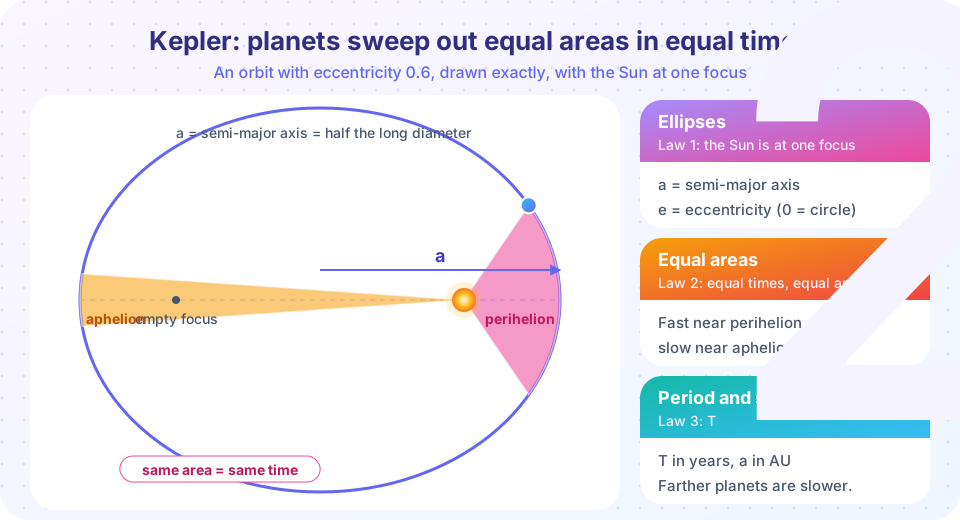
- Planets move on ellipses with the Sun at one focus.
- A line from the Sun to the planet sweeps out equal areas in equal times. The planet moves fastest at perihelion and slowest at aphelion. This is conservation of angular momentum.
- The square of the orbital period is proportional to the cube of the semi-major axis:
T² ∝ a³.
Newton derived all three from his law of gravitation. In the general form for two bodies:
T² = 4π² a³ / (G (M + m))
For a planet around the Sun, M + m ≈ M☉. If you measure T in years and a in AU, the constants collapse to T² = a³. Mars at a = 1.524 AU has T = 1.524^1.5 = 1.88 years, which is correct.
The speed at any point of an elliptical orbit follows from energy conservation (the vis-viva equation): v² = G M (2/r − 1/a). At perihelion r = a(1 − e), at aphelion r = a(1 + e). Halley's Comet, with a ≈ 17.8 AU and e ≈ 0.967, ranges from 0.59 AU to 35 AU from the Sun, and has a period of about 75–76 years.
Weighing worlds
Rearranging Kepler's third law gives the mass:
M = 4π² a³ / (G T²)
This is how we know the mass of nearly everything in the universe: the Sun from Earth's year, Jupiter from the orbit of its moon Io, a star from a planet's orbit, the Milky Way's central black hole from the orbits of stars near it, and, in chapter 5, the dark matter in galaxies from stellar speeds. The only inputs are a distance, a period and a gravitational constant.
Common misconceptions
"Astronauts float because there is no gravity in orbit." At the altitude of the International Space Station gravity is still about 90% of its surface value; they float because they are in continuous free fall around Earth.
"Heavier planets orbit faster." The orbital speed at a given distance does not depend on the orbiting body's mass, only on the central mass and the distance.
"Seasons come from Earth being closer to the Sun." Earth is closest to the Sun in early January; seasons come from the tilt of its axis.
Try it
First measure masses from orbits. The inputs are textbook values for semi-major axis and period. The Earth-Moon result is the total mass of both bodies.
Press Run (or Ctrl + Enter) to see the result here.
Program input · what you'd type while the program runs
Type the answers before you press Run, one per line. Each time the program reads a line (with input()), it gets the next line from this box.
Now watch Kepler's second law emerge from a simulation. The program integrates an orbit with e = 0.6 in units of AU and years (where GM = 4π²), then compares the area swept per time step at perihelion and aphelion.
Press Run (or Ctrl + Enter) to see the result here.
Program input · what you'd type while the program runs
Type the answers before you press Run, one per line. Each time the program reads a line (with input()), it gets the next line from this box.
Check your understanding
Quick check · 4 questions
of 4 answered You scored / 4 · perfect!
-
1. A planet orbits a star at 4 AU. Its period around a Sun-like star is
T^2 = a^3 = 64, so T = 8 years. -
2. Where in its orbit does a planet move fastest?
Equal areas in equal times means the planet must move fastest when it is closest to the Sun. -
3. The escape velocity from a body compared with the circular-orbit speed at the same radius is
v_esc = sqrt(2GM/r) = sqrt(2) v_circ. -
4. If you double the mass of the central star but keep a planet's orbit the same, the period
T^2 is inversely proportional to M, so doubling M divides T by sqrt(2).
Summary
- Gravity obeys
F = G m₁ m₂ / r²; circular speed is√(GM/r), escape speed√(2GM/r). - Kepler's laws: ellipses, equal areas in equal times,
T² = 4π² a³ / (G M). - Measuring an orbit's size and period gives the mass of the central body.
- Orbital speed depends on the central mass, not on the orbiting body's mass.
Next: Chapter 1 review
Track your progress
Create a free account to tick off lessons and pick up where you left off on any device.
of Astrophysics and Cosmology lessons completed