


















Lesson 9 of 48 · Observational Tools
Spectroscopy and the Doppler shift
Read the composition, temperature and speed of stars from their spectra: Kirchhoff's laws, hydrogen's Balmer lines, spectral classes, Doppler shift and redshift.
A photograph tells you where a star is and how bright it looks. A spectrum, the light spread out by wavelength, tells you what it is made of, how hot it is, how fast it moves and sometimes how fast it spins or how dense its atmosphere is. Almost everything we know about the physical nature of stars and galaxies comes from spectra. This lesson explains how lines form and how to read them.
What you will learn
- Kirchhoff's three laws of spectra and what produces each kind.
- Why atoms emit and absorb light only at specific wavelengths, using hydrogen's Balmer series.
- How spectral classes O B A F G K M sort stars by temperature.
- How to compute a velocity from a Doppler shift, and what redshift
zmeans.
Key terms
Spectral line: a narrow range of wavelengths where light is strongly emitted or absorbed by a particular atom or ion.
Balmer series: hydrogen lines produced by transitions to or from the second energy level (Hα 656.3 nm, Hβ 486.1 nm, Hγ 434.0 nm, Hδ 410.2 nm).
Spectral class: a letter (O, B, A, F, G, K, M) ordering stars from hot to cool.
Radial velocity: the part of a velocity along the line of sight.
Redshift (z): z = (λ_obs − λ_rest) / λ_rest.
Kirchhoff's laws
In 1859 Gustav Kirchhoff and Robert Bunsen explained three kinds of spectrum:
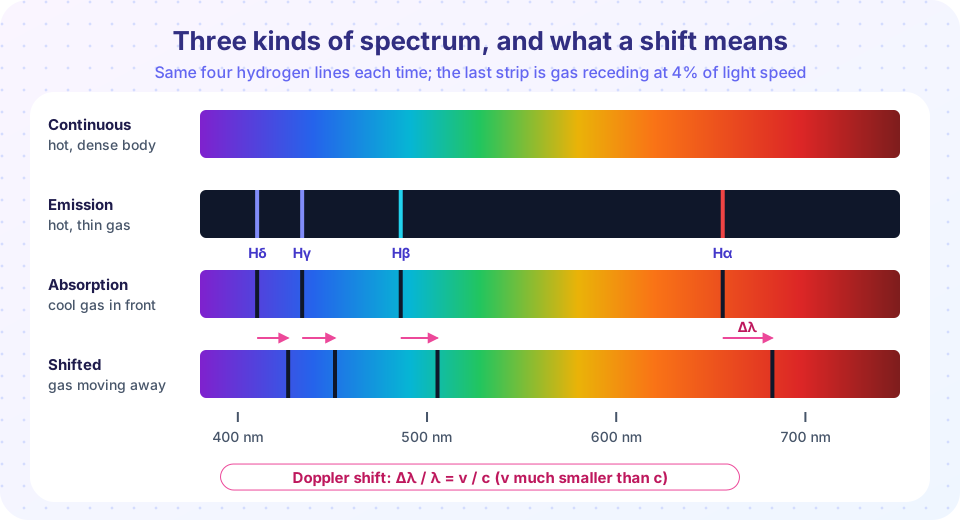
- A hot, dense solid, liquid or gas emits a continuous spectrum: all wavelengths, smoothly (the blackbody curve from chapter 1).
- A hot, thin gas emits an emission-line spectrum: bright lines at specific wavelengths.
- A cool, thin gas in front of a continuous source produces an absorption-line spectrum: dark lines at the same wavelengths where it would emit.
A star is a hot dense ball (the continuum) with a cooler, thinner atmosphere (the photosphere's upper layers) in front of it, so stars show dark absorption lines on a bright background. A glowing gas nebula has no hot dense background behind it, so it shows emission lines.
Why lines exist
An atom has discrete energy levels. A photon is absorbed only if its energy matches the gap between two levels, E = h c / λ. For hydrogen the visible lines come from transitions to or from level n = 2:
1/λ = R (1/2² − 1/n²), R = 1.0968×10⁷ m⁻¹
For n = 3 this gives 656.3 nm (Hα, red), for n = 4 486.1 nm (Hβ, blue-green). Each element has its own pattern, so lines are fingerprints. In 1868 astronomers saw a yellow line in the Sun's spectrum that matched no known element and named the new element helium, from the Greek for Sun, 27 years before it was found on Earth.
The strength of a line depends on temperature and density as well as abundance. Hydrogen's Balmer lines need atoms in the n = 2 state, so they are strongest at about 10,000 K: cooler and almost all atoms are in n = 1; hotter and the hydrogen is ionised. That is why an A star, not the most hydrogen-rich one, has the strongest Balmer lines. Cecilia Payne in 1925 understood this and showed that stars are made mostly of hydrogen and helium, a result so surprising that it was resisted for years.
Spectral classes
| Class | Temperature (K) | Colour | Lines that stand out | Example |
|---|---|---|---|---|
| O | > 30,000 | blue | ionised helium | Mintaka |
| B | 10,000–30,000 | blue-white | neutral helium | Rigel |
| A | 7,500–10,000 | white | strong hydrogen | Sirius |
| F | 6,000–7,500 | yellow-white | ionised calcium | Procyon |
| G | 5,200–6,000 | yellow | ionised calcium, metals | The Sun |
| K | 3,700–5,200 | orange | neutral metals | Arcturus |
| M | < 3,700 | red | molecules such as TiO | Betelgeuse |
Annie Jump Cannon and colleagues at Harvard built this sequence from hundreds of thousands of spectra; the letters are a historical accident, and "Oh Be A Fine Girl/Guy, Kiss Me" is the classic memory aid.
The Doppler shift
If a source moves away from you with radial velocity v, its light is stretched; moving toward you, it is compressed. For speeds far below c:
Δλ / λ = v / c
A hydrogen Hα line with rest wavelength 656.28 nm observed at 656.50 nm has Δλ = 0.22 nm, so v = c × 0.22 / 656.28 = 100 km/s away. A redshift (positive v) means the source is receding; a blueshift means it is approaching. The formula measures only motion along the line of sight, not across it.
For fast sources, such as distant galaxies, the shift is expressed as the redshift z = (λ_obs − λ_rest)/λ_rest, with the relativistic relation 1 + z = √((1 + β) / (1 − β)) for β = v/c. Chapter 6 will show that cosmological redshifts of far galaxies come mostly from the expansion of space rather than from motion through space.
Tiny Doppler wobbles reveal planets. Jupiter tugs the Sun back and forth at about 12.5 m/s, Earth at about 9 cm/s. The first planet found around a Sun-like star, 51 Pegasi b (Michel Mayor and Didier Queloz, 1995), produced a wobble of about 56 m/s.
Common misconceptions
"Redshift means the object is red." It means the spectral lines have moved to longer wavelengths, whatever the object's colour.
"The Doppler shift tells you the full velocity." It gives only the line-of-sight part; proper motion across the sky needs separate measurements.
"Dark lines mean the star lacks light there." They show absorption in the star's cooler outer layers, and the material in front adds information about composition.
Try it
First, hydrogen's Balmer lines from the formula, and a Doppler calculation of the velocities that go with several observed shifts.
Press Run (or Ctrl + Enter) to see the result here.
Program input · what you'd type while the program runs
Type the answers before you press Run, one per line. Each time the program reads a line (with input()), it gets the next line from this box.
Second, an interactive Doppler strip. Drag the slider to move the gas toward or away from you and watch the four hydrogen lines slide. Positive velocities are receding.
Third, a synthetic star spectrum: a blackbody continuum with absorption lines, before and after a Doppler shift.
Press Run (or Ctrl + Enter) to see the result here.
Program input · what you'd type while the program runs
Type the answers before you press Run, one per line. Each time the program reads a line (with input()), it gets the next line from this box.
Check your understanding
Quick check · 5 questions
of 5 answered You scored / 5 · perfect!
-
1. A cool, thin gas lies in front of a hot, dense light source. You observe
Kirchhoff's third law: the gas removes light at its characteristic wavelengths, leaving dark lines. -
2. An Hα line (rest 656.28 nm) is observed at 656.50 nm. The source is
The line moved to a longer wavelength (redshift), so the source recedes with v = c × 0.22 / 656.28 = about 100 km/s. -
3. Which class of star has the strongest hydrogen Balmer lines?
Around 10,000 K many hydrogen atoms sit in the n = 2 level, which makes the Balmer absorption strongest. -
4. The Doppler shift measures
Motion across the line of sight leaves wavelengths unchanged to first order. -
5. Why do stars show absorption rather than emission lines?
Light from the hot, dense photosphere passes through cooler gas that absorbs at specific wavelengths.
Summary
- Kirchhoff's laws: hot dense bodies give continuous spectra, hot thin gas gives emission lines, cool gas in front of a continuum gives absorption lines.
- Lines are fingerprints of atoms, and their strengths depend on temperature as well as abundance; spectral classes O B A F G K M run from hot to cool.
- The Doppler shift
Δλ/λ = v/cgives radial velocity; redshiftzgeneralises it to fast sources. - Tiny periodic Doppler shifts reveal planets orbiting other stars.
Track your progress
Create a free account to tick off lessons and pick up where you left off on any device.
of Astrophysics and Cosmology lessons completed