


















Lesson 41 of 48 · Dark Matter, Dark Energy and Frontiers
Dark Energy and the Accelerating Universe
Learn how Type Ia supernovae revealed cosmic acceleration, what the cosmological constant and the equation of state w mean, why vacuum energy is a puzzle, and the possible fates of the universe.
For seventy years after Hubble, the main question of cosmology seemed to be: how much is the expansion slowing down? Gravity pulls everything together, so the expansion should decelerate, and the rate of deceleration would tell whether the universe is closed or open. In the 1990s two teams set out to measure it using exploding stars as distance markers. In 1998 both announced the opposite result: the expansion is speeding up.
This lesson explains how supernovae measure distance, what the discovery implies, and why dark energy is one of the deepest puzzles in physics.
What you will learn
- How Type Ia supernovae work as standard candles.
- How the data revealed acceleration.
- The cosmological constant, the equation of state
wand the vacuum-energy problem. - Possible futures of the universe and the latest hints of evolving dark energy.
Key terms
Type Ia supernova: the thermonuclear explosion of a white dwarf, with a peak luminosity that is nearly standard.
Distance modulus (μ): μ = m − M = 5 log₁₀(D_L / 10 pc), the difference between apparent and absolute magnitude.
Deceleration parameter (q₀): q₀ = −ä a / ȧ² today; negative means accelerating.
Equation of state (w): pressure divided by energy density, w = P/(ρc²).
Vacuum energy: the energy of empty space predicted by quantum field theory.
Supernovae as distance markers
A Type Ia supernova occurs when a white dwarf accumulates mass (from a companion, or by a merger) and approaches the Chandrasekhar limit of about 1.4 solar masses, igniting runaway carbon fusion. All such explosions are similar, because they happen near the same mass. At peak they reach an absolute magnitude of about M ≈ −19.3, billions of times brighter than the Sun and comparable to an entire galaxy. Mark Phillips (1993) found that slower-fading ones are slightly brighter. With this correction the scatter drops to about 0.1 magnitude, a 5 percent distance precision. If you know M and measure the apparent magnitude m, you get D_L; the host galaxy's redshift gives z.
The surprise
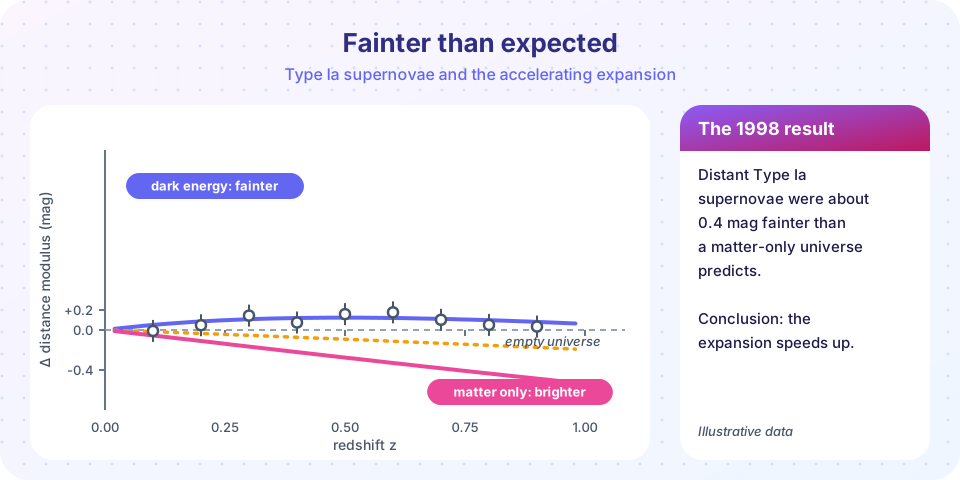
For a matter-only universe the expansion decelerates, so a supernova of a given redshift is closer than in an empty universe, and so brighter. In 1998 the High-z Supernova Search Team (Brian Schmidt, Adam Riess and others) and the Supernova Cosmology Project (Saul Perlmutter and others) found that distant supernovae were fainter than any decelerating model predicts: at z ≈ 0.5, about 0.4 magnitude fainter than a flat matter-only universe, and even about 0.1 magnitude fainter than an empty one. The light had traveled farther: the expansion must have been slower in the past than a decelerating model implies, which means it has since accelerated. Their fit gave Ω_Λ ≈ 0.7, Ω_m ≈ 0.3. This matched independent evidence from the CMB (flat, Ω_total = 1) and from the abundance of clusters (low Ω_m). The three methods intersect at the ΛCDM values. The 2011 Nobel Prize in Physics honored the discovery.
The cosmological constant
Einstein introduced the cosmological constant Λ in 1917 to make a static universe, then dropped it after Hubble found that the universe expands. Physically, Λ acts as an energy density ρ_Λ of empty space that is constant in time and has pressure P = −ρ_Λ c²: w = −1. Since ρ + 3P/c² = −2ρ_Λ < 0, it makes the expansion accelerate. Its value is ρ_Λ ≈ 6×10⁻²⁷ kg/m³ (about 4 proton masses per cubic meter), equivalent to an energy of about (2 meV)⁴ in particle physics units.
The deceleration parameter for matter plus Λ in a flat universe is q₀ = Ω_m/2 − Ω_Λ. With Ω_m = 0.3, Ω_Λ = 0.7, q₀ = −0.55. Acceleration began when Ω_Λ exceeded half of Ω_m (1+z)³, at z ≈ 0.6, about 6 billion years ago.
The vacuum-energy problem. Quantum field theory says empty space has zero-point energy. A naive estimate, cutting off at the Planck scale, gives a value about 10¹²⁰ times larger than observed. Even with more modest cutoffs, the disagreement is tens of orders of magnitude. This is the cosmological constant problem, sometimes called the worst prediction in physics. Why is the observed value small but not zero? And why is dark energy comparable to matter density now (the coincidence problem)? Some physicists invoke anthropic arguments with a multiverse; others look for new dynamics.
Is dark energy constant?
Alternatives to a constant Λ include quintessence, a slowly rolling scalar field, for which w can differ from −1 and change with time. A common parametrization is w(a) = w₀ + w_a (1 − a). Observations from Planck, supernovae and baryon acoustic oscillations give w = −1.03 ± 0.03, consistent with a cosmological constant. Recent surveys, notably the Dark Energy Spectroscopic Instrument (DESI), together with CMB and supernova data, show a preference at about the 3 sigma level (it depends on which supernova sample is used) for w₀ > −1 and w_a < 0, which would mean dark energy weakening over time. This is a hint, not yet a discovery, and it is under intense study.
Fates of the universe
If Λ is truly constant, the universe expands forever, faster and faster. Galaxies beyond the Local Group slip beyond our horizon in the next 100 billion years or so; stars burn out; the universe approaches a cold, dark state: the "Big Freeze". If w < −1 ("phantom" energy), the density would grow and could tear everything apart in a "Big Rip". If dark energy decays, the universe could recollapse. These futures are very distant; the available data favor the Big Freeze.
Common misconceptions
"Dark energy is the energy that causes the Big Bang." It is a separate component, relevant today and in the future, not the cause of the early expansion (inflation is a different, earlier phase).
"Acceleration means the Hubble parameter is increasing." In ΛCDM H decreases and approaches a constant; the acceleration is that of the scale factor, ä > 0.
"The universe is accelerating because galaxies are pushing each other." Nothing pushes galaxies: the stretching of space between them is accelerating.
"Supernovae alone prove dark energy." Their results combine with the CMB and cluster data; the independence of the methods is what makes the case strong.
Try it
Press Run (or Ctrl + Enter) to see the result here.
Program input · what you'd type while the program runs
Type the answers before you press Run, one per line. Each time the program reads a line (with input()), it gets the next line from this box.
Check your understanding
Quick check · 5 questions
of 5 answered You scored / 5 · perfect!
-
1. Why are Type Ia supernovae useful as standard candles?
Ignition near the Chandrasekhar mass makes their peak luminosity almost standard (after the Phillips correction). -
2. What did the 1998 supernova results show at z = 0.5?
They were fainter, so farther away than a decelerating universe predicts. -
3. What is w for a cosmological constant?
P = -rho c^2 gives w = -1. -
4. For a flat universe with Omega_m = 0.3, what is q0?
q0 = 0.3/2 - 0.7 = -0.55. -
5. What is the cosmological constant problem?
The predicted zero-point energy far exceeds the observed dark energy density.
Summary
- Type Ia supernovae (peak
M ≈ −19.3, corrected by the Phillips relation) are standard candles; in 1998 distant ones were fainter than expected, showing acceleration. - ΛCDM has
Ω_Λ ≈ 0.7; a cosmological constant hasw = −1, andq₀ = Ω_m/2 − Ω_Λ ≈ −0.55. - The vacuum-energy problem (a prediction too large by tens to 120 orders of magnitude) is unsolved.
- Current data are consistent with constant Λ; recent DESI-based results hint at evolving dark energy at about 3 sigma.
- If Λ is constant, the future is a Big Freeze.
Next: Tensions and frontiers
Track your progress
Create a free account to tick off lessons and pick up where you left off on any device.
of Astrophysics and Cosmology lessons completed