


















Lesson 42 of 48 · Dark Matter, Dark Energy and Frontiers
Cosmic Tensions and the Frontiers of Cosmology
Explore the Hubble tension and other open problems of cosmology, standard sirens, early galaxies seen by JWST and the new telescopes that will test the standard model.
The standard ΛCDM model, with six parameters, fits an extraordinary amount of data: the CMB, galaxy surveys, supernovae, nucleosynthesis, lensing. A model that works so well invites a hunt for cracks. Cracks are where new physics hides, but most apparent cracks turn out to be measurement problems. Cosmology today lives in that tension between trusting a great model and testing it harder than ever.
This lesson covers the best-known discrepancy, the Hubble tension, a new way to measure distances with gravitational waves, and the telescopes that will answer the next questions.
What you will learn
- What the Hubble tension is and the main explanations.
- How standard sirens measure the Hubble constant.
- Other open questions: neutrino mass, early galaxies, baryon asymmetry.
- The major current and planned facilities.
Key terms
Tension: a statistically significant disagreement between two measurements of the same quantity.
Standard siren: a gravitational-wave source whose distance follows directly from its waveform.
Sigma (σ): the number of standard deviations by which two values differ.
Baryon acoustic oscillations (BAO): a standard ruler of about 150 Mpc imprinted in the clustering of galaxies.
Systematic error: an error that does not average away with more data, such as a miscalibration.
The Hubble tension
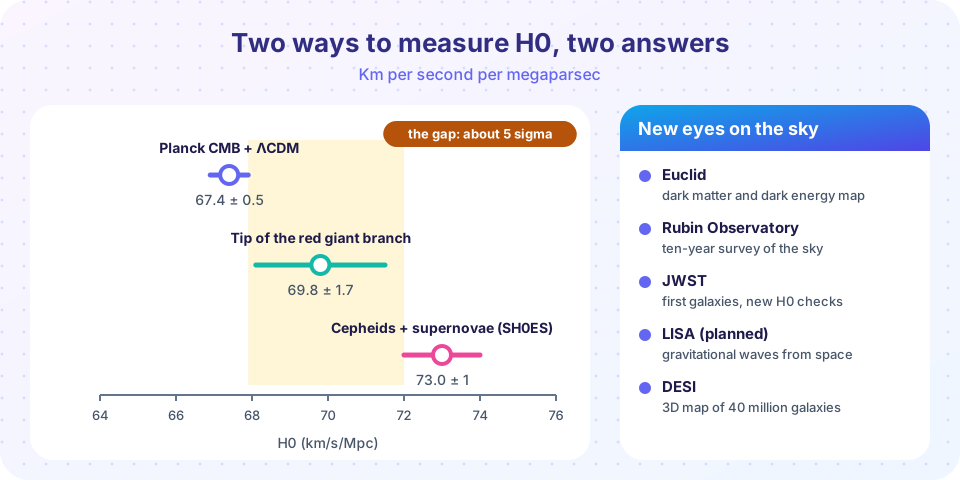
There are two ways to get H₀. The late-universe way builds a distance ladder: parallaxes calibrate Cepheid variables, Cepheids in nearby galaxies calibrate Type Ia supernovae, and supernovae in the Hubble flow give H₀. The SH0ES team (Adam Riess and colleagues) finds 73.0 ± 1.0 km/s/Mpc. The early-universe way takes the CMB, fits ΛCDM and extrapolates to today: Planck gives 67.4 ± 0.5. The difference,
(73.0 − 67.4) / √(1.0² + 0.5²) ≈ 5.0 standard deviations,
is too large to be a statistical fluke.
Possible explanations:
- Systematic errors in the distance ladder: crowded-field photometry, dust, the metallicity of Cepheids. Observations with the James Webb Space Telescope (JWST) have so far confirmed the Cepheid photometry. A rival ladder using the tip of the red giant branch (Freedman and colleagues) gives about
69.8 ± 1.7, between the two and consistent with both within errors. The community is not yet in agreement. - New physics before recombination that shrinks the sound horizon, raising the inferred
H₀: early dark energy, additional relativistic particles, or interactions in the dark sector. Each model that fixes the Hubble tension tends to worsen the fit to other data. - Late-time changes, for example evolving dark energy, though these struggle to match the BAO and supernova data.
The best-motivated resolution is not known. Tensions have come and gone before, but this one has persisted and sharpened for a decade.
Standard sirens
Gravitational waves offer a third, independent route. A merging pair of compact objects emits waves whose amplitude and frequency evolution give the luminosity distance directly, with no ladder: the waveform acts like a standard candle with known intrinsic power. If an electromagnetic counterpart pins down the host galaxy and its redshift, H₀ = v/D. In August 2017 LIGO and Virgo detected GW170817, two neutron stars merging in the galaxy NGC 4993, at about 44 Mpc, and telescopes saw the afterglow. This gave H₀ ≈ 70 (+12, −8) km/s/Mpc from a single event, too uncertain to settle the debate, but demonstrating the method. Many more events (or events without counterparts, using statistical redshifts) are needed: the error shrinks as 1/√N.
Other open questions
- Neutrino mass. Cosmology limits the sum of the three neutrino masses to roughly below 0.1 eV, close to the minimum of about 0.06 eV allowed by oscillation experiments.
- Early galaxies. JWST has found bright, compact galaxies at redshifts above 10, including one at
z ≈ 14, only about 300 million years after the Big Bang. They appear more luminous and abundant than many models expected, but this may reflect efficient early star formation, not a failure of ΛCDM. - Clustering amplitude. Weak-lensing surveys earlier found slightly less clustering ("S₈ tension") than the CMB predicts; recent analyses have eased it.
- Baryon asymmetry. Why is there matter and almost no antimatter? About one extra baryon per billion photon-baryon pairs survived annihilation. The Standard Model cannot explain it.
- Inflation. Is there a primordial gravitational-wave signal?
- Dark energy. Is it a constant, or does it evolve?
- What are dark matter and dark energy?
Instruments of the next decade
| Facility | What it does |
|---|---|
| Euclid (ESA, launched 2023) | Maps the shapes and distances of billions of galaxies to measure dark matter and dark energy |
| Vera C. Rubin Observatory (Chile) | A ten-year survey of the whole southern sky; transients, lensing, supernovae |
| DESI | Spectra of tens of millions of galaxies for BAO and growth of structure |
| JWST | Early galaxies, improved distance ladder |
| Nancy Grace Roman Space Telescope (planned, late 2020s) | Wide-field infrared surveys, supernovae |
| LISA (ESA, planned for the 2030s) | Gravitational waves from space, including massive black hole mergers |
| Simons Observatory and LiteBIRD | CMB polarization, seeking primordial B-modes |
| XENONnT, LZ and successors | Direct searches for dark matter particles |
How to think about a tension
Be wary of both overreaction and complacency. An apparent 3-sigma result shows up by chance in about 1 of 370 measurements, and cosmologists perform many. A 5-sigma discrepancy caused by an unnoticed systematic is the usual history. But sometimes the crack is real: dark energy itself began as an unexpected supernova result. The right response is better data, independent methods and detailed error budgets, which is exactly what the telescopes above are for.
Common misconceptions
"The Hubble tension proves the Big Bang is wrong." Both values come from the same expanding universe; the disagreement is about its present rate, not about whether it expands.
"Five sigma means the new physics is certain." It means the disagreement is not a statistical accident. Unmodeled systematic errors can produce high-significance discrepancies.
"JWST found galaxies older than the universe." None has been found. Early bright galaxies challenge some models, not the age of the universe.
Try it
Press Run (or Ctrl + Enter) to see the result here.
Program input · what you'd type while the program runs
Type the answers before you press Run, one per line. Each time the program reads a line (with input()), it gets the next line from this box.
Press Run (or Ctrl + Enter) to see the result here.
Program input · what you'd type while the program runs
Type the answers before you press Run, one per line. Each time the program reads a line (with input()), it gets the next line from this box.
Check your understanding
Quick check · 5 questions
of 5 answered You scored / 5 · perfect!
-
1. What is the Hubble tension?
The local ladder gives about 73 while the CMB with LCDM gives about 67. -
2. How does a standard siren give a distance?
The waveform gives the luminosity distance directly. -
3. Which statement is true about the tip-of-the-red-giant-branch result of about 69.8?
With an uncertainty of about 1.7 it is consistent with both within about 2 sigma. -
4. Which is NOT an instrument discussed for the coming decade?
The Key Project was completed in 2001. -
5. What should a scientist do with a 5-sigma discrepancy?
The significance is statistical; systematic errors and independent methods must be examined.
Summary
- The Hubble tension is a roughly 5-sigma gap between the local ladder (about 73) and the CMB under ΛCDM (about 67.4); causes could be systematics or new early-universe physics.
- Standard sirens measure distance from gravitational waves; GW170817 gave
H₀ ≈ 70with large errors. - Open questions include neutrino mass, early bright galaxies, the matter-antimatter asymmetry, inflation and the nature of dark energy and dark matter.
- Euclid, Rubin, DESI, JWST, LISA and CMB experiments will test ΛCDM.
Next: Chapter 8 review
Track your progress
Create a free account to tick off lessons and pick up where you left off on any device.
of Astrophysics and Cosmology lessons completed