


















Lesson 23 of 48 · Galaxies
Chapter 5 overview: Galaxies
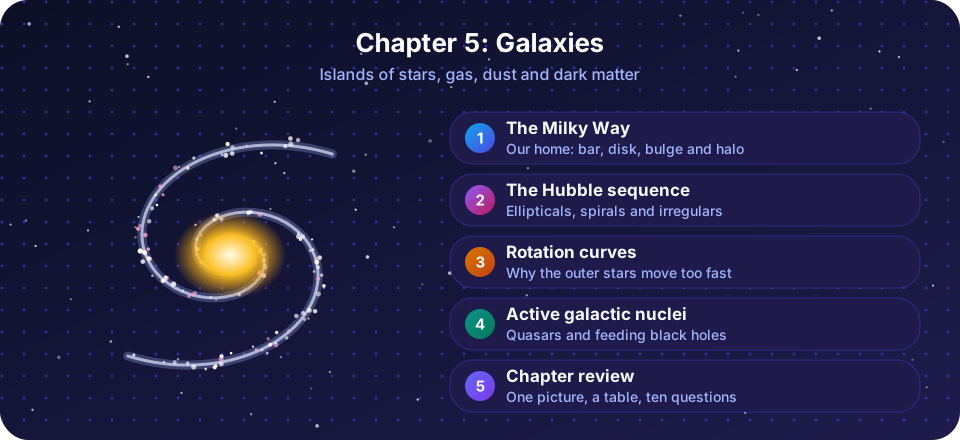
A map of chapter 5: what a galaxy is, how big it is, how astronomers classify galaxies, why rotation curves reveal dark matter, and how active nuclei shine.
Until about a century ago, many astronomers thought the Milky Way was the whole universe. The fuzzy patches called "spiral nebulae" were guessed to be clouds inside it. Then, in the 1920s, Edwin Hubble used pulsating stars to show that the Andromeda nebula lies far beyond our own system of stars. The universe suddenly became much larger, and it became a universe of galaxies.
This chapter is about those galaxies. A galaxy is a gravitationally bound system of stars, gas, dust and dark matter, usually with a supermassive black hole at its center. The Milky Way holds roughly 100 to 400 billion stars (the range is wide because faint red dwarfs are hard to count). Chapters 3 and 4 gave you stars and their remnants. Now you will see how billions of them are assembled into the building blocks of the cosmos.
What you will learn
- What a galaxy is and how big and how far away galaxies are.
- Why the Milky Way is a good laboratory, and the four themes of this chapter.
- How the chapter's lessons connect to the cosmology chapters that follow.
Key terms
Galaxy: a gravitationally bound system of stars, gas, dust and dark matter.
Kiloparsec (kpc): 1,000 parsecs, about 3,262 light-years; the natural unit for galaxy sizes.
Megaparsec (Mpc): a million parsecs, about 3.26 million light-years; the natural unit for distances between galaxies.
Supermassive black hole: a black hole of about a million to ten billion solar masses sitting at a galaxy's center.
Dark matter: matter that exerts gravity but does not emit or absorb light.
The scale of a galaxy
The first thing to get used to is size. The stellar disk of the Milky Way is about 30 kpc (roughly 100,000 light-years) across. The nearest large galaxy, Andromeda (M31), is about 0.78 Mpc away, or about 2.5 million light-years. That is only about 25 times the Milky Way's diameter. Galaxies are, in cosmic terms, crowded: a typical galaxy is only a few tens of its own diameters from its neighbors, whereas a typical star is millions of its own diameters from the next star.
Galaxies range enormously in mass. Dwarf galaxies hold some millions to billions of solar masses of stars. Giant ellipticals at the centers of clusters hold more than a trillion. Our own galaxy sits in the middle, a respectable but not extraordinary member of a small collection called the Local Group, dominated by the Milky Way and Andromeda.
Press Run (or Ctrl + Enter) to see the result here.
Program input · what you'd type while the program runs
Type the answers before you press Run, one per line. Each time the program reads a line (with input()), it gets the next line from this box.
Four themes
This chapter follows four ideas, each of which grows from the one before.
- Structure. The Milky Way is the one galaxy we can study star by star. Its bulge, bar, disk and halo are the template for all spirals.
- Diversity. Galaxies come in shapes, from smooth red ellipticals to blue star-forming spirals, and the shape tells you about the galaxy's history.
- Hidden mass. The speeds of stars and gas in galaxies are too high for the visible mass. Rotation curves are the most direct evidence for dark matter, which will return in chapter 8.
- Engines. At the center of most big galaxies lies a supermassive black hole. When gas falls onto it the galaxy's nucleus can outshine everything else: a quasar.
Galaxies in four steps
The scale
Galaxies are close together compared with their size.
Why it matters
What each lesson covers
| Lesson | Question it answers |
|---|---|
| The Milky Way | What is our galaxy made of, and where are we in it? |
| The Hubble sequence | How are galaxies classified, and what do shapes reveal? |
| Rotation curves | Why do galaxies need dark matter? |
| Active galactic nuclei | How do black holes make quasars? |
| Chapter review | A summary picture, a table and ten questions. |
Common misconceptions
"The Milky Way is the same as the universe." It is one of hundreds of billions of galaxies in the observable universe.
"Stars in a galaxy collide often." Stars are so far apart that collisions between stars, even when whole galaxies merge, are extremely rare.
"Galaxies are mostly stars." Stars make up only a small fraction of a galaxy's total mass; dark matter dominates.
Try it
Press Run (or Ctrl + Enter) to see the console output here.
No output.
Check your understanding
Quick check · 4 questions
of 4 answered You scored / 4 · perfect!
-
1. What is a galaxy?
A galaxy is bound together by gravity and contains stars, gas, dust and dark matter, usually with a central black hole. -
2. About how far away is Andromeda?
Andromeda is about 0.78 Mpc, or roughly 2.5 million light-years, away. -
3. Which unit is most natural for the size of a galaxy?
Galaxies are tens of kiloparsecs across; megaparsecs are used for distances between galaxies. -
4. Which statement about the mass of a galaxy is correct?
Dark matter makes up the large majority of a galaxy's mass; stars are only a small fraction.
Summary
- A galaxy is a bound system of stars, gas, dust and dark matter, often with a central supermassive black hole.
- The Milky Way is about 30 kpc across and holds some 100 to 400 billion stars.
- Galaxies are crowded compared with stars: Andromeda is only about 25 Milky Way diameters away.
- The chapter covers structure, classification, hidden mass and active nuclei.
Next: The Milky Way
Track your progress
Create a free account to tick off lessons and pick up where you left off on any device.
of Astrophysics and Cosmology lessons completed