


















Lesson 7 of 48 · Observational Tools
Chapter 2 overview: how astronomers observe
A tour of chapter 2: how telescopes, detectors and spectrographs turn faint starlight into measurements of temperature, motion and distance.
You cannot visit a star, so every fact in astrophysics is inferred from the radiation and particles that reach us. The craft of observational astronomy is to collect as many of those photons as possible, sort them by direction and colour, count them accurately, and know exactly how the instrument changed them on the way. Everything that follows in the course rests on measurements made with these tools.
What you will learn
- The five stages of an observation and what each one does.
- Why the wavelength you observe depends on what you want to learn.
- What each lesson of this chapter covers.
Key terms
Aperture (D): the diameter of the telescope's main light-collecting mirror or lens.
Resolution: the smallest angular detail an instrument can separate, usually in arcseconds.
Spectrograph: an instrument that splits light by wavelength.
Detector: the sensor (today usually a CCD or similar chip) that records photons.
Redshift (z): the fractional increase in wavelength of light from a receding source.
The big picture
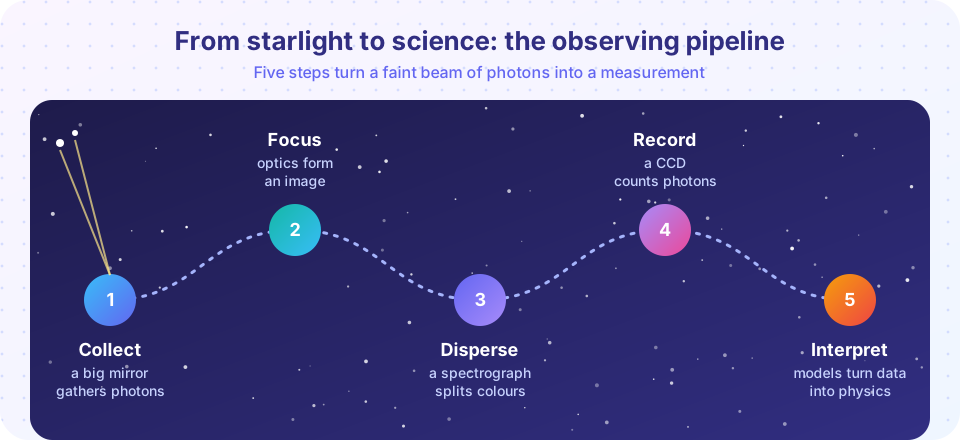
- Collect
- Focus and disperse
- Record
- Interpret
Light is only part of the picture. We also catch cosmic rays, neutrinos and, since 2015, gravitational waves. Using several messengers on the same event (for example, the 2017 neutron-star merger seen in both gravitational waves and across the electromagnetic spectrum) is called multi-messenger astronomy.
Why we need many wavelengths
Different temperatures and processes glow at different wavelengths. Wien's law from chapter 1 tells you roughly where to look:
| Temperature | Peak wavelength | Band | Typical source |
|---|---|---|---|
| 10 K | ~290 μm | Far infrared / sub-mm | Cold dust clouds |
| 3,000 K | ~970 nm | Near infrared | Cool red stars |
| 6,000 K | ~480 nm | Visible | Sun-like stars |
| 10⁶ K | ~2.9 nm | X-ray | Hot gas in galaxy clusters |
Non-thermal processes, such as electrons spiralling in magnetic fields, give radio and gamma rays that are not described by a temperature at all.
What each lesson covers
- Telescopes and resolution: light gathering, the diffraction limit, the atmosphere and detectors.
- Spectroscopy and the Doppler shift: reading composition, temperature and speed from lines.
- The cosmic distance ladder: from radar and parallax to supernovae.
- Chapter 2 review: cheat sheet and quiz.
Common misconceptions
"Bigger telescopes mainly magnify more." Their main job is to gather more light and, for a given wavelength, give finer detail. Magnification is cheap; collecting area is not.
"Space telescopes are better because they are closer." The extra distance gained is negligible; what matters is working above the atmosphere's blur and absorption.
"Colour photos from telescopes show what your eye would see." Many are false-colour maps made from filters, some outside the visible range.
Try it
This program turns a temperature into the band where that object radiates most strongly. Add your own temperatures to the list.
Press Run (or Ctrl + Enter) to see the console output here.
No output.
The wavelength of a telescope determines how large it must be to see detail. This plot shows the angular resolution needed to separate two objects, against the telescope diameter, at three wavelengths.
Press Run (or Ctrl + Enter) to see the result here.
Program input · what you'd type while the program runs
Type the answers before you press Run, one per line. Each time the program reads a line (with input()), it gets the next line from this box.
Check your understanding
Quick check · 4 questions
of 4 answered You scored / 4 · perfect!
-
1. What is the main job of a large telescope mirror?
Collecting area sets how many photons you gather, and a larger aperture lowers the diffraction limit. -
2. A cloud of dust at 15 K radiates most strongly in the
Wien's law gives a peak at about 190 micrometres, in the far infrared. -
3. Which is NOT a wave of the electromagnetic spectrum?
Gravitational waves are ripples in spacetime, a different messenger from electromagnetic radiation. -
4. Why do astronomers make false-colour images?
Infrared, radio and X-ray data must be assigned visible colours in order to be displayed.
Summary
- Observing means collecting, focusing, dispersing, recording and interpreting light.
- Wavelength choice follows temperature and process; no single band tells the whole story.
- Aperture sets both light gathering and resolution.
- Other messengers (neutrinos, cosmic rays, gravitational waves) add information.
Track your progress
Create a free account to tick off lessons and pick up where you left off on any device.
of Astrophysics and Cosmology lessons completed