


















Lesson 28 of 48 · Galaxies
Chapter 5 review: Galaxies
Review chapter 5 with a one-picture summary, a recap table, two practice calculations and a ten-question quiz on the Milky Way, galaxy types, rotation curves and quasars.
Chapter 5 moved from stars to the systems that hold them. You saw the Milky Way from the inside, learned to sort galaxies by shape, found that rotation speeds reveal unseen mass, and met the black hole engines that make quasars. Use this page to check that the pieces fit together.
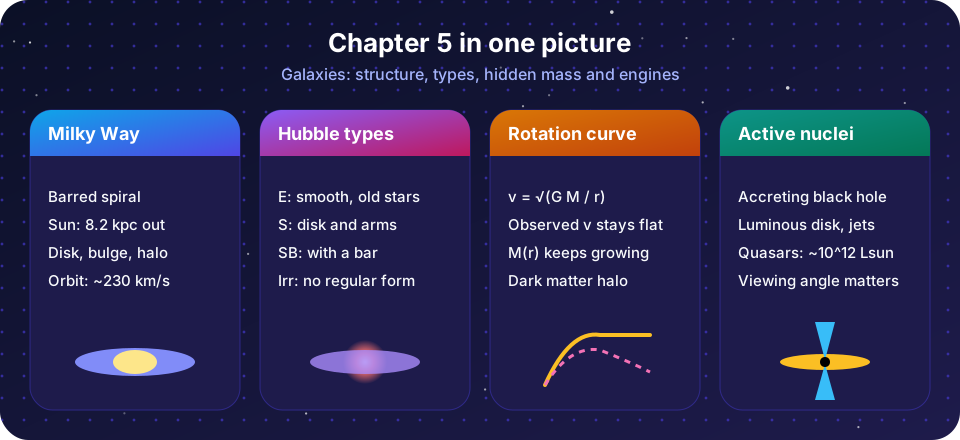
Recap table
| Idea | Key statement | Lesson |
|---|---|---|
| Galaxy scale | Milky Way about 30 kpc; Andromeda at 0.78 Mpc | Overview |
| Milky Way | Barred spiral; Sun at 8.2 kpc, 230 km/s, period about 220 Myr | The Milky Way |
| Mass from orbits | M = v² R / G |
The Milky Way |
| Hubble types | E (n = 10(1 − b/a)), S0, S, SB, Irr |
The Hubble sequence |
| Sérsic index | n = 1 disk, n = 4 elliptical | The Hubble sequence |
| Rotation curves | Flat v means M(r) ∝ r: a dark halo |
Rotation curves |
| Accretion | L = η Ṁ c², η ≈ 0.1 |
Active galactic nuclei |
| Eddington limit | L_Edd ≈ 1.26×10³¹ W × (M/M☉) |
Active galactic nuclei |
| Unified model | Viewing angle explains Seyfert 1 and 2, quasars, blazars | Active galactic nuclei |
Try it
Press Run (or Ctrl + Enter) to see the result here.
Program input · what you'd type while the program runs
Type the answers before you press Run, one per line. Each time the program reads a line (with input()), it gets the next line from this box.
Press Run (or Ctrl + Enter) to see the result here.
Program input · what you'd type while the program runs
Type the answers before you press Run, one per line. Each time the program reads a line (with input()), it gets the next line from this box.
Check your understanding
Quick check · 10 questions
of 10 answered You scored / 10 · perfect!
-
1. The Sun orbits the Galaxy at 230 km/s at R = 8.2 kpc. Roughly what mass lies inside its orbit?
M = v² R / G is about 10^11 solar masses. -
2. Which component of the Milky Way contains the oldest, most metal-poor stars?
Halo stars formed early from gas barely enriched with heavy elements. -
3. A galaxy with axis ratio b/a = 0.4 and no spiral arms is classified:
n = 10 (1 - 0.4) = 6, so E6. -
4. Which is NOT characteristic of an elliptical galaxy?
Thin ordered rotating disks belong to spirals and S0 galaxies. -
5. What does the morphology-density relation say?
Dressler found that early-type fractions increase with local density. -
6. Observed rotation curves stay flat at large radius. What does that imply?
v² = GM/r is constant if M is proportional to r. -
7. Which technique traced rotation far beyond the optical disk?
Neutral hydrogen extends well past the stars and emits at 21 cm. -
8. A quasar with L = 10^40 W and efficiency 0.1 accretes about:
Mdot = L / (eta c²) is about 1.1×10²⁴ kg/s, about 18 solar masses per year. -
9. In the unified model, a type 2 AGN is one seen:
The torus hides the broad-line region and the disk when seen edge-on. -
10. Apparent superluminal jet motion is caused by:
The geometry and finite light speed make beta_app = beta sin(theta) / (1 - beta cos(theta)) exceed 1.
Summary
- The Milky Way is a barred spiral with a central 4-million-solar-mass black hole; the Sun is 8.2 kpc out.
- Galaxies are classified by shape and shape reflects history: mergers build ellipticals, quiet gas settles into disks.
- Flat rotation curves need dark matter halos or modified gravity.
- AGN are accreting black holes; the unified model explains their variety by viewing angle.
Track your progress
Create a free account to tick off lessons and pick up where you left off on any device.
of Astrophysics and Cosmology lessons completed