


















Lesson 9 of 45 · What Is Anthropology
Chapter 2 Review: What Is Anthropology?
Review chapter two of the anthropology course: the four fields, holism, comparison, relativism, emic and etic, and the history of the discipline, with a ten-question quiz.
This chapter answered a deceptively simple question: what is anthropology? You now have a definition, a map of the four fields, three habits of mind and a timeline of how the discipline grew up. This review puts everything on one page and then tests you.
Recap table
| Lesson | What to remember |
|---|---|
| Overview | Anthropology studies humans across time, place and ways of life |
| The four fields | Biological, archaeology, cultural, linguistic; plus applied work |
| Holism and comparison | Connections, many societies, understand before judging, emic and etic |
| History | Tylor, Boas, Malinowski, Mead, Evans-Pritchard, Geertz, Writing Culture |
The chapter in five sentences
- Anthropology is the study of humans in all times and places, in their biological and cultural variety.
- Its four fields use different evidence (bones, objects, fieldwork, speech) to answer shared questions.
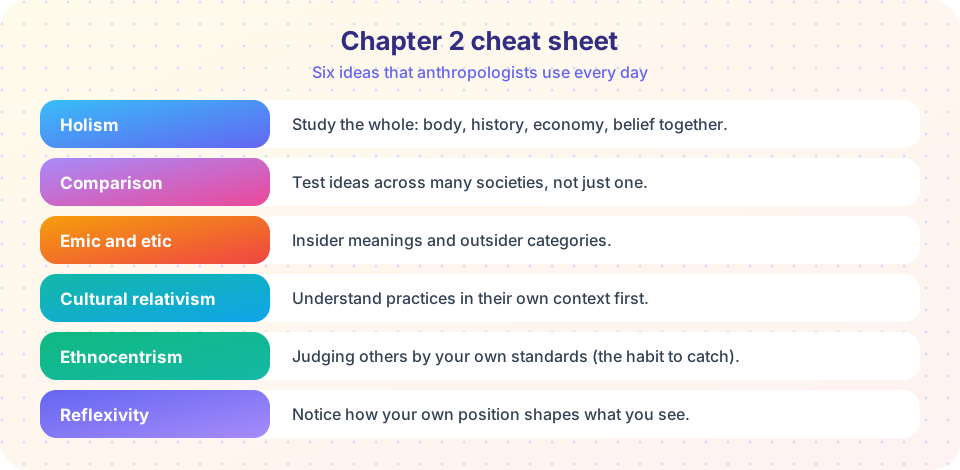
- Holism connects the parts of life, comparison tests ideas across societies and relativism asks you to understand before judging.
- Emic descriptions keep local meaning and etic descriptions allow comparison.
- The discipline began with ladder-style theories of progress and has been revising them for a century.
Common misconceptions
"Relativism means anything goes." As a method, it means understand first; it does not forbid criticism.
"Early anthropologists were all objective." Many held assumptions of their time. Reading with that in mind is part of the skill.
"The four fields are four separate subjects." They are linked by shared questions and often shared projects.
Try it
Drill the six cheat-sheet ideas. Press Show to reveal the definition, then Next.
Next, put the landmark dates in order from memory. Fill the list in any order and let the code sort and print it. Change the names or years to test yourself.
Press Run (or Ctrl + Enter) to see the result here.
Program input · what you'd type while the program runs
Type the answers before you press Run, one per line. Each time the program reads a line (with input()), it gets the next line from this box.
Check your understanding
Quick check · 10 questions
of 10 answered You scored / 10 · perfect!
-
1. Which is the best one-sentence definition of anthropology?
The range across time, place and ways of life defines the discipline. -
2. Which field uses soil layers, tools and pottery as its main evidence?
Archaeologists reconstruct the human past from material remains and their context. -
3. Holism means
Parts of life explain each other. -
4. Galton's problem is that
Counting borrowed traits as separate inventions inflates evidence. -
5. 'Giving the road' is how villagers describe a gesture in their own terms. This description is
It uses the insiders' own category. -
6. Methodological relativism is
It is distinct from moral relativism. -
7. Who is most closely associated with long participant observation in the Trobriand Islands?
Argonauts of the Western Pacific (1922) set the standard. -
8. Which of these is a criticism raised by the Writing Culture debate?
The book highlighted authority and voice in ethnographic writing. -
9. Why is ranking societies from 'savage' to 'civilized' rejected today?
The ladder reflected researchers' assumptions and was used to justify colonial rule. -
10. What did William Graham Sumner call the habit of judging others by your own group's standards?
He used the term in 1906.
Summary
- Anthropology is defined by its range and by its habits of mind: holism, comparison and relativism.
- The four fields share questions and often work together; applied anthropology puts the knowledge to use.
- The history shows both progress (rejecting ranking, long fieldwork) and ongoing critique (power, voice, decolonizing).
Track your progress
Create a free account to tick off lessons and pick up where you left off on any device.
of Anthropology lessons completed