


















Lesson 3 of 45 · Getting Started
How to Study Anthropology
Learn practical study skills for anthropology: reading ethnographies in three passes, taking notes, handling evidence, using respectful language and reviewing on a schedule.
Anthropology is not a subject you can learn by memorizing lists. You will meet unfamiliar peoples, unfamiliar words and arguments that depend on context. A few study habits make this far easier, and they are the same habits that working anthropologists use to read and write.
This lesson gives you a short toolkit: how to read a long ethnography, how to take notes that you can actually use, how to tell a claim from its evidence, how to write about other people respectfully, and how to review so that facts stay in memory.
What you will learn
- A three-pass method for reading articles and book chapters.
- How to separate claim, evidence and context in any text.
- A simple note layout and a review schedule.
- Respectful language habits for writing about peoples and cultures.
- What academic honesty looks like in this subject.
Key terms
Claim: the point an author wants you to accept.
Evidence: the observations, quotes, numbers or finds offered in support.
Context: the setting (place, time, who was speaking) that gives the evidence its meaning.
Primary source: original material, such as field notes, interviews or an excavation report.
Secondary source: someone's analysis of primary material, such as a textbook or review article.
Read in three passes
Most readers start at the top and push through to the bottom. Experts do not. They read in passes.
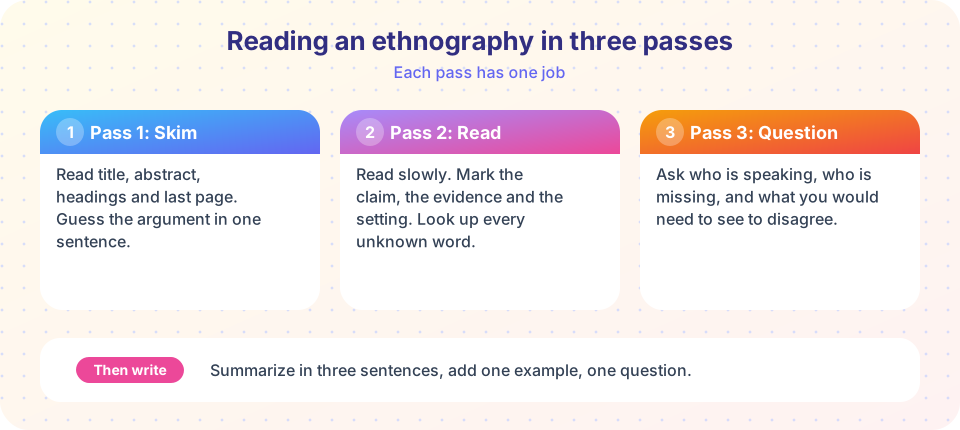
Pass 1: skim (5 to 10 minutes). Read the title, abstract or introduction, the headings and the last page. Close your eyes and say the argument in one sentence. If you cannot, say what you expect it to be; you will check later.
Pass 2: read (the long one). Now read slowly. Mark three things in different colors: the claims, the evidence and the setting (where, when, who). Look up every unfamiliar word the first time you meet it and write the definition in the margin. If a paragraph is dense, stop and say it back in your own words.
Pass 3: question. Ask the questions that anthropologists ask of every text:
- Who is speaking, and from what position (a visiting researcher, a member of the community, a government officer)?
- Whose voices are missing?
- What would I need to see to disagree?
- Could the same pattern appear elsewhere, or is it specific to this place?
Passes 1 and 3 are quick. Pass 2 is where the time goes. The method works because each pass has a single job, so you never try to understand, judge and memorize at once.
Separate claim, evidence and context
Take this short passage, invented for practice:
"In the highland village, families lend each other grain after poor harvests. Most households said they would never refuse a neighbor. The village has no market and few roads."
- Claim (implied): lending is a strong social rule there.
- Evidence: what households said, and the pattern of lending.
- Context: no market, few roads, highland farming.
A careful reader notices that "said they would never refuse" is a statement about intentions, not observed behavior. Good ethnography often supports a claim with both: what people say and what people do. When they differ, the difference is itself a finding.
Practice this on every reading. In a notebook, make three columns, one per word, and fill them for each paragraph that matters.
Take notes you can use
A simple layout that works for lectures and readings:
| Left column (about one third) | Right column (about two thirds) | Bottom box |
|---|---|---|
| Keywords and questions | Notes in your own words, examples, page numbers | Three-sentence summary written after the lesson |
Rules for good notes:
- Write in your own words. Copying a sentence feels productive but teaches little.
- Record names and dates of key thinkers, finds and studies, because these anchor everything else.
- Add one example per idea, ideally from outside your own culture.
- Mark anything you do not understand with a question mark and return to it within a day.
Use respectful, precise language
Words carry history. Anthropology has learned to be careful.
- Prefer the name a group uses for itself (an endonym) when you can, and the specific name over a broad label ("the Maasai" rather than "Africans").
- Avoid words that rank societies, such as primitive, backward or advanced. Describe what people do and what they know instead.
- Write in the past tense only about the past. A society that was described in a 1930s book may look quite different today. The habit of treating living people as frozen in the past is sometimes called the "ethnographic present", and a modern writer flags it.
- Capitalize Indigenous when it refers to Indigenous peoples as a group, as many national and international bodies do.
You will also meet older sources that use outdated or offensive terms. Quote them if you must, but say that the term is outdated and why.
Be honest with sources
Anthropology depends on trust: between researchers and communities, and between you and your readers. In practice:
- Quote with quotation marks and give the source; summarize in your own words and give the source anyway.
- Distinguish what you observed or read from what you infer.
- Never invent a quotation, a study or a statistic. If you are unsure of a number, say "about", or describe the effect without a number.
- Treat internet material with caution. Look for the author, the date and the evidence.
Review on a schedule
Memory fades quickly and recovers quickly if you revisit at the right moments. A simple plan: review on day 1, day 3, day 7 and day 14 after studying a lesson. Each review is short: cover your notes, answer the quiz questions from memory, and check. The little effort of recalling is what builds long-term memory.
Common misconceptions
"Highlighting is studying." Highlighting feels good but is mostly passive. Summarizing and self-quizzing work better.
"A good reader agrees with the author." A good reader first understands the argument fully, then decides how far to agree.
"Primary sources are always better than secondary ones." Each has a job. Primary sources show the raw material; secondary sources show how experts weigh it.
Try it
Rate a short text you are reading against the claim–evidence–context checklist. This demonstration only counts your ticks; it is a study aid, not a test of anything about you.
Now a review planner. Give it the day you studied; it prints the four review dates.
Press Run (or Ctrl + Enter) to see the result here.
Program input · what you'd type while the program runs
Type the answers before you press Run, one per line. Each time the program reads a line (with input()), it gets the next line from this box.
Check your understanding
Quick check · 5 questions
of 5 answered You scored / 5 · perfect!
-
1. What is the main job of Pass 3 when reading?
Pass 1 skims, pass 2 reads closely, pass 3 questions. -
2. 'Most households said they would never refuse a neighbor.' This is evidence about
Statements record intentions or beliefs. Observed lending would be evidence about behavior. -
3. Which wording is the most respectful and precise?
Use a specific group name and avoid words that rank societies. -
4. A sensible schedule for reviewing a lesson is
Short, spaced reviews with self-quizzing build long-term memory. -
5. What does 'ethnographic present' warn against?
Societies change; a description from decades ago may not match life today.
Summary
- Read in three passes: skim, read closely, then question.
- Separate claim, evidence and context in every text.
- Take notes in your own words, with names, dates and one example each.
- Use respectful, specific language and cite your sources honestly.
- Review on days 1, 3, 7 and 14.
Next: Chapter 1 Review
Track your progress
Create a free account to tick off lessons and pick up where you left off on any device.
of Anthropology lessons completed