


















Lesson 8 of 45 · What Is Anthropology
A Short History of Anthropology
Follow anthropology from nineteenth-century evolutionism through Boas, Malinowski and Geertz to today's critical and decolonizing approaches, with the key books and ideas.
Anthropology as a discipline is young. Curiosity about other peoples is ancient: travelers, traders and historians have always described foreigners. But a profession with its own methods, university departments and journals took shape in the second half of the nineteenth century, in the age of European empires. That background matters. It explains why early anthropology often ranked societies, why it rejected that habit later, and why the discipline today spends so much effort asking who writes about whom, and for what purpose.
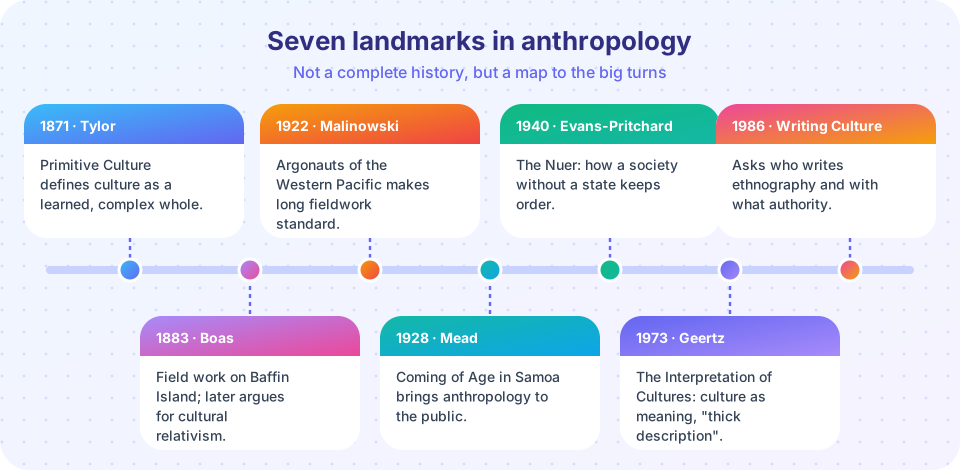
This lesson is a guided tour of seven turning points, ending with current debates.
What you will learn
- The main schools of thought from evolutionism to interpretive and critical approaches.
- Who the key figures were and what they argued.
- How colonialism shaped early anthropology and how the discipline responded.
- Why some classic studies are debated today.
Key terms
Unilineal evolutionism: the nineteenth-century idea that all societies pass through the same stages of progress.
Historical particularism: Boas's view that each culture has its own history and must be understood on its own terms.
Functionalism: the view that customs should be explained by the needs or roles they fulfill in a society.
Structuralism: the approach that looks for underlying mental patterns, such as pairs of opposites, in cultural systems.
Interpretive anthropology: the approach that treats culture as a set of meanings to be read.
1. Nineteenth-century evolutionism
In 1859 Charles Darwin published On the Origin of Species. Scholars soon applied "evolution" to human society too. In Primitive Culture (1871), the British scholar Edward Burnett Tylor defined culture as the complex whole of knowledge, belief, art, law, morals, custom and other capabilities acquired by people as members of society. That definition is still taught. In Ancient Society (1877), the American lawyer Lewis Henry Morgan proposed that all societies move through stages from "savagery" through "barbarism" to "civilization".
These unilineal theories were built mostly from secondhand reports and the researchers' own assumptions. They placed European societies at the top by definition. Modern anthropologists reject the ladder: there is no single path, and no society is "behind". Still, Tylor's idea that culture is learned and shared became central.
2. Boas and historical particularism
Franz Boas (1858 to 1942) trained as a physicist and geographer in Germany and did fieldwork on Baffin Island in 1883 and 1884. After moving to the United States he built a leading PhD program in anthropology at Columbia University. He argued that:
- each culture must be understood in terms of its own history;
- race, language and culture are separate things, and differences in culture are not caused by "racial" brain differences (see his book The Mind of Primitive Man, 1911);
- fieldwork in the local language, with careful recording, is essential.
His students included Alfred Kroeber, Ruth Benedict, Margaret Mead, Zora Neale Hurston and Ella Cara Deloria, a Dakota scholar whose work on Lakota and Dakota language and life remains valuable. Boas's insistence that culture is learned changed public debate about race.
3. Malinowski and Radcliffe-Brown: fieldwork and function
Bronislaw Malinowski lived in the Trobriand Islands (in today's Papua New Guinea) from 1915 to 1918, partly because wartime travel was restricted. In Argonauts of the Western Pacific (1922) he described the kula, a ring of ceremonial exchange across islands, and argued that an anthropologist should live among people, learn their language and record "the native's point of view". This set the pattern of long participant observation.
Alfred Radcliffe-Brown, working in Britain and elsewhere, developed structural-functionalism: societies are systems whose parts (kinship, law, ritual) work together to keep the whole going. Both Malinowski and Radcliffe-Brown trained many students, and the British tradition of social anthropology grew from this soil.
4. Culture and personality: Benedict and Mead
Ruth Benedict's Patterns of Culture (1934) argued that each culture has an overall style, much like a personality. Margaret Mead's Coming of Age in Samoa (1928) compared adolescence in Samoa with that in the United States and became a bestseller. Later, Derek Freeman (1983) argued that Mead had gotten Samoa wrong. The dispute is not fully resolved; most scholars now see Mead's work as a pioneering but limited study, and see Freeman's critique as overdrawn in some parts. What matters here is that anthropologists argue about evidence, and that famous books are tested.
5. Africa, kinship and structure: Evans-Pritchard and Lévi-Strauss
E. E. Evans-Pritchard's Witchcraft, Oracles and Magic among the Azande (1937) showed that beliefs that look irrational from outside follow their own coherent logic. The Nuer (1940) explained how a society without a state keeps order through kinship and feud. Meanwhile in France, Claude Lévi-Strauss developed structuralism, beginning with The Elementary Structures of Kinship (1949), arguing that human thought organizes the world through patterns such as opposites (raw and cooked, nature and culture).
6. Meaning, power and critique
From the 1960s, many anthropologists turned to meaning. Clifford Geertz's The Interpretation of Cultures (1973) argued that culture is a web of meanings that humans spin and are suspended in. He championed thick description: not just recording that someone winked, but explaining the layers of meaning behind the wink, the way it differs from a twitch. His essay on the Balinese cockfight is a famous example.
Others emphasized power and history. Talal Asad's edited volume Anthropology and the Colonial Encounter (1973) asked how the discipline's growth was tied to empire. Eric Wolf's Europe and the People Without History (1982) showed that small societies were never isolated but part of global trade and conquest. Feminist anthropologists asked why women's lives had been overlooked, and what "gender" means in different places.
7. Writing Culture and decolonizing anthropology
Writing Culture (1986), edited by James Clifford and George Marcus, drew attention to ethnography as writing: who has the authority to describe, whose voices are quoted, how literary devices shape what readers believe. The questions it raised led to more collaborative research, in which community members help design studies, review drafts and sometimes co-author.
Today's debates include decolonizing anthropology: hiring and citing scholars from the communities studied, returning data and human remains to communities, questioning who benefits, and recognizing the work of earlier scholars outside Europe and North America, such as Fei Xiaotong in China (Peasant Life in China, 1939) and Jomo Kenyatta (Facing Mount Kenya, 1938), both of whom studied with Malinowski, and many others who were overlooked.
Why history matters for you
When you read an old ethnography, treat it as evidence about two things: the people described, and the researcher's time and assumptions. That double reading (what the text says, and what shaped it) is a core skill.
Common misconceptions
"Anthropology was always respectful of other societies." It was not. Early work often supported ideas of racial hierarchy. Boas and others changed the discipline, and the corrections are still being made.
"Everything old is wrong." Many classic studies are valuable records of languages and lives. They need careful, critical reading, not dismissal.
"Malinowski started fieldwork." Earlier researchers did fieldwork too (including the 1898 Torres Strait expedition and Boas's Baffin Island visit). Malinowski made long language-based participation the standard.
Try it
Pick a landmark to see its key idea. This lookup uses the facts from the lesson.
Now plot the same landmarks on a line and measure the gaps between them. The dates come from the lesson.
Press Run (or Ctrl + Enter) to see the result here.
Program input · what you'd type while the program runs
Type the answers before you press Run, one per line. Each time the program reads a line (with input()), it gets the next line from this box.
Check your understanding
Quick check · 6 questions
of 6 answered You scored / 6 · perfect!
-
1. Which book (1871) defined culture as a complex whole including knowledge, belief, art, law and custom?
Tylor's Primitive Culture gave the classic definition of culture. -
2. Boas argued that
This view is called historical particularism. -
3. Malinowski's main methodological legacy is
Argonauts of the Western Pacific (1922) set the pattern for long fieldwork. -
4. Geertz's 'thick description' means
The wink versus the twitch: the same movement can carry quite different meanings. -
5. What did Writing Culture (1986) mainly question?
It treated ethnography as writing and asked about voice and authority. -
6. Which statement about Mead's Samoa study is most accurate?
Anthropologists continue to discuss what the book got right and wrong.
Summary
- Anthropology grew with European empires; early evolutionist theories ranked societies, which later anthropologists rejected.
- Boas stressed culture as learned and history-bound; Malinowski set the standard of long, language-based fieldwork.
- Functionalism, structuralism and interpretive anthropology offered different ways to explain culture.
- Critical turns (Asad, Wolf, feminist work, Writing Culture) asked about power, voice and authority; decolonizing efforts continue.
- Read old texts for both what they say about people and what shaped the author.
Next: Chapter 2 Review
Track your progress
Create a free account to tick off lessons and pick up where you left off on any device.
of Anthropology lessons completed