


















Lesson 37 of 45 · Globalization and Applied Anthropology
Globalization and Migration: Flows, Diasporas and Hybrid Cultures
Understand globalization through Appadurai's five scapes, Mintz on sugar, Wolf on old connections, Tsing's friction, diasporas and hybridity, with a cultural diffusion model.
It is tempting to think globalization began with the internet or with container ships. Anthropologist Eric Wolf argued in Europe and the People Without History (1982) that the societies anthropologists studied were never isolated: for centuries they had been connected by trade, empire, slavery, religion and migration. What has changed is the speed, scale and variety of the connections. A teenager in Lagos, Manila or São Paulo can watch the same videos, wear similar clothes and still live a very local life.
Anthropology contributes something that statistics on trade and migration cannot: close descriptions of how people experience these flows, make sense of them and turn them into something of their own.
What you will learn
- Appadurai's five "scapes" as a way to describe global flows.
- Mintz's study of sugar as a model of commodity history.
- Diaspora, transnationalism and remittances.
- Hybridity, glocalization and the "friction" of global connection.
- A simple model of cultural diffusion and why diversity can persist.
Key terms
Scape: Arjun Appadurai's term for a fluid, overlapping global flow (of people, technology, money, media or ideas).
Transnationalism: living and keeping social ties across national borders.
Hybridity: the mixing of cultural forms so that new ones emerge.
Glocalization: global products or ideas adapted to local conditions.
Commodity chain: the path of production, trade and consumption of a good.
Five scapes
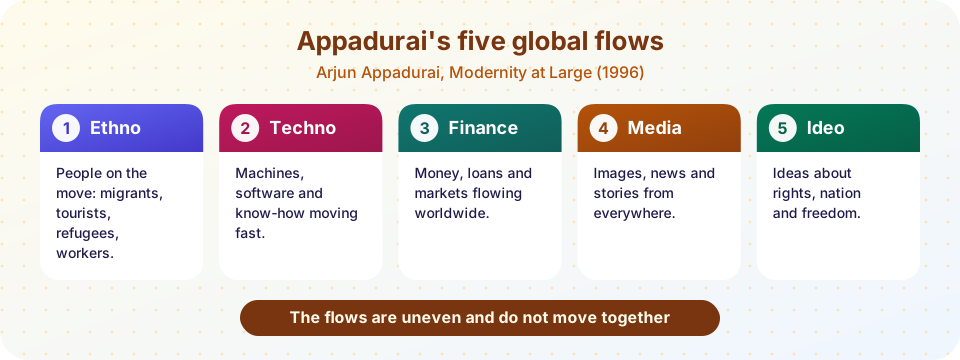
In Modernity at Large (1996) Arjun Appadurai proposed five dimensions of global cultural flow. Ethnoscapes are the shifting landscapes of people: tourists, migrants, refugees, guest workers. Technoscapes are flows of technology and expertise. Financescapes are flows of money through markets and banks. Mediascapes are the images and stories carried by media. Ideoscapes are political ideas such as nation, rights and freedom. The suffix "scape" signals that these are viewed from a particular standpoint and constantly shifting, not neat maps. Appadurai argued that the flows move at different speeds and in different directions, which causes friction and surprise.
Following a commodity
Sidney Mintz's Sweetness and Power (1985) traced sugar from Caribbean plantations worked by enslaved people to the tea tables and factory canteens of Britain. As sugar became cheap, it turned from a luxury of the rich into a daily food of workers. Mintz showed that a product can link colonial labor, industrial work routines, dietary habits and national taxes into one story. Modern commodity chains, from coffee beans to smartphones, can be studied the same way.
Anna Tsing's Friction (2005) added a useful metaphor. Global connections do not glide smoothly; they rub against local conditions, and the friction produces energy and conflict. Her later study of matsutake mushrooms, in The Mushroom at the End of the World (2015), followed the commodity chain from forests to Japanese markets and showed how people on the edges of capitalism find opportunities in the gaps.
Migration, diaspora and transnational life
A diaspora is a population living away from an ancestral homeland while maintaining a sense of connection. Migration has many causes, including work, war, family, climate and study. Anthropologists emphasize that migrants rarely cut ties. Nina Glick Schiller and colleagues developed the idea of transnationalism in the 1990s: many migrants live in social fields stretching across countries, sending money and goods, calling relatives, voting or building houses at home.
Remittances are a vivid example, as the demo in the chapter overview showed. They support households and sometimes entire regional economies. Aihwa Ong coined the phrase "flexible citizenship" (1999) for the strategies of wealthy transnational families that hold several passports, while refugees and low-wage migrants face tight borders. Who can move freely and who cannot is a political question.
Hybridity, homogenization and glocalization
Do global flows make everyone the same? The evidence says "both and neither". Global brands spread, but they are adapted: James Watson's edited book Golden Arches East (1997) described how McDonald's in several East Asian cities changed its menus, spaces and meanings. Néstor García Canclini used hybridity to describe how Latin American cultures mix indigenous, colonial and global forms. Reggae, hip-hop and K-pop have all traveled and been remade. Anthropologists look at who does the remaking and who gains.
A model of diffusion
Robert Axelrod's 1997 model of cultural dissemination asks how diversity persists when people influence each other. In the model, each community has several cultural features, each with a trait. Neighbors interact with a probability equal to how similar they are, and an interaction makes them more alike on one feature. People who share nothing do not interact. The surprising result is that the grid can freeze into several distinct cultural regions rather than one. When there are more possible traits, more regions survive. The model is a thought experiment, not a description of real societies, but it shows that influence and diversity can coexist.
Common misconceptions
"Globalization is only economic." Flows of people, ideas and images shape identities, religion, kinship and politics too.
"Migrants are cut off from home." Many maintain strong ties by phone, money, visits and political engagement.
"Hybrid cultures are impure." All cultures have long histories of borrowing. "Pure" cultures are rare or imaginary.
Try it
First, the diffusion model. Each of 64 communities has five features. The program prints how many different cultures remain after the process stops. The code is a simplified version of Axelrod's model and uses random numbers, so it is a demonstration, not data.
Press Run (or Ctrl + Enter) to see the result here.
Program input · what you'd type while the program runs
Type the answers before you press Run, one per line. Each time the program reads a line (with input()), it gets the next line from this box.
Second, a plot of the same model across more settings, averaged over three runs each. This takes several seconds.
Press Run (or Ctrl + Enter) to see the result here.
Program input · what you'd type while the program runs
Type the answers before you press Run, one per line. Each time the program reads a line (with input()), it gets the next line from this box.
Third, a small sorter that assigns global flows to Appadurai's scapes by keyword. It is a demonstration of the categories, and real cases often fit several at once.
Press Run (or Ctrl + Enter) to see the console output here.
No output.
Check your understanding
Quick check · 5 questions
of 5 answered You scored / 5 · perfect!
-
1. In Appadurai's scheme, which scape covers flows of images and stories?
Mediascapes are the global circulation of images, news and entertainment. -
2. What was Mintz's key point in Sweetness and Power?
He traced a commodity chain connecting slavery, empire, diet and industrial life. -
3. What does 'transnationalism' describe?
Many migrants maintain active ties with home and host countries. -
4. What did the Axelrod model show?
In the model, dissimilar neighbors do not interact, so separate regions can freeze in place. -
5. Tsing's 'friction' suggests that global connections
Contact between global forces and local contexts produces both tension and creativity.
Summary
- Societies have long been connected; today's flows are faster and broader.
- Appadurai's five scapes: ethno, techno, finance, media and ideo.
- Commodity histories (Mintz, Tsing) trace links between distant lives.
- Migrants live transnationally; remittances and diasporas are major flows.
- Global and local mix into hybrid and glocal forms; diversity can persist alongside diffusion.
Track your progress
Create a free account to tick off lessons and pick up where you left off on any device.
of Anthropology lessons completed