


















Lesson 31 of 45 · Language, Religion and Art
Chapter 7 Overview: Language, Religion and Art
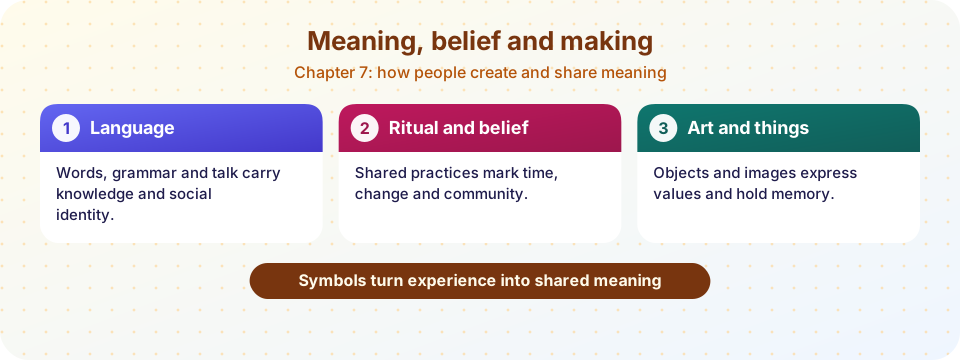
A map of chapter 7: how language, ritual, belief and art create shared meaning, with a visual overview and a demonstration of the arbitrary sign.
Humans live in a world of meanings. A flag is cloth, a wedding ring is metal and a sentence is breath, yet they carry weight far beyond their material. Anthropologists call things that stand for something else symbols. This chapter studies the three richest symbol systems: language, ritual and religion, and art and objects.
The main question is not "Is a belief true?" but "What does it do and mean for the people who hold it?" Anthropologists describe beliefs and practices carefully and in their own terms without claiming to judge ultimate truth.
What you will learn
- What a symbol is and why meaning is shared and learned.
- The three areas of the chapter and how they connect.
- Why anthropologists describe beliefs without ruling on their truth.
Key terms
Symbol: something that stands for something else by shared convention.
Sign: in Saussure's terms, a pairing of a sound or form with a meaning.
Ritual: a formal, repeated, symbolic action.
Material culture: the objects people make and use, and the meanings attached to them.
Symbols
Language
Ritual and belief
Art and things
What each lesson covers
- Language and culture covers linguistic anthropology, color terms, linguistic relativity, directions, speech in context and endangered languages.
- Religion and ritual covers definitions, Durkheim, Malinowski, van Gennep, Turner, Geertz, witchcraft, shamans and pilgrimage.
- Art and material culture covers what counts as art, Gell's agency of objects, cultural biographies and repatriation.
- Chapter review brings the ideas together.
Common misconceptions
"Anthropologists of religion must say whether the beliefs are true." They describe what people believe and do, how it fits their lives and what it does, without asserting the claim is true or false.
"Art is a luxury." In most societies, decorated objects, music and dance are part of work, religion and politics.
Try it
Words are arbitrary signs: nothing in the sound of a word makes it mean what it does. This demo shows the word for "water" in several languages. The point is the lack of a natural link between sound and meaning (Ferdinand de Saussure's observation).
Press Run (or Ctrl + Enter) to see the console output here.
No output.
Press Run (or Ctrl + Enter) to see the console output here.
No output.
Check your understanding
Quick check · 4 questions
of 4 answered You scored / 4 · perfect!
-
1. A symbol is best described as
Symbols get their meaning from social agreement. -
2. Saussure called the relation between a word's sound and its meaning
Different languages use different sounds for the same thing, so the link is a convention. -
3. How do anthropologists usually treat religious beliefs?
Description and interpretation come first; ultimate truth claims are outside the method. -
4. Which is an example of material culture?
Material culture is made objects together with their meanings.
Summary
- Humans live in a world of shared symbols.
- Language, ritual and religion, and art and objects are the three symbol systems studied here.
- Anthropologists describe beliefs and meanings without ruling on truth.
- Signs are conventions, not natural links.
Next: Language and culture
Track your progress
Create a free account to tick off lessons and pick up where you left off on any device.
of Anthropology lessons completed