


















Lesson 21 of 45 · Kinship, Family and Social Organization
Chapter 5 Overview: Kinship, Family and Social Organization
A map of chapter 5: how societies organize people through descent, kinship terms, marriage and households, with a visual overview and a first model.
Almost every society uses kinship to answer a basic question: who are my people? Kinship is the set of recognized relationships built from birth, marriage and sometimes adoption or shared food. In many places it decides where you live, whom you can marry, who inherits land, whom you can ask for help and whom you must avoid. Early anthropologists such as Lewis Henry Morgan, who published Systems of Consanguinity and Affinity of the Human Family in 1871, saw kinship as a doorway into a whole social order.
This chapter does not treat kinship as "biology with labels". It treats it as a cultural system that uses biology as raw material. Two societies can recognize the same biological facts and draw very different maps from them. That difference is what we will study.
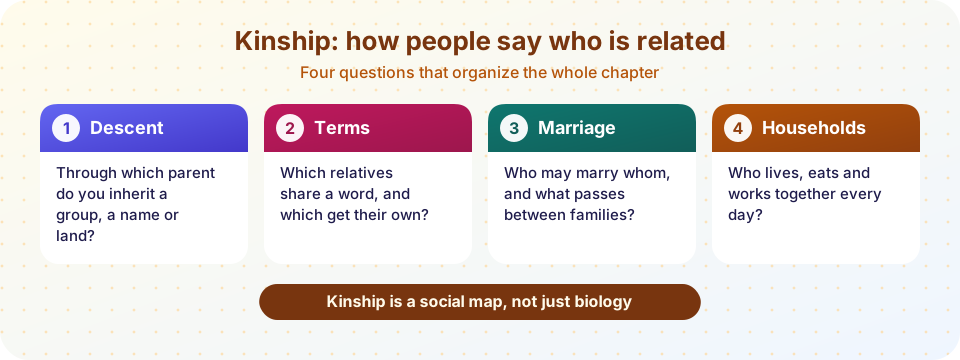
What you will learn
- Why anthropologists treat kinship as a social map and not only as biology.
- The four big topics of the chapter and how they connect.
- The difference between a descent group and a household.
- How to think about "my relatives" as a choice among possible rules.
Key terms
Kinship: socially recognized relationships based on descent, marriage, adoption or shared life.
Descent: the rule that connects you to ancestors and decides which groups you belong to.
Affinal kin: relatives by marriage, such as in-laws.
Consanguineal kin: relatives by "blood", meaning by birth connections as the society counts them.
Household: people who live together and share daily resources, whether or not they are kin.
The big picture
Think of kinship as four layers that work together.
- Descent decides which of your ancestors "count" and which group you join at birth. In some societies you belong to your father's line, in others to your mother's, in others to both or to neither.
- Terminology decides which relatives get which names. Some languages have one word for all mother's sisters and your mother; others keep them apart.
- Marriage decides who may or must marry, and how groups are tied together by weddings, gifts and obligations.
- Household and family decide who actually lives, cooks and works together, which can differ from the group on the family tree.
Why kinship matters
Descent
Terms and marriage
Households
What each lesson covers
- Descent groups explains patrilineal, matrilineal, double and bilateral systems, with lineages, clans and the famous Nuer, Trobriand and Minangkabau cases.
- Kinship terminology systems shows how Eskimo, Hawaiian, Iroquois and other naming systems sort cousins, aunts and uncles.
- Marriage and family covers exogamy, incest taboos, alliance, marriage payments, plural marriage, households and the new kinship studies.
- Chapter review pulls it together with a one-picture summary and a longer quiz.
Common misconceptions
"Kinship is just blood." Many societies count adoption, shared meals, milk kinship or ritual sponsorship as real kinship, and many do not count every biological link. What counts is the society's rule.
"Every society has the same family." Households range from a couple with children to compound homes of dozens of relatives, and the family you picture may not be the common local form.
Try it
A first model of "who counts": if you counted all ancestors, the number would double every generation. A descent rule that follows only one line keeps the number small and stable. This calculator compares the two. It is a counting model, not data about any real society.
Press Run (or Ctrl + Enter) to see the console output here.
No output.
Press Run (or Ctrl + Enter) to see the console output here.
No output.
Check your understanding
Quick check · 4 questions
of 4 answered You scored / 4 · perfect!
-
1. Which description best fits an anthropological view of kinship?
Anthropologists treat kinship as a cultural system. Biology provides facts, but societies decide which ones to emphasize. -
2. Which topic answers the question 'through which parent do I get my group'?
Descent rules decide which ancestors and groups you belong to. -
3. What is a household in anthropology?
A household is defined by coresidence and shared resources, which may or may not match kinship. -
4. Why do descent rules shorten the list of 'relevant ancestors'?
Following one line (or a few) avoids the doubling of ancestors in each generation.
Summary
- Kinship is a cultural map of relationships built from birth, marriage and other ties.
- Four layers work together: descent, terminology, marriage and household.
- Societies choose which biological facts to count, so kinship systems differ.
- Households (who lives together) are not always the same as descent groups (who belongs together).
Next: Descent groups
Track your progress
Create a free account to tick off lessons and pick up where you left off on any device.
of Anthropology lessons completed